
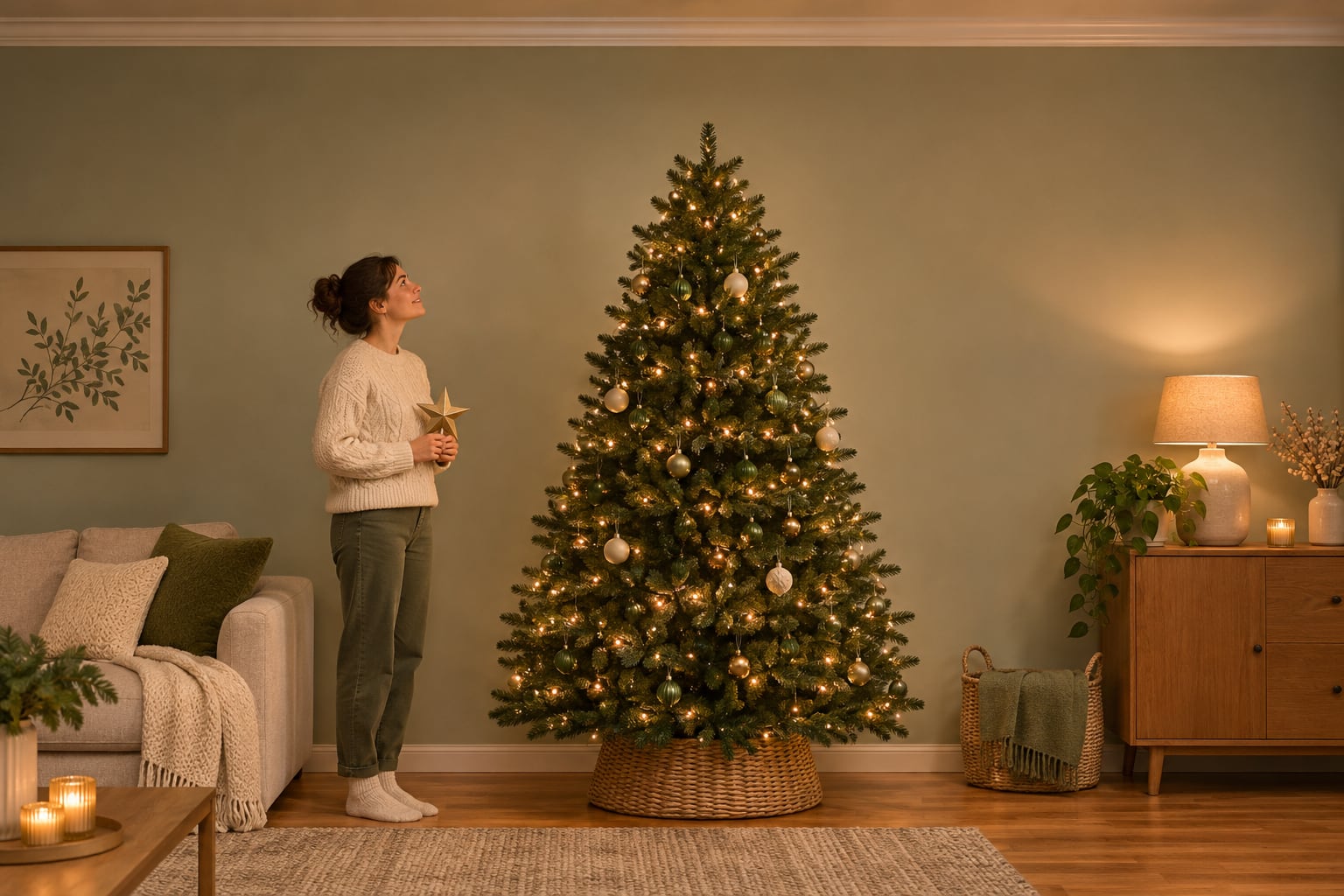
Artificial Christmas trees come in set sizes: half-foot steps up to 7.5 feet, then mostly 9 and 12 feet. The standard size is 7.5 feet, the tallest tree that fits under an 8-foot ceiling without a topper, and 40 of the 48 trees in our catalog come in it. Real trees run shorter, typically 6 to 7 feet.
To find your size, measure from the floor to the ceiling where the tree will stand. Subtract 12 inches if you'll use a topper, or 6 inches if you won't, and you have the tallest artificial tree that fits. Then compare the tree's width with your floor space, because two trees of the same height can differ by a foot or more. Height is the easy one to get wrong, usually by forgetting the topper or by subtracting a stand that's already counted.
Christmas Tree Sizes: What's Standard
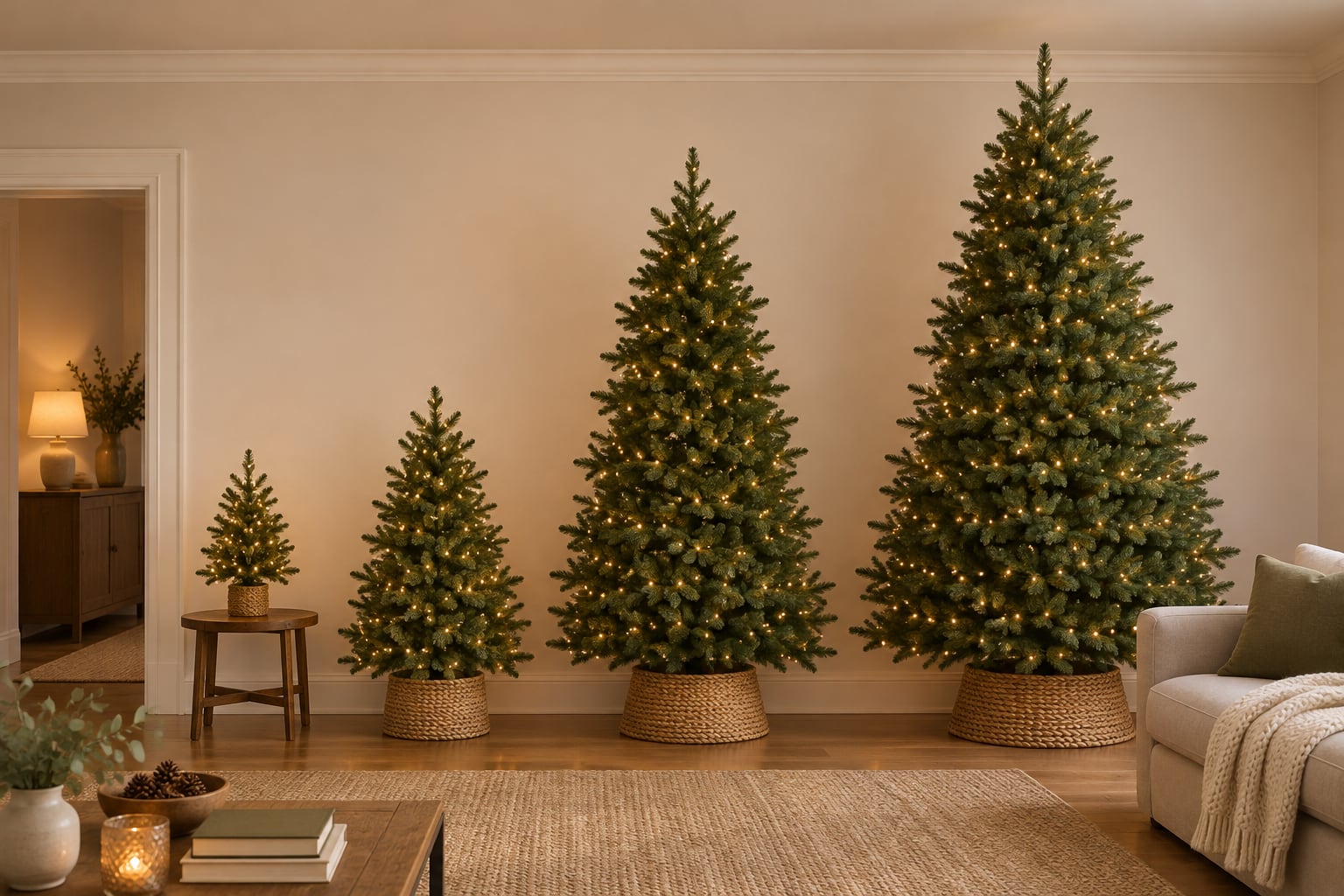
Sizes fall into six classes, each suited to a different room:
- Tabletop, under 4 ft (under 122 cm). A table, a desk, or a room with no floor to spare.
- Small, 4 to 5.5 ft (122 to 168 cm). Kids' rooms, compact spaces, and second trees.
- Medium, 6 to 6.5 ft (183 to 198 cm). Ceilings around 7 to 7.5 feet, or an 8-foot ceiling with a tall star or angel.
- Standard, 7 to 7.5 ft (213 to 229 cm). The size built for 8-foot ceilings.
- Tall, 8 to 9 ft (244 to 274 cm). 9- and 10-foot ceilings.
- Oversized, 10 ft and up (305 cm and up). Vaulted ceilings, two-story rooms, and lobbies.
7.5 ft is by far the most common size. The 48 trees we track come in 16 heights from 4 to 18 feet, but 40 of them come in 7.5 ft and 25 in 9 ft, and no other height is offered on more than nine. Only the Vermont White Spruce comes in 8 ft, so in our catalog most lines jump straight from 7.5 to 9. Balsam Hill's sizing guide puts the average home tree at 7 to 7.5 feet, though "there is no single standard size."
For real trees, the National Christmas Tree Association calls 6 to 7 feet "typical height." If you're shopping the standard artificial size, see our picks for the best 7.5 ft trees.
Christmas Tree Size Chart by Ceiling Height
| Ceiling height | With a topper | Without a topper | Sizes to shop for |
|---|---|---|---|
| 7 ft | Up to 6 ft | Up to 6.5 ft | 6 or 6.5 ft |
| 8 ft | Up to 7 ft | Up to 7.5 ft | 7 or 7.5 ft |
| 9 ft | Up to 8 ft | Up to 8.5 ft | 7.5 or 8 ft |
| 10 ft | Up to 9 ft | Up to 9.5 ft | 9 ft |
| 12 ft | Up to 11 ft | Up to 11.5 ft | 9 or 10 ft |
The chart follows Balsam Hill's rule: allow 12 inches for a standard topper, or 6 inches of breathing room without one. Puleo's guide agrees that under an 8 ft ceiling, a 7 ft tree "leaves 12 inches for the topper," and King of Christmas recommends leaving 6 to 12 inches between the tree and the ceiling.
A few things change the math:
- Toppers. Measure only the part that will sit above the tree's tip; the cone or spring that slides over the tip doesn't add height. Puleo puts a star or angel at 6 to 12 inches or more, so if yours is taller than about 6 inches, subtract its height plus 6 inches instead of the standard 12. Check the weight and how it attaches too, since the top section is the thinnest part of the tree.
- Vaulted or sloped ceilings. Measure where the treetop will actually be, not at the peak. When the ceiling isn't the limit, size for the room instead. Puleo suggests a tree about three-quarters of the ceiling height, such as a 12 ft tree under a 16 ft ceiling, and floor space often runs out first: a full 12 ft tree is close to 6 feet wide and needs about 13 feet of ceiling.
- Things hanging down. A ceiling fan, light fixture, beam, or soffit above the tree's spot is your real ceiling.
How Artificial Christmas Trees Are Measured
- Listed tree height
How tall the tree stands in its own stand, from the floor to the top tip. Every brand we found that explains its method measures this way, so a 7.5 ft tree stands 90 inches tall before you add a topper.
Balsam Hill, King of Christmas, Puleo, and Nearly Natural all say their listed heights include the stand and run to the top tip. If you read an earlier version of this guide, we told you to subtract the stand as well. That was wrong for these brands, and it pointed you to a tree half a foot to a foot and a half shorter than your room could take.
That's also why size charts disagree. Not every brand spells out how it measures, and some guides, even from tree makers whose own specs include the stand, still tell you to allow for it again. If a listing doesn't say, look for an overall height in the dimensions or ask the seller. If you can't confirm it and the fit is tight, size down half a foot.
Buying a real tree? It's measured without a stand, so subtract the stand's height as well. Alabama Cooperative Extension suggests a real tree "about 1 foot shorter than the ceiling height" as a starting point.
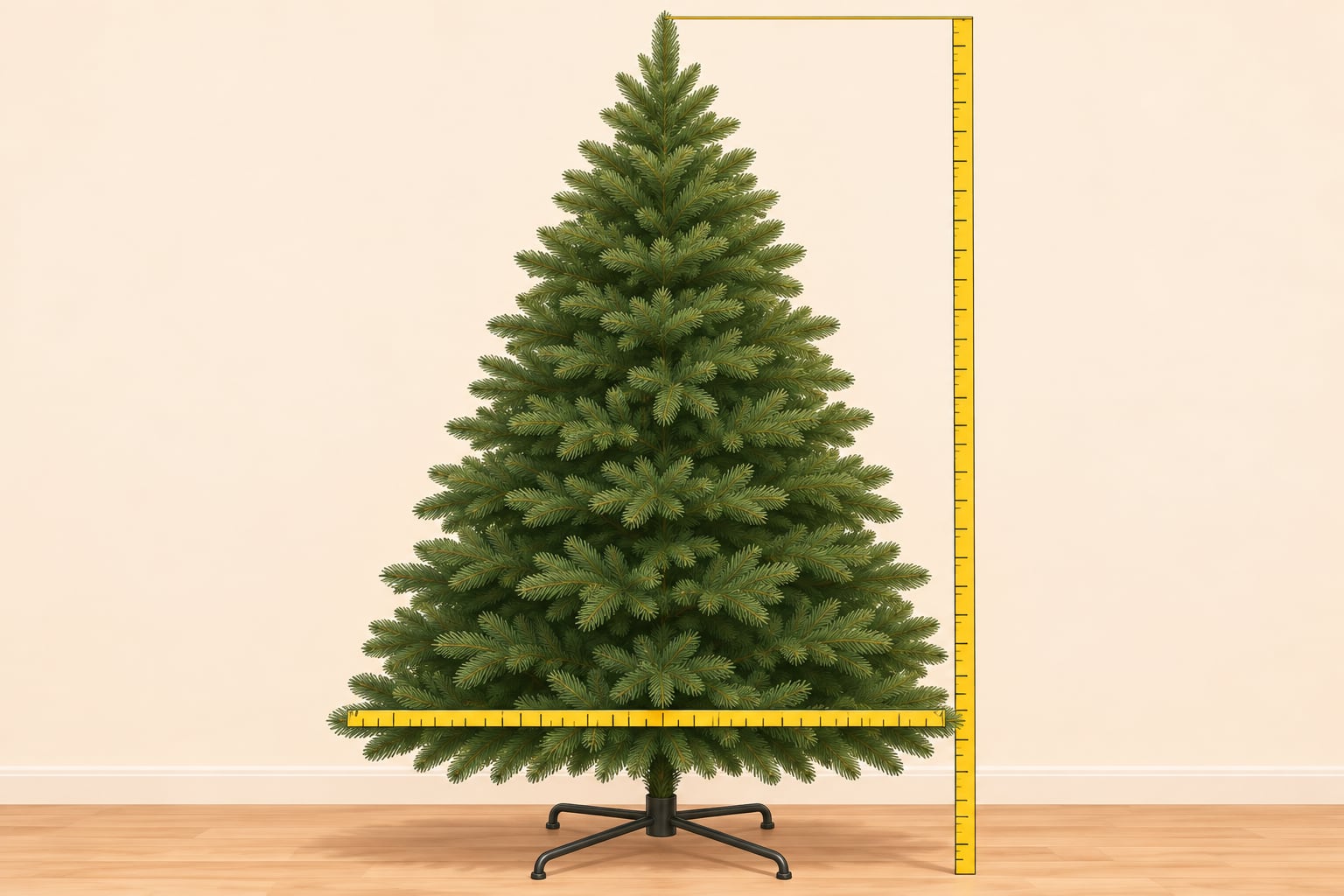
Brands that explain their width measure it tip to tip across the widest row of branches, near the base, on a fully fluffed tree. Spec sheets often call this the diameter. Straight out of the box the branches hug the trunk, so the tree looks narrower until you've fluffed it. Plan for the listed width, not what you see on day one.
Christmas Tree Dimensions: How Wide Is Each Size?
A tree's dimensions are usually listed as height by width, and the width decides how much floor it takes. Here's how wide the full-profile trees in our catalog run at each height, and the floor space we'd clear for them. Typical means the middle half of the trees we track at that height. The 4, 6, and 12 ft rows rest on only six or seven trees each, so treat them as rough.
| Tree height | Typical width (full tree) | Floor space to clear |
|---|---|---|
| 4 to 4.5 ft | 29 to 40 in | About 4.5 ft across |
| 6 to 6.5 ft | 42 to 48 in | About 5 ft across |
| 7 to 7.5 ft | 50 to 56 in | About 6 ft across |
| 9 ft | 56 to 66 in | About 6.5 ft across |
| 12 ft | 66 to 71 in | About 7 ft across |
The floor space column adds about a foot to the width, 6 inches on each side, the same allowance Balsam Hill's guide makes when it says to subtract 12 inches from your floor space to get the widest tree that fits. Puleo figures hanging ornaments add 3 to 6 inches to the spread, and the extra foot covers that while keeping the bottom branches off the wall or the couch. Give it more if people need to walk past. A tree skirt that shows a few inches past the branches fits inside that allowance, and our tree skirt size chart works from these same widths. We track too few 5, 8, and 10 ft trees to give a range, and the few we have vary widely, so check the listing.
As a rule of thumb, a full artificial tree is a little more than half as wide as it is tall: about 60 percent through 9 ft. Taller trees get proportionally narrower, and a typical 12 ft tree is less than half as wide as it is tall.
Widths still vary a lot at the same height. At 7.5 ft, the Birchwood Fir is 50 inches wide and the Yorkshire Fir is 62 inches. That's a foot more floor for the same height, so check the width of the exact tree you're considering.
Full, Slim, or Pencil: Picking a Profile
Full trees are the classic shape and need the floor space in the width table above. Slim trees keep the height and give up width: most slim 7.5 ft trees we track run 29 to 44 inches wide. Pencil trees are narrower still, 28 to 36 inches at 7 to 7.5 ft, for entryways and tight corners.
The labels aren't standardized. At 7.5 ft, the Ashland Glacier Fir is sold as a slim tree at 29 inches wide, narrower than the Sanford Pencil Fir at 36 inches, so go by the width. Our slim vs pencil tree comparison lines up every slim and pencil tree we track at 7 to 7.5 ft and explains when one looks sparse, and our guide to choosing a tree for a small apartment weighs slim trees against short and tabletop ones.
6 vs 7 ft, 6.5 vs 7.5 ft, or 7.5 vs 9 ft?
When your ceiling fits either of two sizes, look at what the bigger one adds besides height. Within the same model, each step up in our catalog adds a few inches of width. Light counts below are mini lights for a classic look, from the chart in our guide to how many lights a Christmas tree needs, where each step takes roughly one more 100-light set; pre-lit trees usually add more.
6 ft vs 7 ft
The ceiling usually decides this one. A 7 ft tree with a topper needs an 8 ft ceiling, while a 6 ft tree fits under 7 feet, so a basement or an older home with low ceilings points to the 6. Under an 8 ft ceiling, the 7 ft tree is the one that fills the room, and the floor cost is small: Tree Classics' Deluxe Noble Fir, now discontinued, was 47 inches wide at 6 ft and about 51 at 7 ft. The 7 ft tree takes about 490 to 630 lights against 420 to 540, roughly one more 100-light set, and the pre-lit Deluxe Noble Fir went from 500 lights to 700.
6.5 ft vs 7.5 ft
This is usually the 8 ft ceiling question, and your topper decides it. A 7.5 ft tree leaves about 6 inches, enough with no topper. A 7 ft tree leaves 12 inches, room for a topper up to about 6 inches tall, and a 6.5 ft tree leaves 18 inches for a tall star or angel. The width barely moves: Tree Classics' Classic Fraser Fir is 48 inches wide at 6.5 ft and 52 at 7.5 ft, and the Vermont White Spruce goes from 60 to 66. For lights, figure about 455 to 585 against 525 to 675.
7.5 ft vs 9 ft
A 9 ft tree needs a 10 ft ceiling with a topper and 9.5 feet without one, so under a 9 ft ceiling it doesn't fit even bare. For a 9 ft ceiling, 8 ft is the tidy answer if you can find it, and a 7.5 ft tree with 18 inches to spare is the size you'll find most often. With a 10 ft ceiling, the 9 ft tree takes only a little more floor. Across the 15 trees we track at both heights, the 9 ft version is typically only 4 to 6 inches wider, such as 52 to 56 inches for the Classic Fraser Fir and 66 to 72 for the Vermont White Spruce.
The bigger costs are lights and reach. The chart puts a classic 9 ft tree at 630 to 810 lights, against 525 to 675 at 7.5 ft, and pre-lit makers add more than that: the Classic Fraser Fir goes from 700 lights to 1,050 and the Vermont White Spruce from 1,440 to 2,240. Ornaments go up by about a third too, by our ornament count chart. You'll also be setting the top section and topper above head height, so plan on a step stool.
If Your Tree Is Too Tall or Too Wide
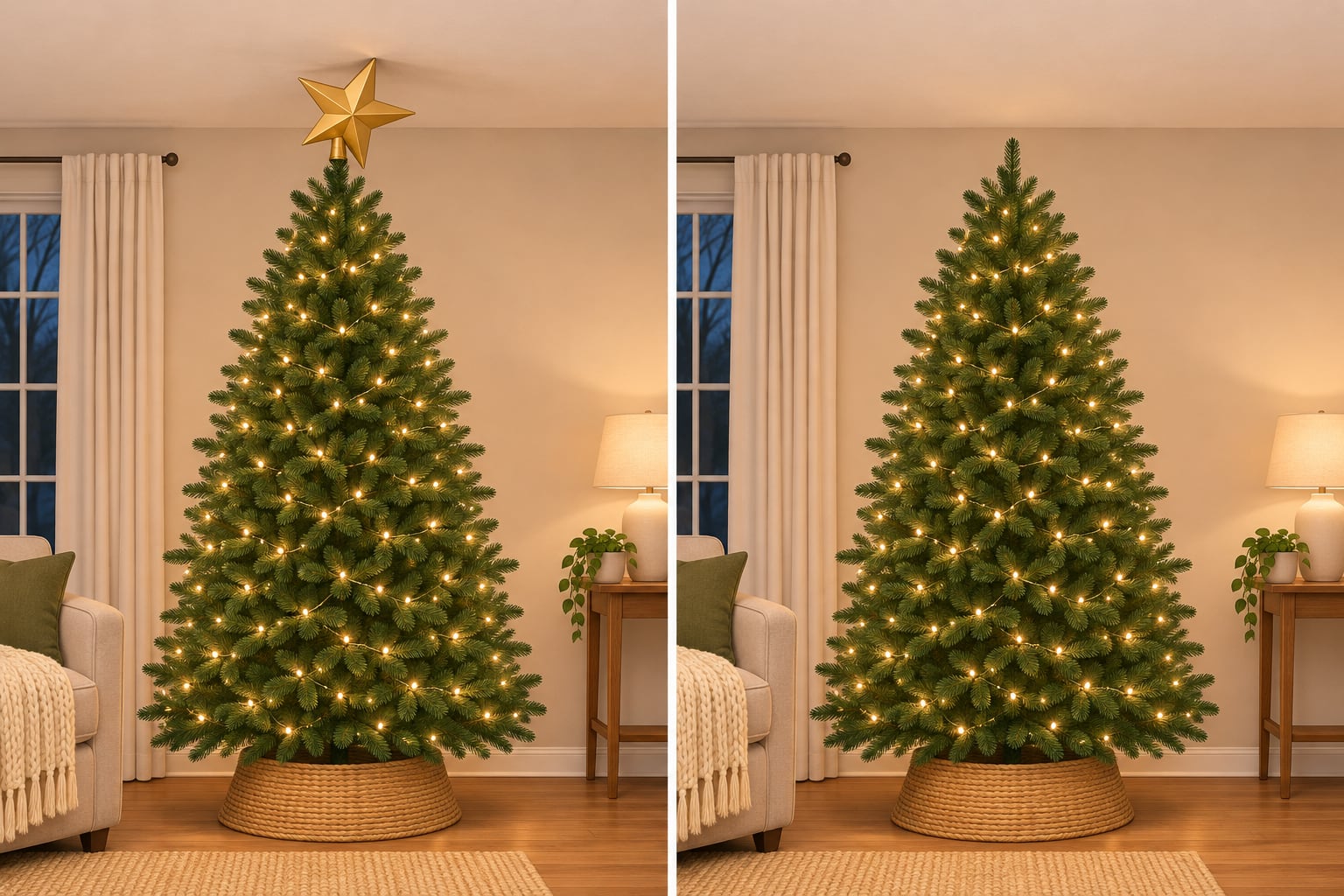
Start with the topper. If the tree fits and only the star hits the ceiling, the tree isn't too tall: try a shorter topper, or leave it off. Balsam Hill's rule for a tree with no topper is to leave just 6 inches, which is how a 7.5 ft tree fits under an 8 ft ceiling.
If the tree itself is too tall, don't cut the pole or leave out a section. We didn't find a tree maker that suggests either. ZMF's sizing guide says to "never attempt to cut or physically alter the trunk or internal structure of an artificial Christmas tree," and to use the tree only with the stand it was designed for. The sections aren't interchangeable, either: National Tree Company's assembly video points out that the bottom section's pole has the crimped end that goes into the stand, and on a pre-lit tree the lights run through every section. If you can still exchange the tree, the next size down is the clean fix.
A real tree is different. Alabama Cooperative Extension says not to cut the base or the bottom branches to shorten one, since losing even one low branch can leave a hole, and to "selectively thin some branches at the top" instead.
Too wide has fewer fixes. ZMF says you can "slightly adjust the width of lower branches through careful fluffing" to fit a tighter spot. Beyond that, the answer is a different tree: a slim one at the same height, or, if the tree reaches too far into the room but the wall has space, a half tree that stands flush against the wall and reaches about half as far out.
Measure Your Room Before You Shop
- Ceiling height at the tree's spot. Floor to ceiling, or to the lowest thing hanging above that spot.
- Your topper. Only the part that will sit above the tip.
- Floor space. The open floor in both directions, minus about a foot for breathing room.
- Traffic. Doors, drawers, and walkways that need to keep working with the tree in place.
- Power. For a pre-lit tree, an outlet within reach of the trunk's cord, ideally without an extension cord across a walkway.
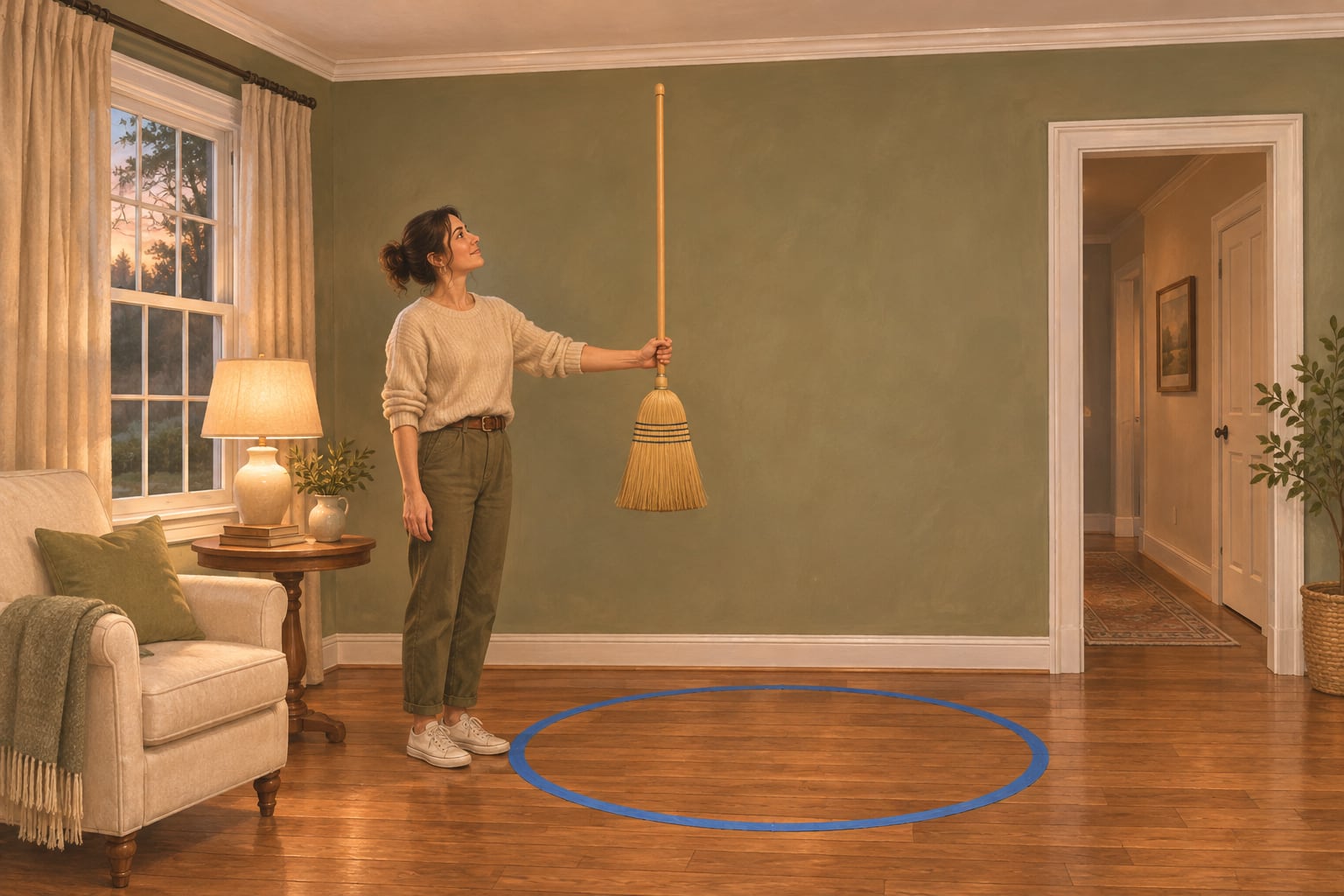
To sanity-check the result, mark the tree's footprint on the floor with painter's tape and hold a broom handle up to the height you're considering. It looks silly and takes two minutes, which beats returning a tree. Once you know your size, our artificial Christmas tree buying guide covers the rest of the decision, from needle types to lights.
Frequently Asked Questions
What size Christmas tree do I need?
Measure from the floor to the ceiling where the tree will go, then subtract 12 inches if you'll use a topper or 6 inches if you won't. That's the tallest artificial tree that fits. Then check its width against your floor space, leaving about a foot of clearance.
What is the average Christmas tree height?
For an artificial tree, 7.5 feet is the standard and by far the most common size: 40 of the 48 trees in our catalog come in it, and Balsam Hill puts the average home tree at 7 to 7.5 feet. It's the tallest size that fits under an 8 ft ceiling without a topper. Real trees run shorter, and the National Christmas Tree Association calls 6 to 7 feet a typical height. A full 7.5 ft artificial tree is typically 50 to 56 inches wide.
What size Christmas tree for an 8 foot ceiling?
A 7 ft artificial tree if you'll use a topper up to about 6 inches tall, a 6.5 ft tree for a taller star or angel, or a 7.5 ft tree without a topper. A 7.5 ft tree leaves about 6 inches below an 8 ft ceiling, which is enough on its own but not with a topper. This assumes the listed height includes the stand, as it does for every brand we found that says how it measures.
What size Christmas tree for a 9 foot ceiling?
An 8 ft artificial tree with a topper up to about 6 inches tall, or a 7.5 ft tree if you want room for a tall star or angel. 8 ft trees are scarce (one in our catalog), so the 7.5 ft tree, with 18 inches to spare, is the size you'll find most often. A 9 ft tree is too tall even without a topper.
What size Christmas tree for a 10 foot ceiling?
A 9 ft artificial tree with a topper up to about 6 inches tall. A taller star or angel calls for an 8 ft tree, but those are scarce, so with a tall topper your realistic choices are a 7.5 ft tree or a shorter topper on the 9 ft one.
What size Christmas tree for a 12 foot ceiling?
A 10 ft artificial tree, which leaves 2 feet for a topper, or an 11 ft tree with a topper up to about 6 inches tall. Both are scarce: only two trees in our catalog come in 10 ft and one in 11 ft, so the size you'll find most often is 9 ft, with 3 feet to spare. A 12 ft tree is too tall; it needs about 13 feet of ceiling once a topper goes on. Check the width too: the two 10 ft trees we track are 56 and 78 inches wide.
Does an artificial tree's height include the stand?
For every brand we found that says how it measures, yes: Balsam Hill, King of Christmas, Puleo, and Nearly Natural all measure from the floor, stand included, to the top tip. Many brands don't say, so if a listing is unclear, check the overall height in the dimensions.
How wide is a 7.5 ft Christmas tree?
A full 7.5 ft tree is typically 50 to 56 inches wide, and the widest we track is 66 inches. Most slim 7.5 ft trees we track run 29 to 44 inches, though some brands' slim trees are wider, and brands don't agree on where slim ends and pencil begins.