
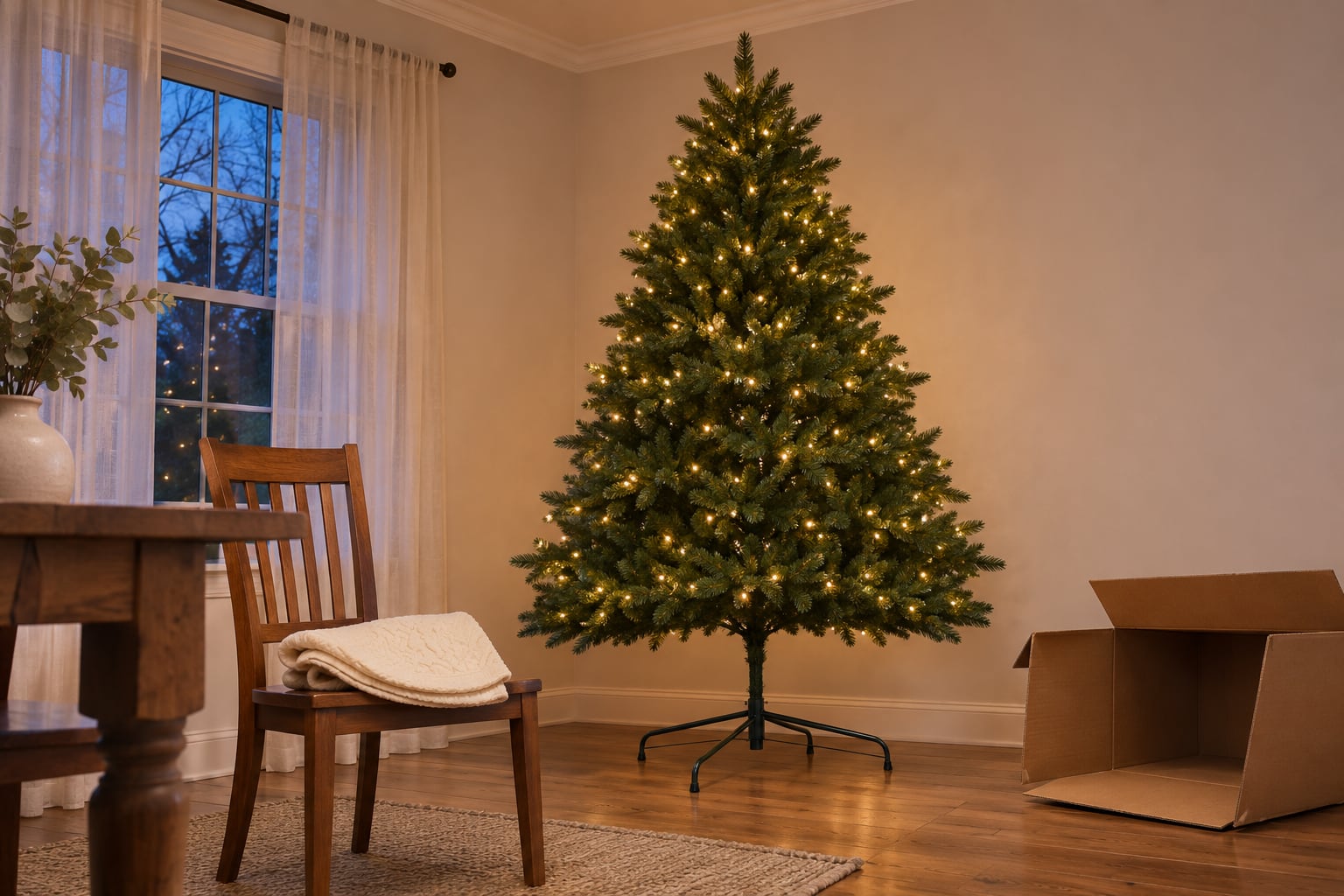
To find a replacement Christmas tree stand that fits, measure the diameter of the tree's bottom pole, then ask the tree's maker for its own stand. If the maker can't help, buy a universal stand that lists that pole size in its range and is rated for your tree's height and weight. The pole decides the fit, and it varies more than tree heights suggest: the makers that publish it list poles from 1.25 inches to about 2 inches, while many universal folding stands top out at 1.25.
If your stand is only wobbly, try straightening it before you buy anything. Puleo, which makes both trees and the stands under them, says a lean usually comes down to one of three things: "the pole is sitting off-center in the socket, one of the legs is bent, or the pole is a smaller diameter than the socket was built for and is sitting loose." Centering the pole fixes the first. A bent leg calls for a new stand, and a pole too thin for its socket needs an insert or a stand that fits it. The steps at the end of this post cover all three.
Measure the Pole Before You Shop
You need one number: the diameter of the pole where it sits in the stand.
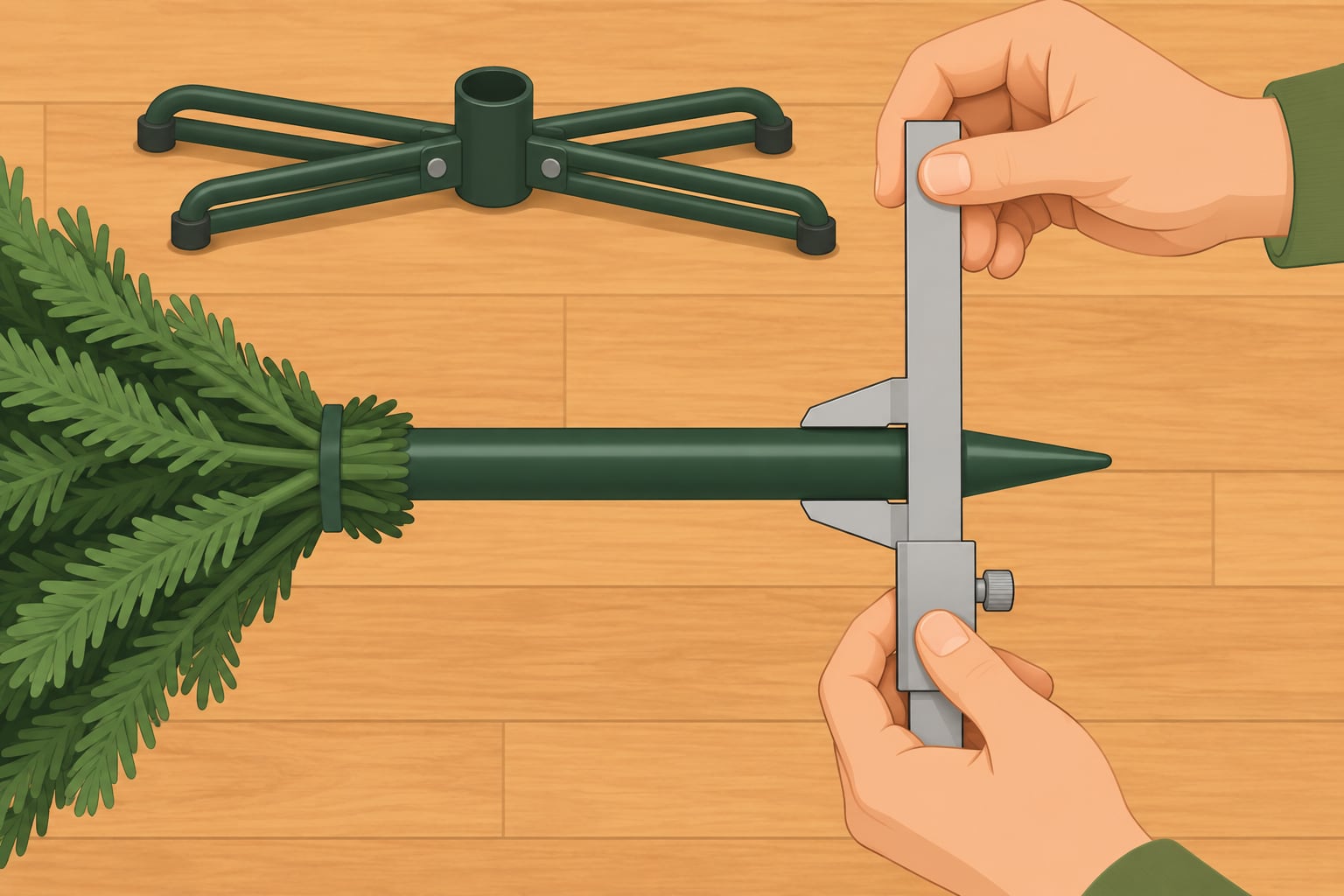
- Take out the bottom section and lay it on its side. The end that goes into the stand often narrows to a point. Puleo's manual tells owners the bottom section "will have a pointed, tapered pole."
- Measure across the pole just above the taper. A caliper is the easy way. Without one, Puleo's stand guide says to "wrap a strip of paper around the pole, mark where it overlaps, measure that length flat and divide by 3.14." A strip about 3.9 inches long means a 1.25-inch pole, 4.3 inches means 1 3/8 inches (1.375), and 6.3 inches means 2 inches.
- Look at the end of the pole. "Some poles are a plain tube," the same guide notes. "Some have a fixed foot or a taper at the bottom that changes what will accept it." A stand that takes your diameter still has to take that end.
- Measure the old stand, if you have it. Go from one leg tip to the opposite one. The replacement should be at least that wide, and our skirt and collar sizing guide uses the same measurement if you plan to hide the new stand.
Why tree height won't tell you the pole size
Pole sizes change between brands, between heights from the same brand, and even between stands sold for the same tree height. A few makers publish theirs:
| Tree or stand | Pole diameter | Stand width |
|---|---|---|
| King of Christmas 7 ft King Noble Flock | 1.25 in | 22 in |
| King of Christmas 7.5 ft King Flock | 1.25 in | 26 in |
| King of Christmas 9 ft King Flock | 2 in | 42 in |
| Puleo folding stand, 6.5 to 8 ft trees | 1.25 in | 22 in |
| Puleo metal stands, 7 to 9 ft trees | 1 3/8 in (1.375) | Not listed |
| Puleo metal stand, 12 ft trees | 1 5/8 in (1.625) | Not listed |
| Balsam Hill rolling stand | 1.25 to 2.12 in, with inserts | 30 in under a 7.5 ft tree |
Puleo's own lineup shows why height isn't enough. Its folding stand and its fixed metal stand are both sold for 7.5-foot trees, and they take different poles: "A 1.25 inch pole will sit loose in a 1 3/8 inch socket, and a 1 3/8 inch pole will not go into a 1.25 inch one at all." The King of Christmas figures come from its listings for the 7-foot King Noble Flock and the 7.5-foot and 9-foot King Flock.
Ask the Tree's Maker
A stand made for your tree fits by design, because its maker already knows the pole. As Puleo's guide puts it, the part you need "is defined by a specific pole diameter, and that information sits with whoever made the tree." Even so, Puleo's parts guide asks you to measure the pole and match the tree's height before you order one of its stands.
If the tree is new and arrived without a stand, or with a broken one, go back to the seller first. National Tree Company, for one, tells owners who bought one of its trees through a retailer to contact that retailer about damaged, defective, or incorrect items.
If the stand failed from a defect, ask whether the warranty covers it, and check the timing. National Tree Company's warranty applies to trees 6.5 feet and taller once they're registered, and it covers the stand that came with the tree unless it broke from "tipping or moving a fully assembled or decorated tree." It processes warranty replacements "only between January 15 and September 15," though. You can file a claim now and it's queued until then, so a December failure on one of its trees still needs a stopgap for this season. Our setup and warranty guide covers what tree warranties usually include.
For anything else, the maker will ask for the model or item number, and the box is the first place to look:
- National Tree Company says the item number and UPC are on the original box, and asks for the item number when you contact it about parts.
- Puleo's manual puts the model number "on the short side of the box" and says it may also be on "a sticker located on the pole of the very bottom section going into the stand."
- Fraser Hill Farm's manual lists the side of the carton and your purchase receipt.
No box? Check the bottom pole for a sticker, then your receipt or order confirmation.
Puleo sells replacement stands by pole size, and its parts guide says it also lists stands for trees it made for retail partners, matched by model number. National Tree Company sells available parts "for a fee plus shipping charges" when the warranty doesn't cover the damage. If only a bolt went missing, you don't need a whole stand: Balsam Hill sells replacement "tree stand keys or eye bolts" and rubber feet for its stands, and Puleo sells sets of replacement eye bolts.
At least one maker wants its trees kept on the stand they came with: as our size guide notes, ZMF tells owners to use a tree only with the stand it was designed for. That's one more reason to ask the maker before buying a universal stand.
What to Check on a Universal Stand
If the maker can't help, or you can't wait for a part, a universal stand works when all of these line up:
- Your pole size, inside the listed range. Most listings give the range in decimals, so convert fractions first: 1 3/8 inches is 1.375, and 1 5/8 is 1.625. Many universal folding stands top out at 1.25 inches. Of the others we found, one stops at 1.35 and another at 1.37, both just short of 1 3/8 inches, three stop at 1.57, and one reaches 1.9. A 2-inch pole needs a stand that says 2 inches. For a 12-foot tree, get the maker's stand: Puleo's guide says, "Do not improvise at this height."
- A snug fit. A pole thinner than a fixed socket sits loose, which is one of Puleo's three causes of a lean. Universal stands cover a range with their screws, and some add inserts or adapter sleeves to fill the gap: Balsam Hill's rolling stand comes with "inserts in 4 sizes" and a stabilizer for pointed poles. An adapter only fills a socket that's too big. Nothing makes a pole fit a socket smaller than it is.
- Three screws. Puleo recommends three bolts spaced around the pole, "because two can only clamp on one axis and the tree will still pivot."
- Legs at least as wide as the old stand's. "More spread means more stability," says Puleo. On the full 7.5-foot trees in our catalog that list one, the stand measures 21 to 26 inches across, and on 9-foot trees, 26 to 33 inches. King of Christmas puts its 9-foot King Flock on a 42-inch stand. Some universal folding stands are only 16 to 18 inches across.
- Height and weight ratings with room to spare. Puleo treats a weight rating as "a ceiling to stay comfortably inside rather than a target to reach." Its guide puts its 7.5-foot trees at 26 to 63 pounds, depending on profile, and King of Christmas lists its 9-foot King Flock at 65 pounds. That's all before ornaments, whose weight sits "on the outside of the branches where it has the most leverage." Not every universal stand lists a weight rating, so for a tree in that range, pick one that does.
Skip stands made for real trees. They're built to grip a tapered wooden trunk and hold water, and Puleo warns that if you put an artificial tree's smooth pole in one, "the screws have nothing to grip."
If the treetop was already close to the ceiling, compare stand heights: one that holds the pole higher than the old one raises the top by the same amount.
Folding, universal, rolling, or rotating
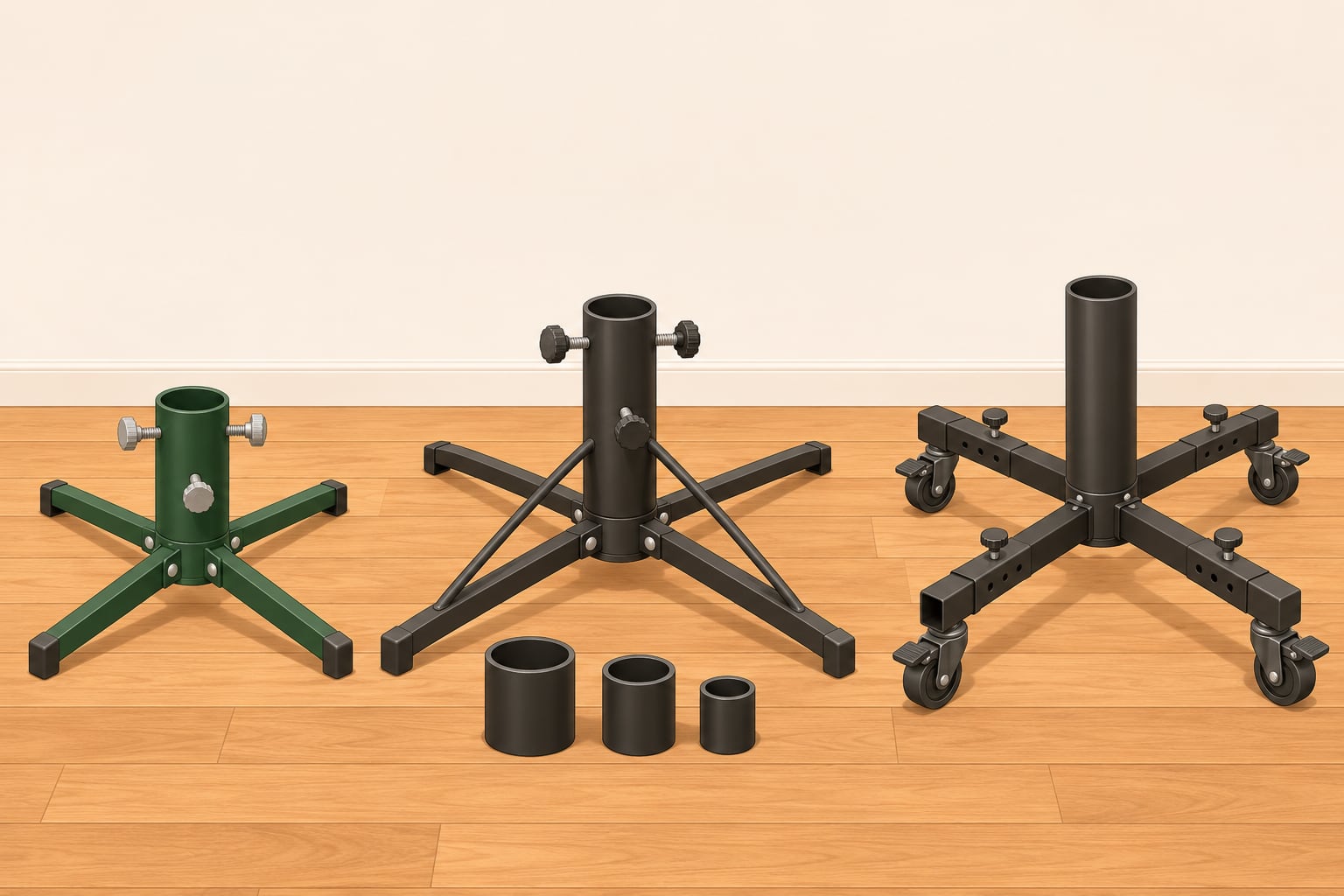
- Folding and fixed metal stands are what most trees in our catalog ship with. Puleo says a folding stand "typically takes a 1.25 inch pole," while a fixed four-leg stand, which doesn't fold, tends to have a deeper socket and a wider spread. Folding is easier to store; fixed is steadier under a heavy, fully decorated tree.
- Universal stands are sold by pole range instead of for one tree, so the checklist above is what to go by.
- Rolling stands add lockable wheels so you can move the tree, and Balsam Hill's spreads its legs wider as trees get taller.
- Rotating stands turn the tree, so read their limits closely. Puleo's revolving stand takes a 1.25-inch pole and is rated for "up to an 80 lb, 7.5 foot tree."
Straighten a Wobbly Tree Before You Replace the Stand
See whether the stand you have can hold the tree straight. Push the trunk just above the stand. If the whole stand rocks, look at the floor and the legs. If the pole shifts inside the socket, it's the seat or the screws.
- Check the stand. A bent leg, or a bolt that's missing or seized, keeps the pole from sitting straight. Bolts and feet can be replaced on their own; a bent leg is the case for a new stand.
- Open the legs fully on a level floor. Fraser Hill Farm's troubleshooting asks for "a completely level surface," with the legs "fully extended and making 90-degree angles with one another." The manual for one unbranded tree also warns against spots "where tree is likely to wobble due to uneven floors or thick carpeting." If the floor dips, a thin shim under the leg on the side the tree leans toward levels the stand. On carpet, a board under the stand gives it the hard, flat surface that manual asks for.
- Seat the pole. Loosen the screws, lift the bottom section, and set it back down until it bottoms out. Puleo's manual says "the pointed end of the bottom section should fit firmly in the bottom of the stand."
- Hook up the cables, if your tree has them. Some of Fraser Hill Farm's 12-foot trees come with four steel cables that clip to the pole and hook onto the stand. Its manual says they "must be installed to the base in order to safely stabilize your tree," and warns, "do not attempt to straighten the tree with the stand bolts," because "the cables are the mechanism to straighten the tree."
- Otherwise, center it with the screws. The unbranded tree's manual has owners turn the screws in "so they touch tree trunk," then straighten the tree "by adjusting screws in or out" and tighten them. Puleo's advice for a lean matches: loosen the eye bolts, re-center the pole, and tighten them again as the stand's instructions describe.
- Push down every section above. A section that isn't fully seated tilts everything on top of it.
- Balance the load. If the tree stands straight bare and leans once it's decorated, the unbranded tree's manual says to "shift the weight of the decorations" and use support wires to the walls. With pets, the American Veterinary Medical Association suggests tying the tree "to the ceiling or a doorframe using fishing line," and our cat-proof tree guide shows how to set that up.
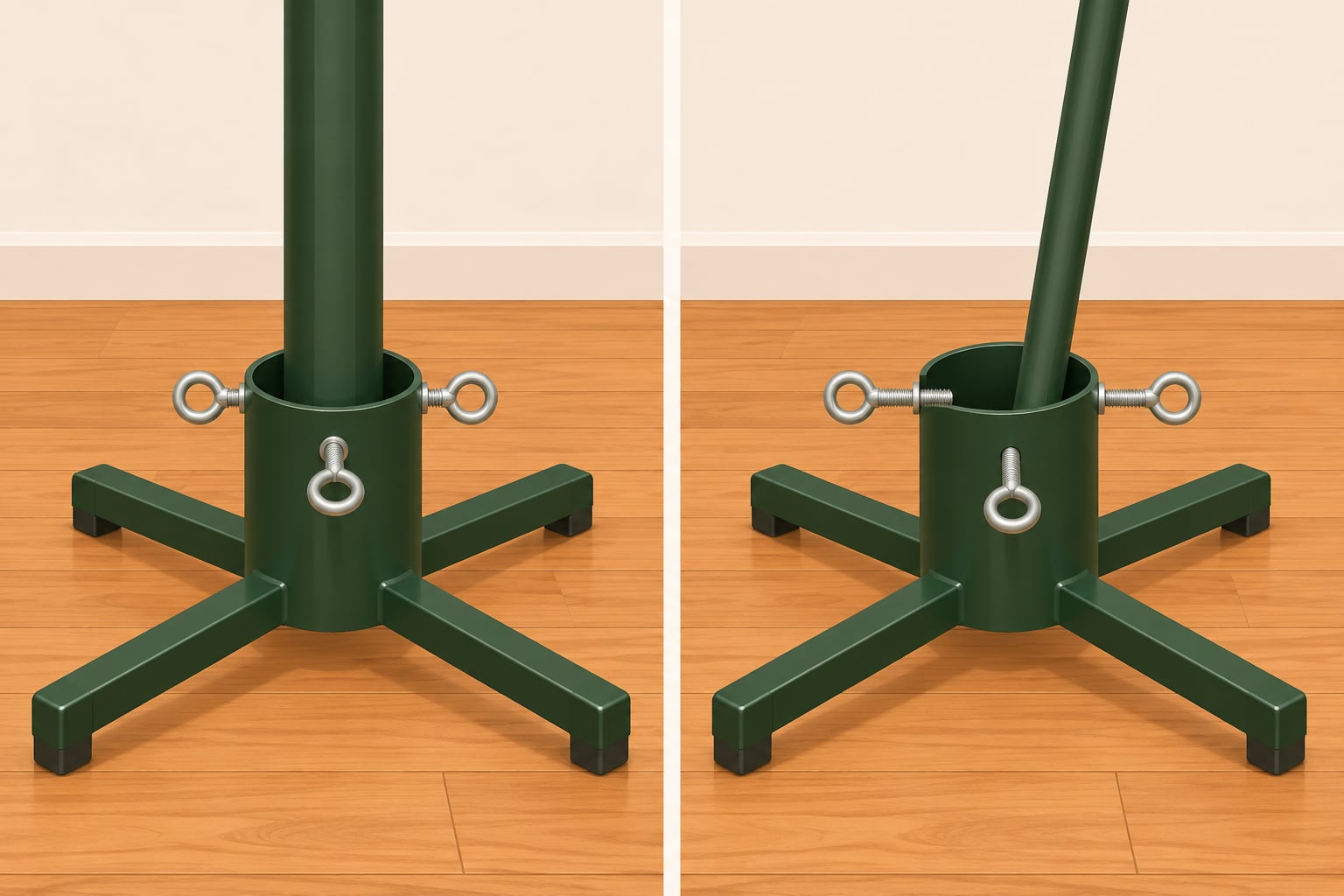
If the pole is thinner than a fixed socket, centering helps, but it can still drift. A stand that matches the pole, or one with inserts sized for it, settles it.
Replacement Stand Questions
What size stand does a 7.5 ft artificial tree need?
One that takes its pole and spreads at least as wide as the original stand. Some 7.5-foot trees use a 1.25-inch pole, King of Christmas's King Flock among them, while Puleo's fixed metal stand for 7.5-foot trees takes a 1 3/8-inch pole, so measure yours before you buy. The full 7.5-foot trees in our catalog that list a stand size sit on stands 21 to 26 inches across.
Can I use a real tree stand for an artificial tree?
Usually not. A real-tree stand is built to grip a tapered wooden trunk and hold water. Puleo, which makes artificial trees and their stands, warns that with an artificial tree's smooth pole, "the screws have nothing to grip, so the tree is not properly secured." Use a stand that lists your pole's diameter in its range.
Will a universal stand hold a 9 ft tree?
Only one rated for the tree's height, its weight, and its pole, which can be thicker on tall trees. King of Christmas lists a 2-inch pole and 65 pounds for its 9-foot King Flock, while Puleo's stands for 9-foot trees take 1 3/8 inches. One universal stand we found is rated for 9- to 14-foot trees but tops out at 1.5 inches, too small for that 2-inch pole.
What if the pole doesn't fit the stand?
First check that it's the bottom section, usually the one with a pointed or crimped pole end. Puleo tags its sections by letter, and "Section A is always the top section of the tree," so on its trees the bottom one carries the last letter. Then back the screws out: Fraser Hill Farm's manual says to "loosen or remove the thumbscrew(s), slide the base tree section in place, and then re-tighten" them. If the pole still won't go in, the opening is too small, and no adapter changes that, so you need a stand whose range includes your pole. If it goes in but sits loose, the socket is too big: center the pole with the screws, or use a stand with inserts sized for it.
Do I need a new stand if I lost the screws?
Not necessarily. Balsam Hill sells replacement tree stand keys and eye bolts, along with rubber feet, and Puleo sells sets of replacement eye bolts. For another brand, contact its customer service with the model number from the box.