
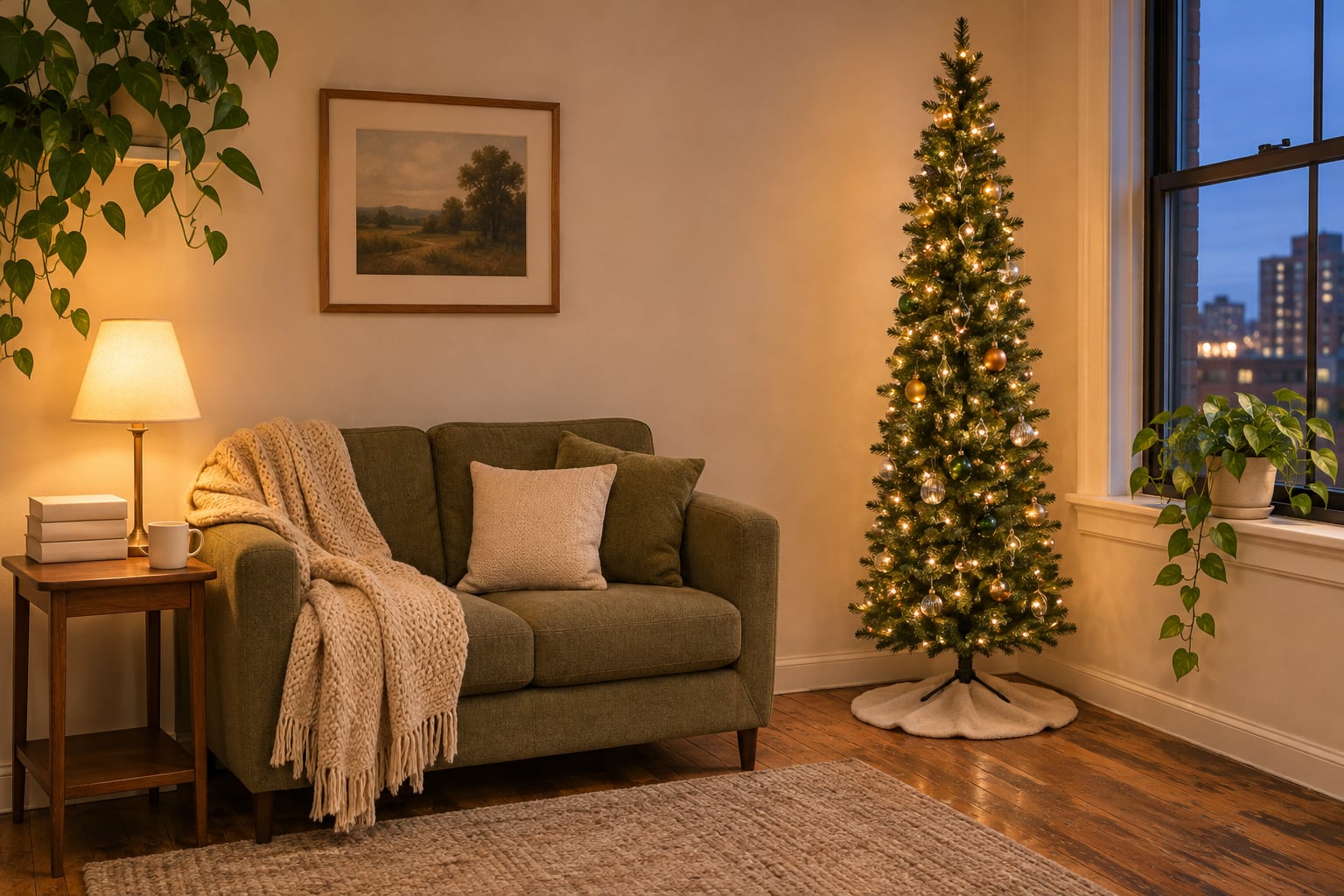
If your ceilings are 8 feet, the artificial tree that usually fits a small apartment best is a slim or pencil tree 7 to 7.5 feet tall, or 7 feet if you'll use a topper. It keeps the height that makes a tree look like the main event and gives up width, which is the thing a small room lacks. Going shorter saves less floor than you'd expect: slim 7.5 ft trees are mostly 29 to 44 inches wide, no wider than a typical full 6 ft tree, and a pencil tree is about as narrow as a full 4 ft one.
A shorter full tree makes sense when a low ceiling caps the height and the floor can take its width. A tabletop tree needs no floor at all, and a half or flat-back tree stands flush against a wall. Whichever you choose, pick the spot first. The U.S. Fire Administration says to keep a tree at least 3 feet from heat sources such as radiators and space heaters, and clear of exits, and the Consumer Product Safety Commission says to keep cords out of the path of foot traffic.
How Much Floor Each Kind of Tree Takes
How much of the room a tree takes comes down to its width, not its height. The floor space column adds about a foot to the widest tree in each range, the same allowance our Christmas tree size guide uses, so the bottom branches stay off the couch and the wall.
| Tree | Typical width | Floor space to clear |
|---|---|---|
| Full, 7 to 7.5 ft | 50 to 56 in | About 6 ft across |
| Full, 6 to 6.5 ft | 42 to 48 in | About 5 ft across |
| Full, 4 to 4.5 ft | 29 to 40 in | About 4.5 ft across |
| Slim, 7.5 ft | 29 to 44 in | About 5 ft across |
| Pencil, 7 to 7.5 ft | 28 to 36 in | About 4 ft across |
| Half or flat-back | As wide as a full tree | About half the depth, against a wall |
| Tabletop, 2 to 3 ft | Fits on furniture | None beyond the furniture |
Typical means the middle half of the full trees in our catalog at each height, and most of the slim and pencil trees. Only the full 7 to 7.5 ft row rests on many trees, so treat the others as rough.
A slim 7.5 ft tree takes about the floor of a full 6 ft tree while standing a foot and a half taller, and a pencil tree takes less floor than a full 4.5 ft one. You can see it within a single model. The Holiday Living Hayden Pine comes as a 7 ft pencil tree 28 inches wide and as a 6 ft full tree 48 inches wide, so the taller version needs 20 inches less floor. The Holiday Living Parque is 44 inches wide as a 7.5 ft slim tree and 55 as a 7.5 ft full one.
"Slim" and "pencil" aren't standard sizes, so go by the listed width. You can filter our catalog to slim and pencil trees to compare. Your ceiling sets the height, and the size guide's chart covers that, including how much room to leave for a topper.
Slim or Short: Which Works Better in a Small Room?
Width is what costs you floor, and height mostly doesn't. So pick the width your floor can spare, then the tallest tree at that width your ceiling allows. Puleo's size guide makes the same point ("Choose by the width you can spare, not by the photo") and its advice for a "small room, corner, or apartment" is to "go slim, keep the height, and lose the footprint."
Go slim when the floor is tight and the ceiling isn't. With 8 feet or more overhead, a 7 to 7.5 ft slim or pencil tree reads as a full-height tree on the floor of a full 4 to 6 ft one. The trade is branch length. Narrow trees have short branches, so big ornaments crowd a slim tree and overwhelm a pencil one. A short tree of the same width has the same limit, though. Big ornaments need a wider tree, and a wider tree needs more floor.
Go full when the ceiling sets the height. If a low ceiling, a beam, or a soffit stops the tree around 6 feet, the height is settled, so get the fullest tree at that height your floor can take. If a full one won't fit, a slim one that height still beats a shorter full tree. And if you simply prefer a classic cone to a column, a full 4 to 4.5 ft tree takes about the floor of a slim 7.5 ft one.
Tabletop and Half Trees
A tabletop tree, usually 2 to 3 feet tall, needs no floor if it sits on a console, a dresser, or a sturdy side table you already own. It's the simplest answer for a studio where every bit of floor already has a job, or for a second tree. It reads as decoration more than as the room's tree, it holds only small ornaments, and unless it runs on batteries it needs an outlet near the furniture. Our catalog starts at 4 feet, so we don't have tabletop picks.
A half or flat-back tree has branches across the front only, so it stands flush against a wall and needs roughly half the depth of a full tree of the same height. It still needs the full width along the wall. Our catalog doesn't include any.
Picking the Spot: Heat, Exits, and Outlets
In a small apartment, the spot is usually harder to find than the tree. Rule out the bad ones first.
- Heat. The U.S. Fire Administration says to keep a tree at least 3 feet from heat sources "like fireplaces, radiators, space heaters, candles or heat vents." If a radiator or baseboard heater runs under the window you had in mind, that spot is out unless the tree can stand 3 feet away. The Consumer Product Safety Commission also says to look for the "fire resistant" label on an artificial tree.
- Exits. The Fire Administration also says to make sure the tree doesn't block exits. In an apartment, we'd count the path to the front door and any window onto a fire escape. For everyday walkways, our artificial Christmas tree buying guide suggests leaving about 30 inches.
- The outlet. A pre-lit tree's power cord comes out near the base of the trunk, and the trees in our catalog that list a cord length run from 6 to about 9 feet, so the tree needs an outlet within that reach. Ready.gov says "do not run cords under rugs or furniture" and not to overload extension cords and outlets, and the CPSC's home electrical safety checklist says to move cords "out of the path of foot traffic," where they trip people and get damaged underfoot. If you need an extension cord, run it along the wall.
- Switching it on. In a corner, a foot pedal or a switch on the cord can end up behind the tree. A remote saves the reach, and so does a plug-in timer or an outlet controlled by a wall switch. Check first that your tree comes back on in the setting you left it: our review of the Ashland Melody Spruce notes its lights come back on red every time it powers on, whatever color you left them on.
Carrying and Storing a Tree Without a Garage
Without a garage, the tree spends the rest of the year somewhere in your apartment, so measure for the box as carefully as for the tree.
A box has to fit the tree's longest section, so a 7 to 7.5 ft tree's box runs roughly 3.5 to 4.5 feet long whether the tree is full or slim. Puleo says a 7.5 ft tree fits in "roughly a 55 by 18 by 18-inch box." Some pack smaller. Ashland's slim 7.5 ft Glacier Fir comes in a box 46 by 12.5 by 14 inches, and its full 7 ft Celebration Pine in one 44 by 12.5 by 12.5 inches. Its full 7.5 ft Jackson Spruce needs 46 by 20.5 by 14.5. Girth varies from model to model, so check the listed box size before you buy.
Check the listed weight too if you'll carry the box up stairs alone. Within one model, weight climbs quickly with height: the Classic Fraser Fir lists 15 to 18 pounds at 4.5 feet, 25 to 31 at 6.5 feet, and 35 to 41 at 7.5 feet. Width counts as well, so a tall narrow tree can weigh less than a shorter full one: the 7 ft pencil version of the Holiday Living Flocked Greensboro lists about 20 pounds.
A box 4 feet or so long can stand on end in a coat closet, which beats lying flat: our setup and storage guide says to store a tree upright if you can, since laying it flat can bend branches over time. A closet inside the apartment stays at room temperature all year, which makes it a good home. A building storage locker works if it stays dry and doesn't bake in summer or freeze in winter.
A pre-lit tree also spares you a bin of light strands. Our pre-lit vs unlit comparison covers the rest of that choice.
Trees in Our Catalog for Small Spaces
These are the trees in our catalog we'd look at first for a small room, chosen on width and on what their reviews say about living with them. Under an 8 ft ceiling, the 7.5 ft trees leave about 6 inches, enough without a topper.
Holiday Living Parque, 7.5 ft slim
The slim Parque is 44 inches wide, with 2,018 tips and 55% PE needles, the highest PE share on this list. Its dual-color lights run from a foot pedal with no remote, so keep the pedal where you can reach it, and plan on some time fluffing. Pick it if realism matters most and your floor can take the wide end of slim.
Holiday Living Hayden Pine, 7 ft pencil
The pencil Hayden Pine is 28 inches wide, the narrowest tree here, with 1,220 tips and color-changing lights run from a remote. Our review calls it "perfect for apartments, condos, or tight spaces," with two catches: its 210 lights work out to about 30 per foot, low next to the full versions, and a lighted topper needs an adapter because the tree runs on a 29-volt power supply.
Holiday Time Sanford Pencil Fir, 7.5 ft
The Sanford Pencil Fir is 36 inches wide, with warm white lights. It's mostly PVC, has no lighting controls, and comes without manufacturer warranty coverage. It's a budget pick that its review calls "ideal for apartments, first trees, guest rooms."
Ashland Glacier Fir, 7.5 ft slim
The Glacier Fir is 29 inches wide and heavily flocked, with dual-color lights that mix globe bulbs in with standard LEDs, run from a foot pedal. Its review calls it "perfect for small apartments" but sees it as an accent tree more than a centerpiece, and notes that owners praise how it looks with few or no ornaments, which means fewer ornaments to store. Expect some flocking mess during setup.
Tree Classics Classic Fraser Fir, 4.5 or 6.5 ft
The Classic Fraser Fir is the short, full option: 40 inches wide at 4.5 feet and 48 at 6.5, with 50% PE and dual-color or clear lights run from a foot pedal. Pick it for a low ceiling, or if you'd rather have a full shape than a narrow one.