
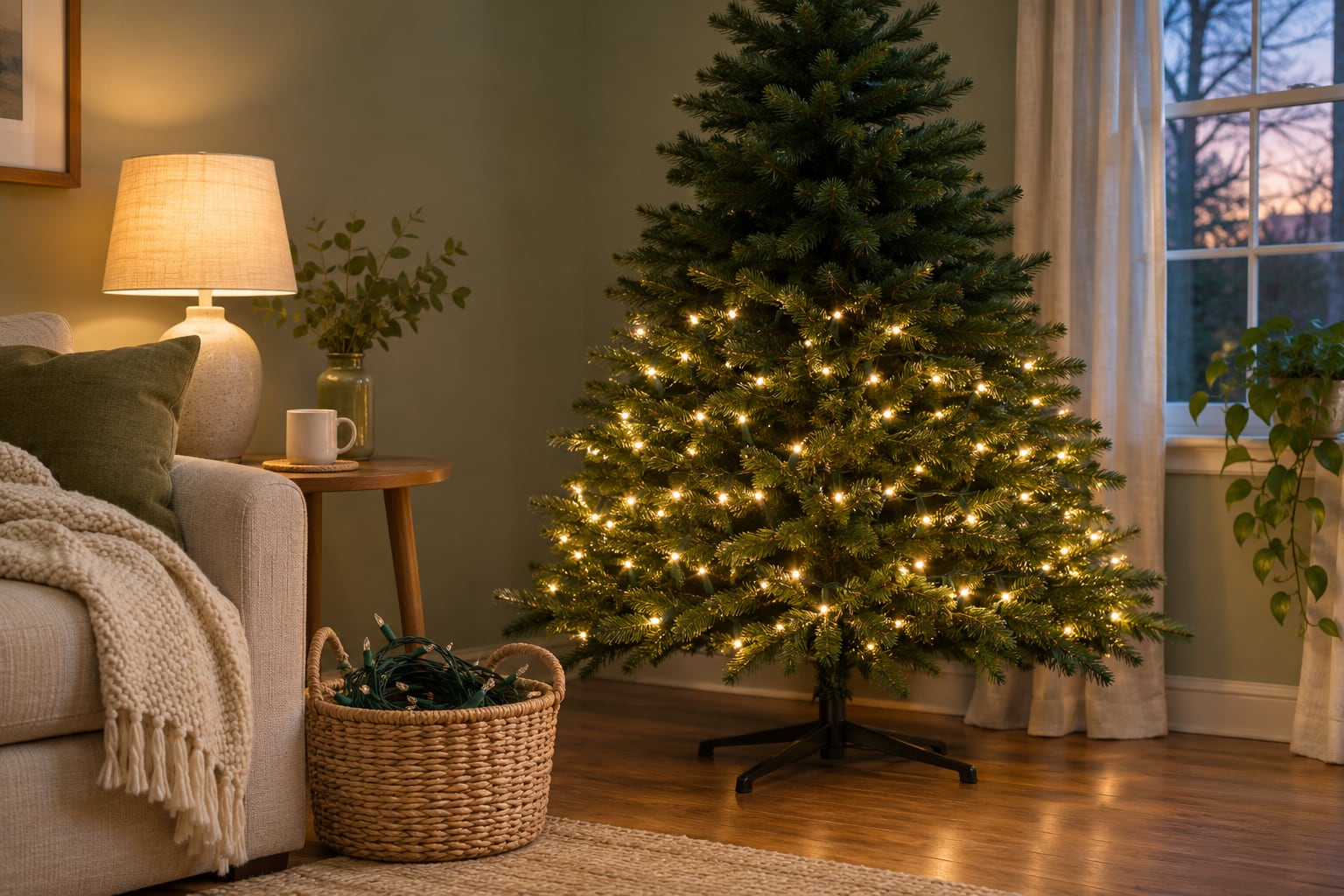
For mini lights, the standard small bulbs most light sets use, plan on 70 to 90 lights per foot of tree height for a classic look, 100 to 120 per foot for a lush one, and 130 or more if the tree is the main event in the room. A 6-foot tree takes about 420 to 540 lights for a classic look and 600 to 720 for a lush one. A 7.5-foot tree takes about 525 to 675, or 750 to 900. In 100-light sets, that's five or six sets for a classic 6-footer and eight or nine for a lush 7.5-footer.
Those counts assume a full-profile tree. A slim tree needs fewer lights, a very wide one needs more, and micro or fairy LEDs, which are much smaller points of light, call for roughly twice as many. The chart below does the math for every common height. If you're judging a pre-lit tree's light count instead of buying lights, the "Light Count and Density" section of our lights and controls guide covers that.
How Many Lights for Each Tree Height
| Tree height | Classic (70 to 90 per ft) | Lush (100 to 120 per ft) | Statement (130+ per ft) |
|---|---|---|---|
| 4 ft | 280 to 360 (3 to 4 sets) | 400 to 480 (4 to 5 sets) | 520+ (6+ sets) |
| 5 ft | 350 to 450 (4 to 5 sets) | 500 to 600 (5 to 6 sets) | 650+ (7+ sets) |
| 6 ft | 420 to 540 (5 to 6 sets) | 600 to 720 (6 to 8 sets) | 780+ (8+ sets) |
| 6.5 ft | 455 to 585 (5 to 6 sets) | 650 to 780 (7 to 8 sets) | 845+ (9+ sets) |
| 7 ft | 490 to 630 (5 to 7 sets) | 700 to 840 (7 to 9 sets) | 910+ (10+ sets) |
| 7.5 ft | 525 to 675 (6 to 7 sets) | 750 to 900 (8 to 9 sets) | 975+ (10+ sets) |
| 8 ft | 560 to 720 (6 to 8 sets) | 800 to 960 (8 to 10 sets) | 1,040+ (11+ sets) |
| 9 ft | 630 to 810 (7 to 9 sets) | 900 to 1,080 (9 to 11 sets) | 1,170+ (12+ sets) |
| 10 ft | 700 to 900 (7 to 9 sets) | 1,000 to 1,200 (10 to 12 sets) | 1,300+ (13+ sets) |
| 12 ft | 840 to 1,080 (9 to 11 sets) | 1,200 to 1,440 (12 to 15 sets) | 1,560+ (16+ sets) |
Set counts assume 100-light sets and round up, so you won't come up short. Sets come in other sizes too, so divide by the count on the box if yours differ. One spare set is worth having for burnouts.
To pick a column, our lights guide's rule is that a tree loaded with ornaments looks best at the classic count, while a tree with few ornaments or an all-white theme can carry lush or statement counts. Cool white also reads brighter than warm white at the same count, so you can stay toward the low end of a range.
You'll see other numbers elsewhere. Balsam Hill's lighting guide calls 100 lights per foot "a common rule" for a balanced look and suggests doubling it "for a more dramatic effect." That lands at the bottom of our lush range, and doubled, it's a statement tree. Published advice runs anywhere from 50 to 200 lights per foot, partly because guides rarely say which bulb size they mean. Balsam Hill's guide never does.
How Many Feet of Lights Do You Need?
Light sets are sold by bulb count, and how much wire that comes to depends on the spacing between bulbs. Wintergreen sells the same 100-light Kringle Traditions set with 2.5-inch, 4-inch, and 6-inch spacing, and the total lengths come to 21.1, 33.7, and 50.5 feet.
To convert, multiply the number of lights by the spacing in inches, then divide by 12. At 100 lights per foot of tree, that's about 21 feet of string for every foot of tree height on 2.5-inch spacing, 33 feet on 4-inch spacing, and 50 feet on 6-inch spacing. A lush 7.5-foot tree with 750 to 900 lights takes roughly 155 to 190 feet of string on 2.5-inch spacing, or 250 to 300 feet on 4-inch spacing.
That's why length-based rules are slippery. Govee's guide calls "10-20 feet of lights for each foot of tree height" a good rule. On 2.5-inch spacing, that's 48 to 96 lights per foot, classic at best. On 4-inch spacing, it's only 30 to 60.
Closer spacing puts more bulbs on each foot of wire, which suits a dense look on an indoor tree. Wider spacing covers more branch per set, with fewer bulbs per foot of wire.
What Changes the Count
Width. The chart assumes a full-profile tree, and a full 7.5-foot tree is typically 50 to 56 inches wide. Our Christmas tree size guide has widths for every height. A narrower tree has less branch to cover. By rough cone geometry, a 36-inch pencil tree has about two-thirds the surface of a 54-inch full tree of the same height, so about two-thirds the lights gives it the same look. The same math works in the other direction: the widest 7.5-foot tree we track, at 66 inches, needs about 25 percent more lights than a 54-inch one.
Bulb size. Micro and fairy LEDs are tiny points of light on thin wire, and pre-lit makers use far more of them than mini lights. In our catalog, the typical 7.5-foot micro-LED tree carries about twice as many lights as the typical mini-light tree (more on that below), so for micro or fairy lights, double the chart as a starting point. Big C7 and C9 bulbs go the other way, and they don't suit every artificial tree. National Tree Company's assembly manual says to decorate its trees with miniature or LED light strings only, and it doesn't recommend C-size bulbs.
Depth. Lights woven toward the trunk give the tree a glow from inside, but some of their light sits behind needles. If you'll light the interior as well as the outer branches, plan on the high end of your range.
What Pre-Lit Trees Ship With
Here's what the full-profile pre-lit trees in our catalog carry at three common heights. Typical means the middle half of the trees we track at that height. The 6 to 6.5 ft row rests on only seven trees, so treat it as rough.
| Tree height | Typical light count | Full range | Trees we track |
|---|---|---|---|
| 6 to 6.5 ft | 300 to 525 | 250 to 1,080 | 7 |
| 7.5 ft | 500 to 1,200 | 400 to 3,080 | 34 |
| 9 ft | 675 to 1,650 | 450 to 3,600 | 19 |
Bulb size explains a lot of that spread. At 7.5 feet, the trees with mini lights typically carry 450 to 700, about 60 to 93 per foot, which runs from a little under the classic range to just over it. The trees with micro LEDs typically carry 775 to 1,875, and the median micro-LED tree lists about twice as many lights as the median mini-light tree (1,200 against 550).
A few examples at 7.5 feet:
- The Birchwood Fir ships with 500 warm white mini lights, about 67 per foot, just under the classic range.
- Tree Classics' Classic Fraser Fir carries 700 mini lights, about 93 per foot. It's also sold unlit, so if you buy it bare, that's the maker's own count to aim for.
- The Vermont White Spruce carries 1,440 mini lights, about 192 per foot, which is statement territory.
- The Grand Duchess lists 2,250 micro LEDs, about 300 per foot. Because the bulbs are so small, that number doesn't compare directly with the mini-light trees.
Adding Lights to a Pre-Lit Tree
Start with the gap. Divide the tree's light count by its height to get lights per foot, pick the range you want from the chart, and add the difference. The Birchwood Fir's 500 lights on a 7.5-foot tree come to about 67 per foot. One 100-light set brings it to 600, or 80 per foot, solidly classic. Three or four sets put it in the lush range of 750 to 900.
Match what's already there. Buy the same color, whether that's warm white, clear, or multicolor, and the same bulb size. Mini lights on a micro-LED tree look like a second tree, and a cool-white strand stands out on a warm-white one. If both list a color temperature, match that too; our lights and controls guide explains the warm and cool ranges.
Check the tree's manual before you add anything. GE's pre-lit tree FAQ answered "no" to adding extra string sets, because they "will cause fuses in the light sets to blow." Puleo's manual says not to connect extra light sets "to the existing light sets on your pre-lit tree." One LED tree manual we found goes the other way and allows added strings up to 216 watts in total. If your manual rules out extra lights, take it at its word.
If it allows them, give the added strings their own power instead of connecting them to the tree. Use a wall outlet or a power strip; the U.S. Fire Administration says to choose power strips "that have internal overload protection." Don't plug power strips or extension cords into each other, either. UL Standards & Engagement warns that this daisy-chaining "can cause an electrical fire."
Whether a pre-lit tree is worth it in the first place is its own question, and our pre-lit vs unlit comparison covers it.
How Many Light Strands Can You Connect?
Check the tag near the plug. UL's advice is to "follow the instructions in the user manual or on the tag on the string near the plug," and NFPA and the U.S. Fire Administration both say to read the manufacturer's instructions for the number of strands to connect. The limit comes down to watts. Northlight's mini sets, for example, say a connected run must "not exceed 210 watts," so a set that draws less power can connect more sets.
That's why incandescent and LED limits are so far apart:
- Kringle Traditions' 100-light incandescent mini set draws 40.8 watts and is listed to connect up to five sets end to end. Brite Star's comparable set allows four.
- LED sets draw a fraction of that. Wintergreen's 70-light LED mini set draws 4.8 watts and allows 45 sets, and Brite Star's 150-light LED set allows 14.
- Fairy sets on thin copper or silver wire work differently. The two whose specs we read run from a plug-in adapter or transformer, and Northlight's 100-light fairy set says it "cannot connect multiple sets together."
For incandescent lights, the CPSC is stricter than those tags: "Never string together more than three sets of incandescent lights and never overload electrical outlets." Follow whichever limit is lower. NFPA reports that electrical distribution or lighting equipment was involved in 40 percent of home Christmas tree fires.
In practice, a lush 7.5-foot tree in incandescent minis, eight or nine sets, needs at least three separate runs, each plugged in on its own. The same tree in LED minis fits on one run by most tags. On an artificial tree, it's still easier to give each section its own run, so the lights unplug when the tree comes apart.
Frequently Asked Questions
How many lights do I need for a 6 foot Christmas tree?
About 420 to 540 mini lights for a classic look, 600 to 720 for a lush one, and 780 or more for a statement tree. In 100-light sets, that's five or six sets for classic and six to eight for lush. Use fewer for a slim tree and about double for micro or fairy LEDs.
How many lights do I need for a 7.5 foot Christmas tree?
About 525 to 675 mini lights for a classic look, 750 to 900 for a lush one, and 975 or more for a statement tree. That's six or seven, eight or nine, or ten or more 100-light sets. For comparison, the middle half of the 7.5-foot pre-lit trees we track with mini lights ship with 450 to 700.
How many feet of lights do I need for a Christmas tree?
Multiply the number of lights by the spacing between bulbs in inches, then divide by 12. At 100 lights per foot of tree, that's about 21 feet of string for every foot of tree height with 2.5-inch spacing, 33 feet with 4-inch spacing, and 50 feet with 6-inch spacing. A lush 7.5-foot tree, with 750 to 900 mini lights, takes roughly 155 to 190 feet on 2.5-inch spacing or 250 to 300 feet on 4-inch spacing.
Is there a simple Christmas tree light calculator?
Multiply the tree's height in feet by 70 to 90 for a classic look, 100 to 120 for a lush one, or 130 or more for a statement tree. Then divide by the number of lights per set and round up. A 7-foot tree at 100 per foot needs 700 lights, or seven 100-light sets. Go lower for a slim tree, a little higher for an extra-wide one, and about double for micro or fairy LEDs.
Can you add more lights to a pre-lit Christmas tree?
Often, but check the tree's manual first, because some makers say no. GE's pre-lit tree FAQ said extra string sets "will cause fuses in the light sets to blow." If your manual allows extra lights, plug them into a wall outlet or a power strip instead of the tree, match the tree's light color and bulb size, and work out how many to add from the tree's lights per foot.