
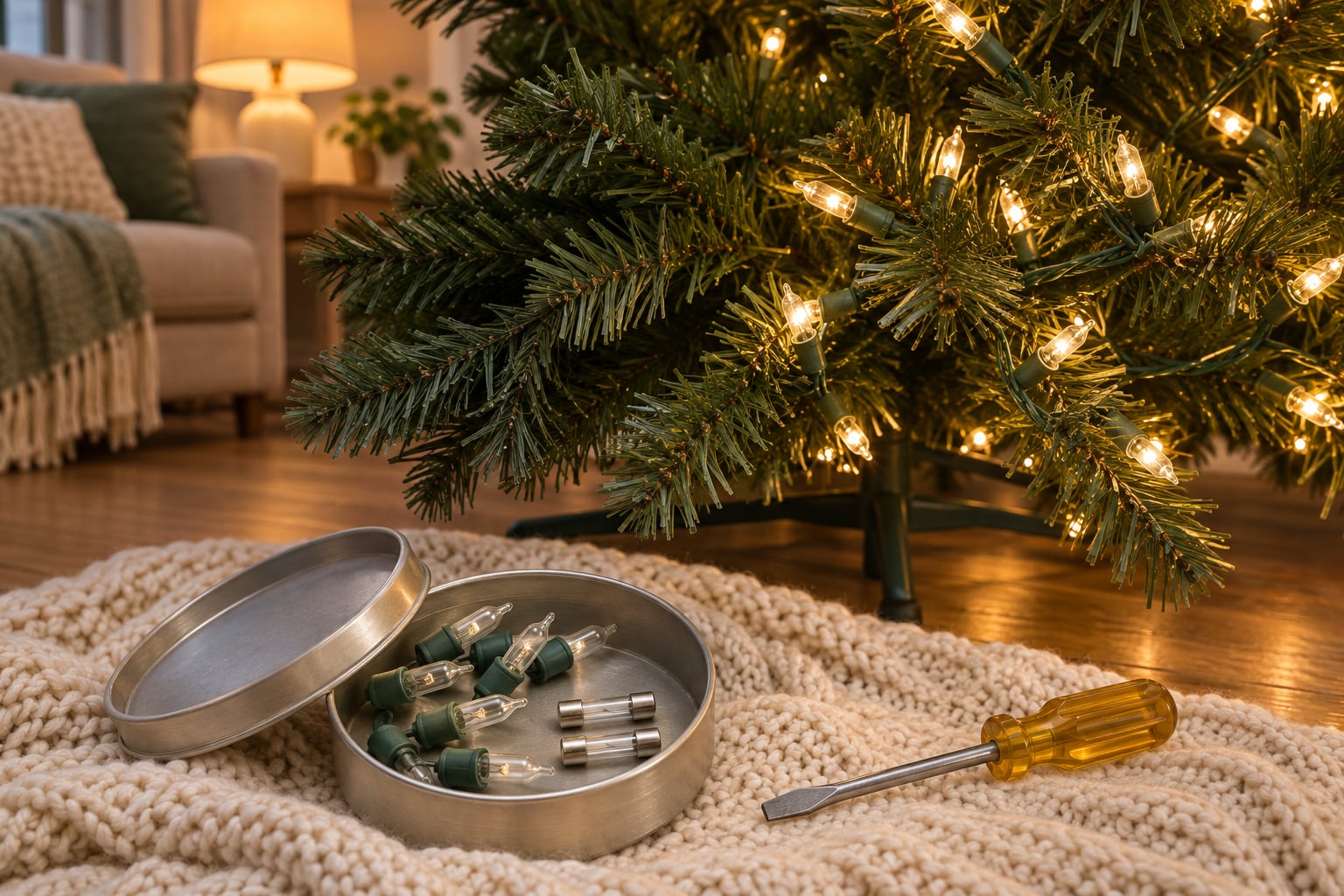
When part of a pre-lit tree stays dark, work from the quickest fix to the slowest. Check that the tree is getting power, every section is pressed all the way down, and every light plug is connected. Then check the fuses in the plugs, and only then hunt for a loose, broken, or missing bulb in the dark part. That order follows how long each check takes, not how likely each cause is. Ruling out the connections takes a few minutes; the bulb hunt can eat an evening.
What the Dark Part Tells You
| What you see | Where to look, in order |
|---|---|
| The whole tree is dark | The outlet and its GFCI reset button, if it has one; any switch, timer, foot pedal, or remote; the power adapter; the fuse in the main cord's plug |
| A section and everything above it | A second power cord that isn't plugged in, if the tree has one; the joint at the bottom of the dark part (unplug, then press the section down and turn it slightly); then the plug and fuse that feed it |
| One section or strand, with lit sections above it | That strand's plug on the pole or the section below, or a second power cord that isn't plugged in; its plug fuse; then a loose, broken, or missing bulb |
| Several strands at once, on a tree with a wiring harness | The fuses in the taped plugs on the harness |
| A patch of about 50 bulbs, often half a strand | One loop: a loose, broken, or missing bulb somewhere in it, or one whose shunt failed. If the rest of that strand is lit, it's not the plug fuse. |
| Single bulbs scattered around the tree | Burned-out bulbs. The rest stay lit, but replace them soon. |
| Lights that flicker | A bulb that isn't fully seated, or a loose section joint or plug |
| A new fuse blows as soon as you plug in | Unplug and stop. It points to a short circuit. |
Start With the Connections
Setting up and fluffing a tree tugs on its wiring, which is why Balsam Hill's troubleshooting guide says to check the plugs "before anything else."
If the whole tree is dark, start at the wall. Plug a lamp into the outlet, and if it's a GFCI outlet, make sure it hasn't tripped, as Fraser Hill Farm's manual reminds owners. Then check any timer, foot pedal, or remote (and its batteries), and make sure the power adapter is connected at both ends. If the tree runs on a timer or smart plug, press its foot switch once the power is back on. One owner on a smart-home forum found their tree "will not go back on unless I hit the foot switch." Our lights and controls guide covers remotes and app-controlled trees.
Sections connect in one of two ways. On pole-connect trees, the contacts sit inside the trunk, and the connections are "made as each section is assembled," as National Tree Company's manual puts it. On others, you join each section's cord to the next by hand. Puleo's manual says to make sure "the labels on the plugs and cord connectors match each other," and National Tree Company's connectors are keyed to fit only one way, with a nut you twist closed. Either way, if power reaches a section through the one below it, a bad joint darkens everything above it.
Bigger trees can also have a second cord. National Tree Company's manuals say trees with roughly 1,300 or more lights include an extra extension cord that "must be plugged into an electrical outlet separately," and if it isn't, the lights it feeds stay dark.
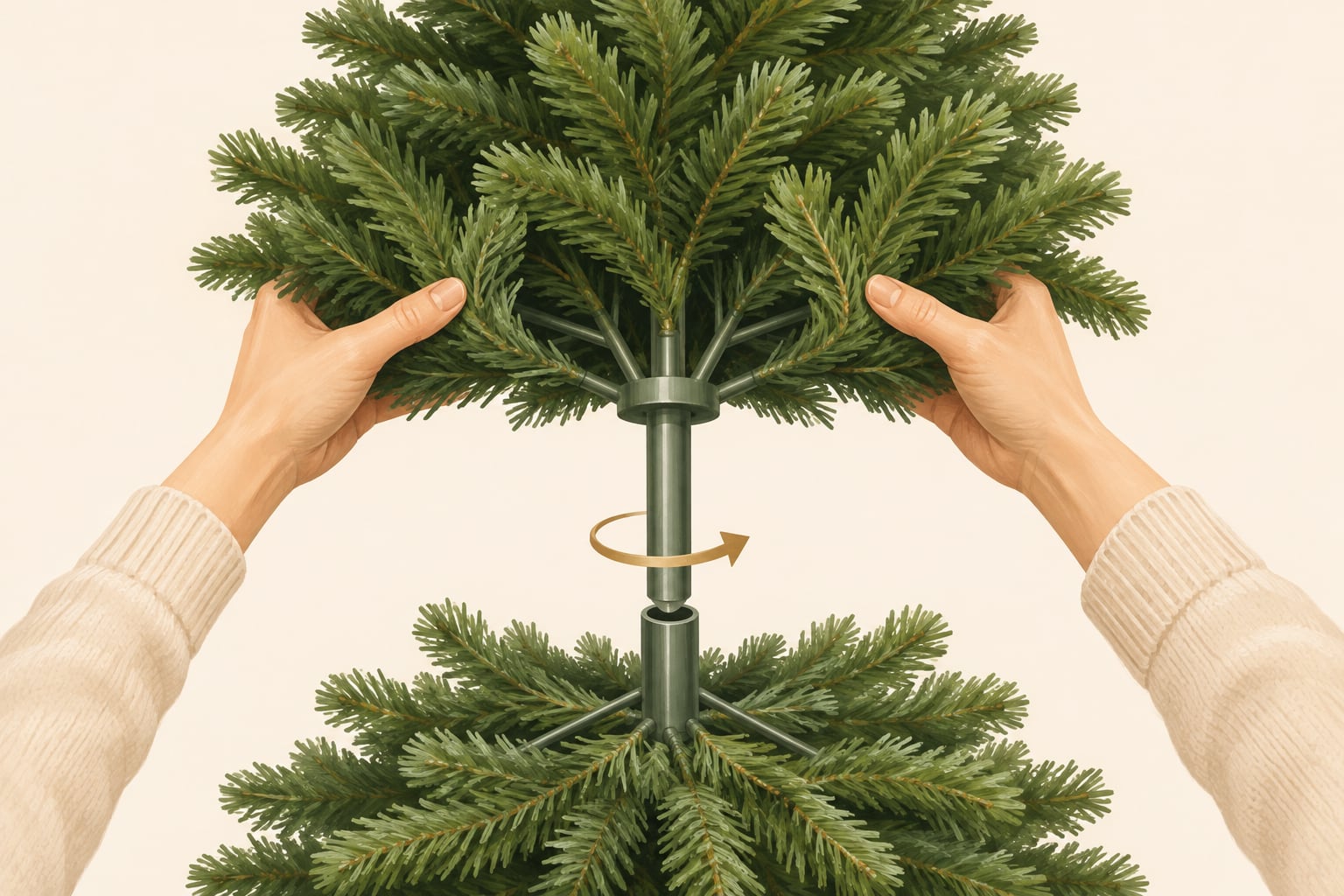
- Seat every section. Unplug the tree, lift the lowest dark section, and set it back down firmly with a slight turn. Holiday Living's manual says rotating a section slightly helps "ensure proper circuit connection if lights are not functioning."
- Follow each dark strand to its plug. Make sure it's connected at both ends and isn't "pinched between branches or stuck in a hinge," as Balsam Hill's guide puts it. Plugs tucked against the trunk are easy to miss.
- Clear flocking from the contacts. On a flocked tree, Fraser Hill Farm's manual says to make sure there's "no extra snow located in the base connectors."
- Test the section by itself. If the dark section has its own standard plug, plug it straight into a wall outlet, as Puleo's manual suggests. If it lights, the problem is in the wiring below it. Skip this on a low-voltage tree that runs from a power adapter, since Puleo warns against connecting those light sets to household power.
Then Check the Fuses
If part of a strand is dark and the rest of it is lit, skip this step. The fuses in a strand's plug feed the whole strand, so a blown one darkens all of it.
Otherwise, unplug the tree and find the right plug: the main power cord's plug if the whole tree is out, or the dark strand's own plug if one section is. Balsam Hill's fuses are "housed on the male end of the plug of each light string," and National Tree Company's manual says its fuses "are found in the light string plug." Slide the little door on top of the plug toward the prongs (a small flathead screwdriver helps) and tip the fuses out. Fraser Hill Farm's manual says a blown fuse "should fall into your hand" when you turn the plug over.
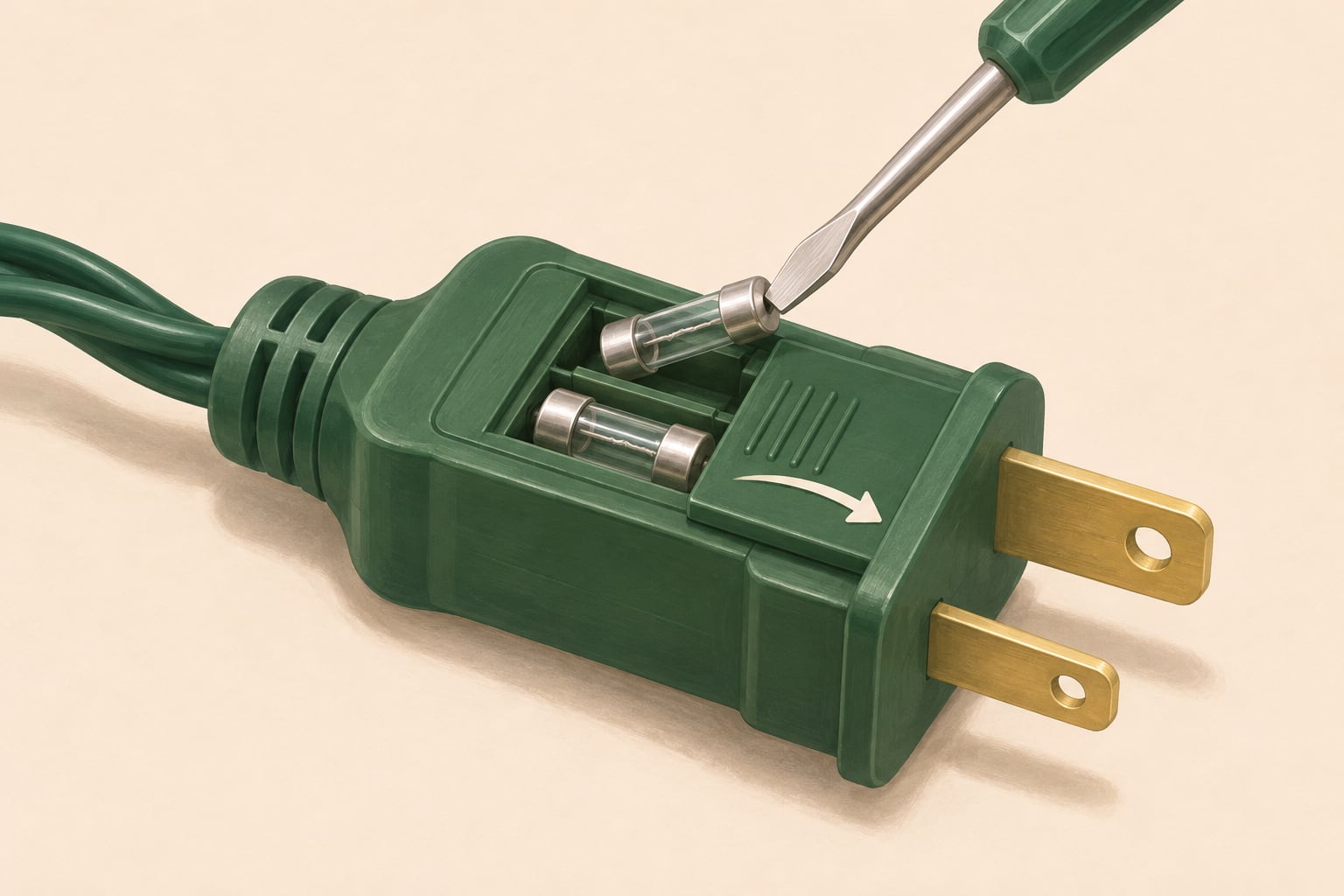
Puleo's manual says black fuses are burnt out, but if yours look fine and the section's still dark, swap in spares anyway. Plugs can hold two fuses: Balsam Hill's have "one active in a metal casing and one spare," while Puleo and Polygroup say to replace both. Spares come in the parts bag with the spare bulbs, in the plug itself on Balsam Hill's trees, or, for the main cord on Fraser Hill Farm's trees, in a holder on the cord near the plug.
Use only the rating printed on the plug or its tag. The tree manuals we read call for 3-amp, 125-volt fuses in light-string plugs and 5-amp fuses in some main cords, sometimes on the same tree. Never put in a bigger fuse to stop one from blowing; one LED tree manual's fuse warning starts with "Risk of fire."
Before you plug back in, take off anything you've added, like a lighted topper or an extra strand. Puleo's manual says a blown fuse "indicates an overload or short circuit situation," and the LightKeeper Pro manual blames overloads on "connecting too many light sets together end to end." If the new fuse blows anyway, unplug and stop. Puleo's manual says that when a replacement fuse blows, "a short circuit may be present and the product should be discarded." If the tree is under warranty, call the maker first.
On trees whose strands plug into a wiring harness along the trunk, check the harness too. Puleo's manual says a bad fuse "will normally be in the wiring harness," where it takes out several light sets at once, and that a single dark strand is very unlikely to be a fuse problem. On Puleo's trees, those plugs sit under green electrical tape, which the manual says comes off only to replace a light set or fuses. One Fraser Hill Farm manual says not to remove the harness tape at all, so check yours, and call the maker if it says no.
If the tree is new, stop here and call the maker before you start on the bulbs, since a dark section on a new tree is a warranty claim. King of Christmas goes further and asks owners to get in touch "before trying to resolve it on your own, which may void the warranty."
Then Find the Loose, Broken, or Missing Bulb
Incandescent mini lights are wired in series. Puleo's manual describes the standard set as "50 bulbs each 2.5V are connected together in one string," and the LightKeeper Pro FAQ says a 100-light set "consists of two 50 Light sections," which is why half a strand can go out on its own.
Each bulb has a shunt, a coated wire inside it that takes over when the filament burns out, so one dead bulb doesn't kill the loop, as the U.S. Department of Energy explains. But a shunt can't help if its bulb isn't making contact. In the words of Puleo's manual, "If a bulb is loose, broken or not seated properly in its socket, the 'flow' of electricity from one bulb to the next is stopped causing the entire light set to not light." The same manual says most individual light set failures are "caused by a bulb not seated properly in its socket or by a shunt failure."
So the bad bulb can be anywhere in the dark patch. Some guides say it's the first dark bulb after the last lit one, but a break anywhere in a loop darkens all of it.
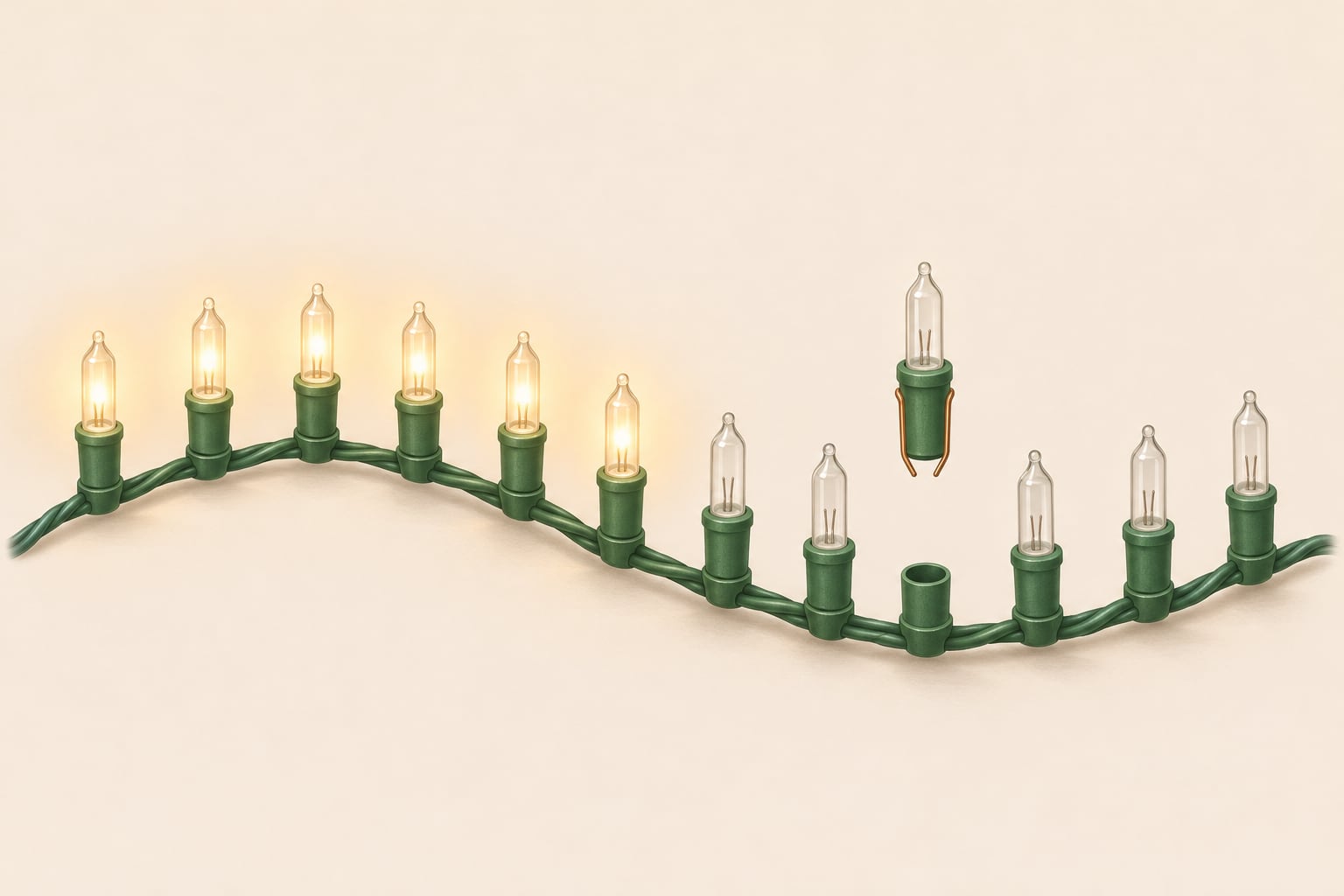
- Unplug the tree. National Tree Company's bulb instructions start there: "Unplug light string from power source."
- Look and feel. Scan the dark patch for empty sockets, broken glass, and bulbs sitting crooked or high. Holiday Living's manual says to "gently push (don't twist) each bulb firmly into the socket," but Puleo's says not to push or twist and to pull and check each bulb instead, so follow your own manual. Then plug in and test.
- Go bulb by bulb. With the tree unplugged, pull each bulb straight out (lift the lock tab first if there is one), check that its two thin wires are "straight up and flush with the base," as National Tree Company's manual puts it, and push it back in until it seats. Test every ten bulbs or so, plugging in and unplugging again before you carry on, so you know when you've passed the culprit.
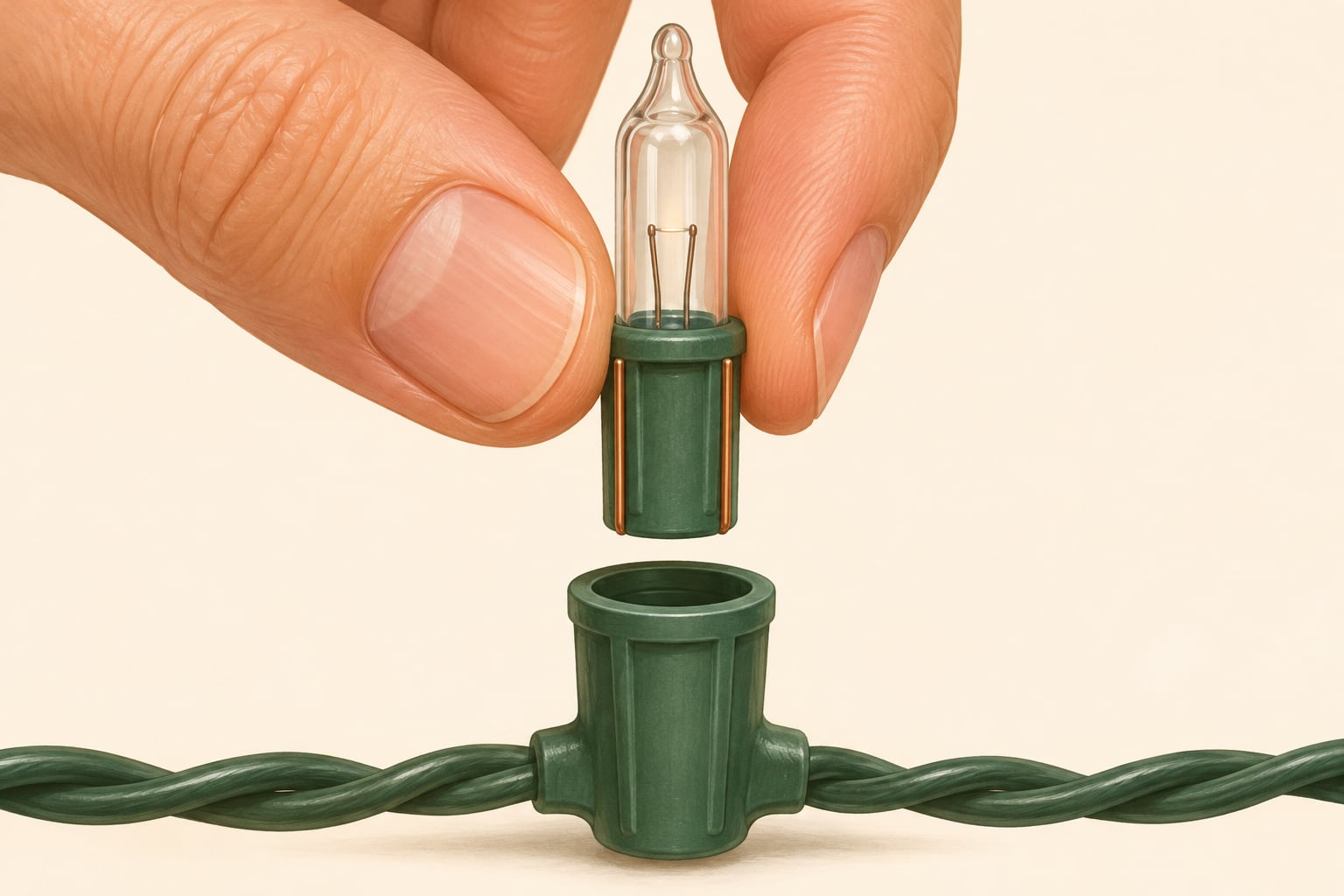
- Watch for the odd bulb. Some strands have a master bulb. Balsam Hill's guide says to look for "a bulb in a larger plastic casing" and to replace it only "with a master bulb from your replacement parts kit." Others have a "non-replaceable fused bulb," which the LightKeeper Pro manual says has "a different color ring at the base of the socket." If it burns out, the manual says, "the set is not repairable." Don't put a regular bulb in either socket. In the owner forum threads we read, strands with that bulb bypassed or swapped for a regular one ran abnormally bright, and some burned out within seconds. If the kit has no matching part, call the maker.
- Swap in a known-good bulb. If every bulb is seated and the loop is still dark, a shunt has probably failed, and that bulb looks like every other dark one. Try a spare in a lit socket to make sure it works, then swap it into each dark socket in turn (skipping any master or fused bulb), testing each time, or check each bulb with a bulb tester like the one built into the LightKeeper Pro. Use the spares from the box, or bulbs that match the voltage and wattage on the tag near the plug. The CPSC says matching the voltage prevents "dangerous overheating, melting, and possible fire."
Once the loop lights, replace any bulbs that stay dark. Puleo's manual says that when bulbs burn out, "the remaining bulbs get an increased voltage which shortens their life." A run of blackened bulbs means the loop has cascaded, with bulbs failing one after another, and the same manual says to replace every bulb in that set, with the tree unplugged. That takes more bulbs than the box holds, so order matching bulbs from the maker, or cover the section with a new strand.
What a Light Tester Can and Can't Do
A basic Christmas light tester is a non-contact voltage detector. It beeps near wire that's carrying voltage, so you run it along a dark loop and note where the beeping stops. The LightKeeper Pro manual says its detector finds "a loose bulb, broken wire, broken glass," and only on a set that isn't lit. Some basic testers are incandescent-only, so check before you buy one for an LED tree.
The LightKeeper Pro adds a bulb tester, a fuse tester, and a trigger for stuck shunts. You fit an empty socket from the dark loop into the tool, plug the tree in, and pull; each pull sends a pulse meant to close a stuck shunt. You still replace the bad bulbs afterward, since the FAQ says the tool "does not bring a bad bulb back to life." Owner reports in the forum threads we read are mixed: about as many people said it didn't help as said it fixed the strand.
The trigger "will only work in series Miniature Light sets with shunted bulbs," the FAQ says, and the manual rules out LEDs and "light sets with control boxes (including battery packs)." That covers boxes that make lights twinkle, chase, or dance, and likely the controllers on trees with remotes or timers. It can't fix a loose or missing bulb, either. The maker's LED version is meant for series LED sets, but its manual says it "cannot assist with" low-voltage sets, which it calls "most pre-lit tree designs."
So a tester is worth having for incandescent mini lights with removable bulbs, once you've pushed every bulb in the dark patch.
If Your Tree Has LED Lights
First, find out whether the bulbs come out; the tag or the manual will say. Balsam Hill's bulb guide says its standard LED bulbs "can be replaced at the bulb and strand level," but its micro LED, fairy, and app-controlled Twinkly lights can't be replaced bulb by bulb. One LED tree manual we read says "do not attempt to replace lamps or modify string."
If yours come out, the bulb hunt applies with two changes. LED bulbs work only one way round, so match each new bulb's direction to the old one's. And LEDs typically don't have shunts. A failed LED "typically short circuits," as the Department of Energy explains, so one dead LED often leaves the rest lit, but not always, and a loose or missing one darkens its loop. Check every bulb in the dark patch.
If the bulbs are sealed, what you can fix is everything outside the strands: section joints, plugs, fuses, the power adapter, and any controller, foot pedal, or remote. Use only the adapter the tree came with, or the maker's matching replacement. Polygroup's manual for one low-voltage tree warns that a different adapter "will damage the lights and may cause fire, or electrical shock hazards," and Puleo notes that "a 29V tree needs a 29V adapter." If all of that checks out, the strand itself has failed, and that's a warranty call.
When to Stop and Call the Maker
Among the warranties we read, light coverage runs three years at Balsam Hill (excluding burned-out bulbs, and 60 days on clearance trees) and at National Tree Company on trees 6.5 feet and taller, once you register the tree; two years at King of Christmas; two or three at Puleo, depending on the lights; and one year at Fraser Hill Farm. Our setup and warranty guide covers what warranties usually leave out.
Reseating, fuse swaps, and bulb swaps from the parts kit are in the troubleshooting instructions from Balsam Hill, National Tree Company, and Puleo. Going further can cost you coverage. Balsam Hill's warranty page asks owners not to attempt self-repair "other than as shown in instructions that we have provided," King of Christmas asks owners not to attempt repairs outside its own instructions, and National Tree Company's warranty says "removing factory attached functioning or nonfunctioning light strings from any section of your pre-lit tree will void the warranty."
Before you call, take photos of the lit tree with the dark section showing, plus close-ups of any broken or unlit bulbs, which is what King of Christmas asks for, and find the receipt. Don't count on a quick fix in December. National Tree Company's warranty says it does warranty repairs only "between January 15th and September 15th," and Balsam Hill warns that parts availability "can change rapidly during the months of November and December."
Some problems mean you stop using the lights rather than fix them: a replacement fuse that blows right away, cracked sockets, or frayed or bare wire. The U.S. Fire Administration says to "throw away light strands with frayed or pinched wires," and the CPSC says to "throw out damaged sets." On a pre-lit tree, unplug it and call the maker.
Replacing or Covering a Dead Section
When a strand can't be saved, ask the maker for a replacement light set or section. Balsam Hill says it may send a "user-installable part," King of Christmas lists part and section replacements among its warranty resolutions, and Puleo's manual shows how to swap a set: "plug the new light set into the wiring harness" where the old one was, and wrap it on the branches the same way. Parts can outlast the warranty, too. Balsam Hill says "you can buy Christmas tree replacement parts if your product warranty has expired," and National Tree Company says replacement parts "are available for select items."
If a replacement won't arrive in time, leave the dead strand in place and weave a new strand over that section. That's far less work than stripping it, which owners in the forum threads we read put at one to six hours, and it keeps you clear of warranty terms like National Tree Company's. Match the light color, bulb size, and color temperature, and use about as many bulbs as went dark, which is roughly 50 per dark loop.
Give the new strand its own power, from a wall outlet or a power strip. Puleo's manual says not to connect extra light sets "to the existing light sets on your pre-lit tree." Don't plug anything into the taped-over outlets on a wiring harness, either. One Fraser Hill Farm manual warns that "exposing and using the outlets covered on the harness may cause a fuse to blow or a circuit overload that could result in a fire." Our post on how many lights a tree needs covers adding strands to a pre-lit tree.
If you're on your third dead section, our pre-lit vs unlit comparison covers how long pre-lit lights tend to last.
Pre-Lit Tree Light Questions
Why did half of my pre-lit tree stop working?
One circuit lost power. Check, in order, for a section that isn't fully seated, a light plug or second power cord that came loose, a blown fuse in that strand's plug (or in the taped plugs on the wiring harness, if several strands are out), and a loose, broken, or missing bulb in the dark patch. If part of one strand is dark and the rest is lit, skip the fuse, since the plug's fuses feed the whole strand. A bad contact anywhere in a loop of about 50 bulbs darkens all of it, so the culprit isn't necessarily next to the last lit bulb.
How do you find the bad bulb in Christmas tree lights?
Unplug the strand and check the dark loop for empty sockets, broken glass, and bulbs sitting high or crooked. Then pull and reseat each bulb, making sure its two wires lie straight and flat against the base, and test every ten or so. If the loop still won't light, a shunt has probably failed: swap a spare you know works into each socket in turn, skipping any master or fused bulb, which needs its own matching part, or check each bulb with a bulb tester. On incandescent sets, a tool like the LightKeeper Pro can also try to close the stuck shunt.
Where is the fuse on a pre-lit Christmas tree?
In the plugs: the main power cord's plug, each light string's plug on many trees, and the taped plugs along the trunk on trees with a wiring harness (check the manual before removing that tape). Unplug the tree, slide the small door on top of the plug toward the prongs, and tip the fuse out. Replace it only with one of the same rating; the manuals we read call for 3-amp fuses in light-string plugs and 5-amp fuses in some main cords. If the new fuse blows too, stop, since that points to a short circuit.
Do Christmas light testers work on LED trees?
Mostly not. The LightKeeper Pro's maker says its repair trigger only works on incandescent mini lights with shunted bulbs, not LEDs or sets with control boxes, and its LED version's manual excludes low-voltage sets, which it calls most pre-lit tree designs. On an LED tree, check the connections, fuses, power adapter, and any removable bulbs, then contact the maker.
Can you replace the lights on a pre-lit Christmas tree?
Bulbs, often, using the spares that came with the tree, though some can't be replaced one at a time; Balsam Hill's micro LED and fairy lights are examples. For a whole strand, ask the maker for a replacement light set first. Otherwise, weave a new strand over the dead section on its own power. Check the warranty before cutting anything, since National Tree Company's says removing factory light strings voids it.