
Balsam Hill's top-tier trees are worth the money if realism is the reason you're shopping and you'll keep the tree long enough to spread out the cost. The clearest example is the Vermont White Spruce, the only tree from Balsam Hill's own line that we've reviewed and the highest-scoring tree in our catalog: mostly molded PE tips, sturdy sub-branched limbs, heights from 4.5 to 18 feet, and a three-year warranty that covers the lights.
It's harder to justify if you want a tree that looks finished an hour after it comes out of the box, if you need warm white factory lights, or if ornaments will hide most of the needles. The Vermont White Spruce takes an afternoon of fluffing the first year, its clear LEDs read neutral white, and a few memory-wire trees in our catalog nearly match or beat its PE share for much less money and less fluffing. The verdict here rests on that tree, two cheaper trees sold under the Tree Classics by Balsam Hill name, and Balsam Hill's published policies.
What the Balsam Hill Premium Buys
More of the tree is molded PE
True Needle is Balsam Hill's name for molded polyethylene (PE) tips. Like other molded PE, the needles are rounded and three-dimensional instead of the flat strips on a traditional PVC tree. Our guide to PE, PVC, and build quality shows the difference. The rest of the tree is flat filler that Balsam Hill calls Classic Needle. Its pages describe that filler as PVC in some places and PET in others; either way, it's the flat plastic needle you'd find on a traditional tree.
Balsam Hill sorts its trees into three realism tiers: Most Realistic, Realistic, and Traditional. Its main tree page says it crafts its "most realistic trees with at least 65% of our patented True Needle foliage." Realistic trees mix in more filler, and Traditional trees have no PE at all. The Vermont White Spruce's current product page doesn't give a percentage, but an older Balsam Hill product showcase for business buyers listed it at 80% True Needle. We put it at 70% PE or more, with PE on the outer branches where you see it and PVC deeper inside for fullness.
Sturdy branches, and a lot of fluffing
On the Vermont White Spruce, each branch splits into three sub-branches you can position separately, and the branches angle upward, so they hold heavy ornaments without drooping. That structure is a big part of why the tree looks deep instead of flat once it's fluffed.
It's also why fluffing takes so long. The Vermont White Spruce has no memory wire, so every tip gets bent into place by hand. Balsam Hill's fluffing guide tells owners to plan on two people and two to three hours the first time, and our review budgets two to four hours for the Vermont White Spruce, depending on its size. Taste of Home's testers, who tried three Balsam Hill trees, called it the brand's one weak spot: "The only downside is that Balsam Hill trees require a lot of fluffing."
Memory wire springs branches back to a preset shape, which cuts the work by very different amounts from tree to tree; our review of the Elegant Grand Fir found it needs none at all. Balsam Hill sells some memory-wire trees under the name Pre-Fluffed, but we haven't reviewed one. Our fluffing guide has the method for any tree.
More sizes and shapes than any other tree we've reviewed
The Vermont White Spruce comes in heights from 4.5 to 18 feet, in full, slim, and wide shapes. No other tree in our catalog comes in more than five heights, and most come in a single shape. That matters if you have a tall ceiling, a narrow spot, or a big room to fill.
Some Balsam Hill trees, the Vermont White Spruce included, also come as a Flip Tree. The base rolls into place and the lower part of the tree flips up, so there's far less lifting, and you add the top. Taste of Home's testers haven't found an easier tree to set up, though theirs still had "some pretty noticeable gaps" to fill by hand. The cheaper Classic Fraser Fir below offers a similar rolling, flipping base in some sizes.
Lights you can switch
The Vermont White Spruce's lights connect through the trunk, which Balsam Hill calls Easy Plug, the same trunk wiring plenty of brands use. Its Color+Clear lights switch between clear, multicolor, or both. That's handy, but switching between white and multicolor is common in our catalog, including on some of the cheaper trees below, so it isn't much of a reason to pay more by itself. On the 7.5-foot Vermont White Spruce that's 1,440 LEDs, controlled by a remote and a foot pedal that both dim. The tree also comes unlit if you'd rather choose your own lights, and Balsam Hill sells some other trees with Twinkly app-controlled lights.
A three-year warranty that covers the lights
Balsam Hill's warranty page gives regular and sale-priced trees a three-year limited warranty on the frame, foliage, hinges, stand, and factory-installed lights, though not burned-out bulbs. Trees bought on clearance get the same coverage for only 60 days. A sale price alone doesn't shorten it, so if you shop the after-Christmas markdowns, check whether a tree is listed as on sale or on clearance. Our guide to the best time to buy covers that tradeoff. The warranty applies only to the original owner, so a secondhand tree has none.
The return window is short. Balsam Hill's order help page takes returns within 30 days of delivery or before December 25, whichever comes first, and deducts the return label fee from your refund unless the tree arrived damaged or defective. Set the tree up soon after it arrives, while there's still time to report a problem.
Three years is solid, but it isn't rare. Some Ashland, Holiday Living, and Philips trees in our catalog list three years too, and the two Tree Classics by Balsam Hill models we've reviewed list two. If an older review mentions a ten-year Balsam Hill warranty, that was a policy for some collections that ended in 2018.
Where the Marketing Outruns the Trees
A few of Balsam Hill's claims need a closer read.
- "Most realistic" depends on which page you read. Most Realistic is the name of Balsam Hill's top tier, which covers several trees. Two product claims go further. The Vermont White Spruce's product page calls it "our most realistic artificial evergreen tree," while Balsam Hill's main tree page says "the BH Fraser Fir is our most realistic Christmas tree to date." They may both be lovely trees, but only one of them can be the most realistic.
- "Up to 65%" is a ceiling. Balsam Hill's clearance page describes many of its trees as containing "up to 65% True Needle foliage mixed with proprietary PET needles for fullness." A tree described that way could have far less PE. If realism is why you're paying more, buy from the Most Realistic tier, or ask Balsam Hill for the specific tree's percentage.
- "Warm white" isn't always warm. Balsam Hill's guide to its lights describes Color+Clear as "warm white, color, or both." Our Vermont White Spruce review found its clear LEDs neutral white rather than warm, with multicolor that leans a little cool. Running both modes together warms the overall look, but it still doesn't read as warm white.
- "Pre-fluffed" doesn't mean finished. The Deluxe Noble Fir, sold under the Tree Classics by Balsam Hill name, has memory wire and a pre-fluffed pitch, and owners do report quick setups. Some also report gaps in the middle that wouldn't close no matter how they bent the branches.
Where Are Balsam Hill Trees Made?
Balsam Hill designs its trees in California, and most of them have been made in China. Answering readers on its own blog several years ago, the company wrote, "Most Balsam Hill products are designed in California, manufactured in China, and warehoused throughout the United States."
That's shifting. In November 2025, founder Mac Harman told NBC News that "around a third of Balsam Hill's trees will come from outside of China" that season, and told NPR that production had spread to Mexico, Indonesia, and other parts of Southeast Asia. He also said pre-lit artificial trees have never been made in the U.S.; their lights are attached by hand. Balsam Hill's current FAQ says only that its trees are designed by its California team and "crafted using globally sourced materials," so if the country matters to you, ask before you order.
The Balsam Hill Trees We've Reviewed
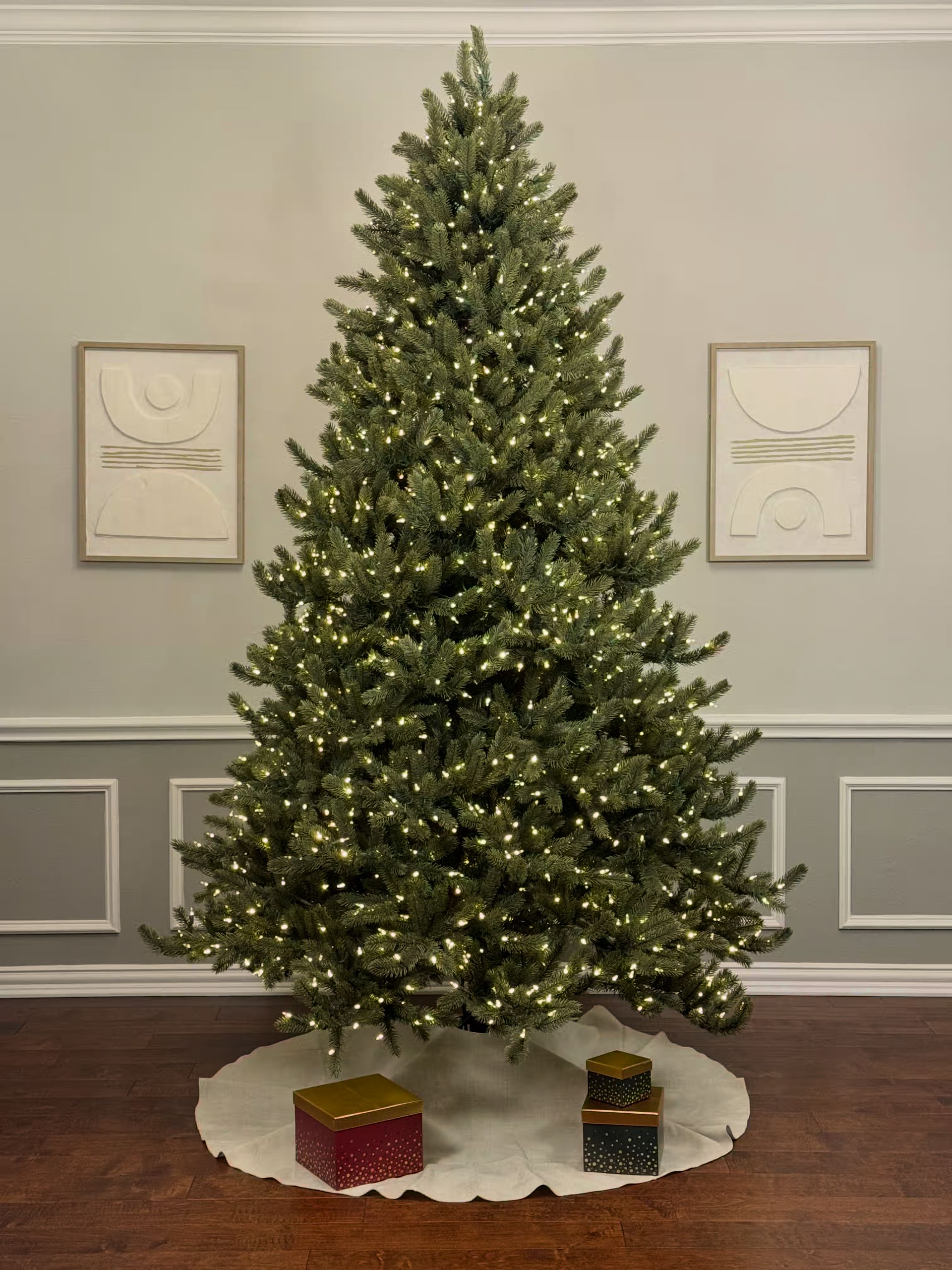
Most of what's above comes from this tree. Two practical costs haven't come up yet: the 7.5-foot tree ships in two boxes and weighs 71 pounds, and owners report that the storage bags are tight to repack once the tree has been fluffed.
Tree Classics by Balsam Hill is a different build
Trees labeled Tree Classics by Balsam Hill come from a wholesale line sold through other retailers, and our two reviews show the gap. The Classic Fraser Fir is 50% PE, with 1,671 tips and 700 LEDs at 7.5 feet. We call it an honest middle ground: realistic outer needles, with PVC you can see up close, for buyers who want some PE realism without the premium. The Deluxe Noble Fir has an estimated 60% PE and memory wire, but its upswept needle clusters split opinion, and some owners report lights shorting out within weeks. Our review questions its value, since the Yorkshire Fir costs less and has more than twice the tips per foot.
Both score well below the Vermont White Spruce in our catalog. The Balsam Hill name on the box doesn't get you the Vermont White Spruce's build.
What Testers and Owners Report
Taste of Home's testers came away convinced on realism: "If realism is your top concern, look no further than Balsam Hill." Owner ratings are harder to read. On Trustpilot, Balsam Hill had a 4.3 TrustScore from about 46,700 reviews when we checked in November 2026, with 70% five-star and 12% one-star ratings. The five-star reviews we read were mostly about easy ordering and fast delivery, which tells you more about the shopping than about how a tree holds up.
The complaints we read there and on complaint sites fall into a few groups: pre-lit sections going dark after a few seasons, replacement bulbs that are hard to find, shipping damage, and customer service that gives conflicting answers. Complaint sites skew much more negative, and none of it tells you how often a tree fails, only what goes wrong when one does.
Our Vermont White Spruce review found owners describing years of reliable use, alongside scattered reports of light strands failing. Once the warranty runs out, a dark section usually means troubleshooting or running a separate strand over it. Our pre-lit vs unlit guide covers what to do when a section goes dark, and the case for buying unlit if that risk bothers you.
Who Should Skip the Vermont White Spruce, and What Comes Close
Skip the Vermont White Spruce if you want the tree finished in under an hour, need warm white LED lights, are short on storage space, or plan to cover it so thoroughly that the needles won't show. If ornaments will hide most of the tree, our realism guide's advice applies: save on PE and put the money into a sturdy frame.
If you want most of the realism with less fluffing, these memory-wire trees from our catalog are the nearest matches:
| Tree (7.5 ft) | PE share | Memory wire | White light |
|---|---|---|---|
| Vermont White Spruce | 70% or more | No | Neutral white, dimmable |
| Yorkshire Fir | About 69% | Yes | Warm white, dimmable |
| Eastcastle Balsam Fir | About 69% | Yes | Bright and cool, no dimmer |
| Elegant Grand Fir | 100% | Yes | Warm white only |
- The Yorkshire Fir is the strongest alternative, and it scores second only to the Vermont White Spruce in our catalog. It answers the Vermont White Spruce's two main drawbacks with memory wire and true warm white LEDs. Its fine needles and dark green color don't suit everyone, and its 62-inch base needs a wide spot.
- The Eastcastle Balsam Fir is the fullest of the three, with PE outside and dense PVC inside. Its lights are the problem: bright, cool, and not dimmable.
- The Elegant Grand Fir is all PE and needs no fluffing, but it's only moderately full, its branches struggle with heavy ornaments, and owners report lights dimming or failing after a season or two.
All three cost far less than a comparable Balsam Hill tree, and none matches the Vermont White Spruce's range of sizes and shapes. Our most realistic trees roundup ranks them side by side.
Balsam Hill Questions
Is Balsam Hill worth the money?
For its top-tier trees, yes, if you want a very realistic tree and will keep it for years. The Vermont White Spruce, the only tree from Balsam Hill's own line we've reviewed, pairs a high PE share with sturdy limbs that hold heavy ornaments and more sizes than any other tree in our catalog. If you'd rather skip a long first fluff or need warm white light, a memory-wire tree like the Yorkshire Fir costs much less. Sale-priced Balsam Hill trees keep the full three-year warranty; clearance trees get 60 days.
Are Balsam Hill trees all PE?
No. Even the top tier mixes molded PE tips, which Balsam Hill calls True Needle, with flat filler needles. Balsam Hill says its Most Realistic trees are at least 65% True Needle, and its Traditional trees use none. The Vermont White Spruce's product page doesn't give a percentage; we put it at 70% or more, and an older Balsam Hill sheet for business buyers listed 80%.
How does Balsam Hill compare with National Tree Company?
National Tree Company is a mid-range brand whose lineup runs from all-PVC trees to trees with molded PE tips it calls Feel Real. Its warranty terms are narrower: its FAQ lists three years on trees 6.5 feet and taller (two if flocked, one if white), the warranty takes effect only once you register the tree, and warranty replacements are processed only between January 15 and September 15. Its own store takes change-of-mind returns only on trees that are unused and unassembled, minus a restocking fee. Balsam Hill's three years applies to any regular or sale-priced tree. On realism, compare specific trees on PE share, memory wire, and light color. We haven't reviewed a National Tree Company tree yet, so we can't make a model-by-model call.
How long do Balsam Hill trees last?
Longer than the three-year warranty, with care. Our Vermont White Spruce review expects 10 years or more from that tree. The lights are usually the first thing to go, and how long they last depends on handling and storage.