
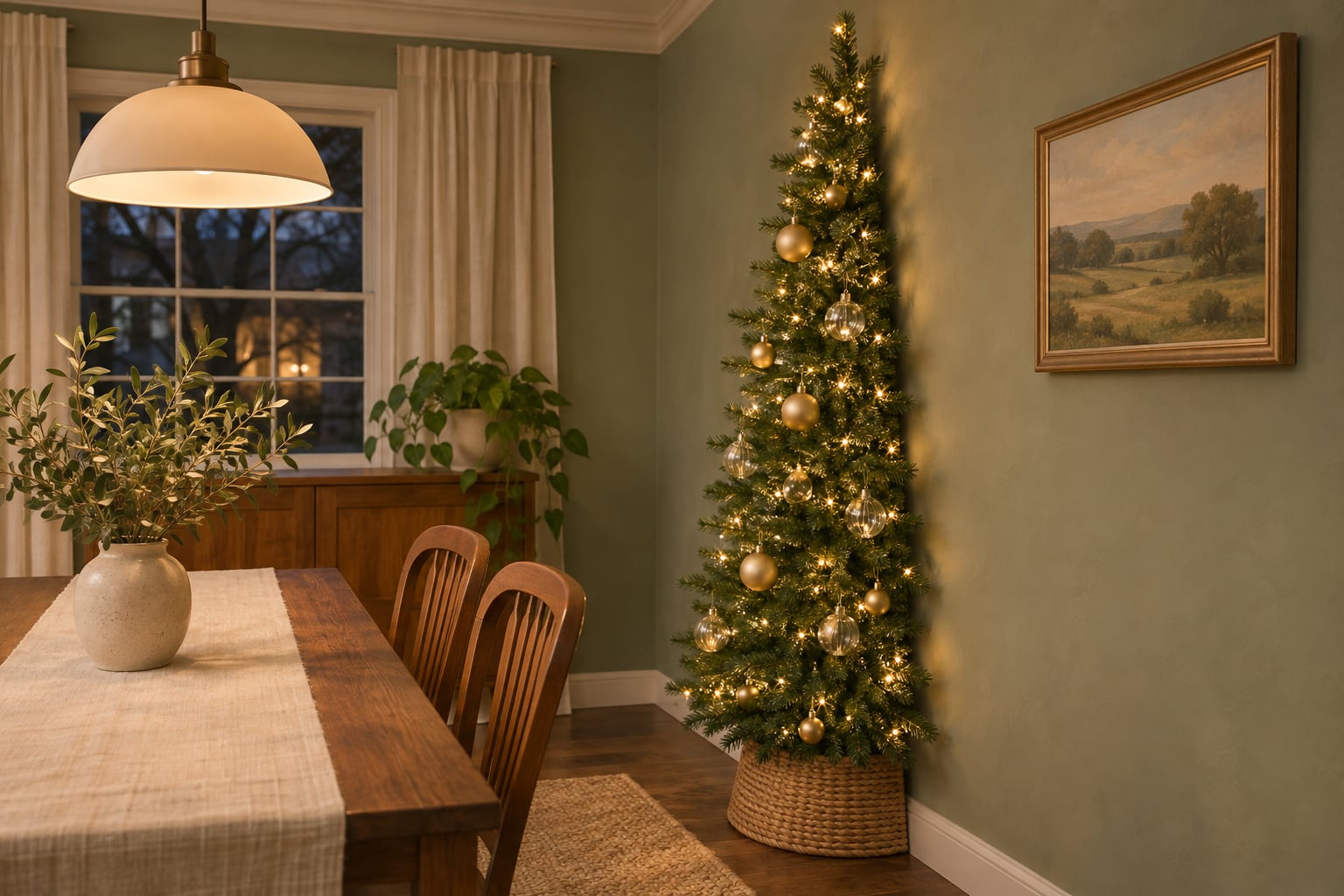
A half Christmas tree, also sold as a flat-back or wall tree, is an artificial tree with branches across the front and none at the back, so it stands flush against a wall. It reaches about half as far into the room as a round tree of the same width. Full 7.5 ft trees are typically 50 to 56 inches wide, so a 7.5 ft half tree that wide sticks out about 25 to 28 inches, less than most pencil trees.
What it doesn't save is wall. A half tree needs its full width along the wall, all of its branches and decorations hang in front of the pole, and from the side it looks like half a tree. It's the right call for a long, shallow spot that people face head-on. If the wall is short, or people will see the tree from the side, a slim or pencil tree fits better. For an empty corner, a quarter tree tucks right in, and a half tree can stand across it. Our catalog doesn't include half, flat-back, or corner trees, so the numbers here come from makers' listings and the full trees we track.
Half, Flat-Back, and Wall Trees
Makers use "half tree," "flat-back tree," and "wall tree" for the same shape. Balsam Hill, which calls its version a flatback, says its flat-back trees "rest easily against the wall, creating the illusion of a full tree when viewed from the front," and describes it as "the same trick used in television and movie sets." Fair enough, as long as nobody walks around the set.
Check two numbers before you buy: the width along the wall and the depth out from it. Listings don't always make clear which is which. One 6.5 ft half tree was listed at 43 inches wide and 22 inches deep, about what the shape predicts. Another maker lists its 7 ft flat-back tree at 43 by 43 inches, which can't both be right for a tree with a flat back, and a third gives a single 19-inch width for its 6 ft flatback, the same figure it lists for the box the tree is stored in. If a listing gives one number, find out which one it is before you measure.
Wall-hanging flat trees are a different product. They hang on the wall instead of standing on the floor, and the ones we found run about 2 to 4 feet tall, more a decoration than the room's tree.
How Much Room a Half Tree Saves
The trade is easiest to see at one height. This compares a full 7.5 ft tree 52 inches wide, near the middle of the typical range, with half and quarter trees cut from it and with mid-range slim and pencil trees.
| 7.5 ft tree | Reaches into the room | Wall it blocks | Floor under the branches |
|---|---|---|---|
| Full, 52 in wide | 52 in | 52 in | About 14.7 sq ft |
| Half or flat-back | 26 in | 52 in | About 7.4 sq ft |
| Quarter corner tree | 26 in from each wall | 26 in on each wall | About 3.7 sq ft |
| Slim, 36 in wide | 36 in | 36 in | About 7.1 sq ft |
| Pencil, 30 in wide | 30 in | 30 in | About 4.9 sq ft |
The half and quarter rows are simple geometry: half and a quarter of the full tree's circle. Real trees vary, so measure against each listing.
A half tree's advantage is the shape of the floor it covers, not the amount. It takes about as much floor as a 36-inch slim tree, stretched along the wall instead of out into the room. So it wins where depth is what you're short of: the wall facing the sofa in a narrow living room, or a dining room where the chairs need room to pull out. Where the wall is short, the slim tree wins.
Leave some room around it, too. Our Christmas tree size guide adds about a foot to a tree's width for floor space, 6 inches on each side, so plan on the tree's width plus about a foot of wall and about 6 inches more depth. The same guide covers how tall a tree your ceiling takes, including room for a topper.
Where a Half Tree Looks Right
Straight on, a half tree's outline matches a full tree's, and Balsam Hill's "illusion of a full tree" depends on it sitting flush against the wall. From the side, the outline drops straight down at the back like a tree cut down the middle. A 2017 news story said half trees "look like they're not finished, or as if they've been chopped in two," and from that angle it's hard to argue. So put it where people face it: across from the sofa, at the end of a hall, on the wall you see as you walk in.
A few spots work against it:
- A wall you walk along. You'll see it edge-on every time you pass.
- A front window. With its flat back to the glass, the view from the street is the back of a half tree.
- The end of a wall by a doorway. Anyone coming through the door sees the side.
Fluffing goes faster with no back to do, but give the branches at the two ends extra care, since those are the ones people see at an angle. Our fluffing guide has the method.
Check what's on that wall, too. The U.S. Fire Administration says to keep a tree at least 3 feet from heat sources such as "radiators, space heaters, candles or heat vents," which rules out a stretch of wall over a baseboard heater or beside a floor vent. Our small-apartment guide covers the rest of picking a spot, including outlets and exits.
Keeping a Half Tree From Tipping
Every branch, light, and ornament on a half tree hangs in front of the pole, so it's front-heavy. One owner's review of a Balsam Hill flatback puts it plainly: "As this tree is all front-heavy it will naturally want to fall forward." An owner review quoted in that 2017 news story called one a "lovely half tree with plenty lights" but said it "leans when all decs are on it," decs being decorations.
Don't count on the box to solve it. That owner's tree, a UK model, came with a safety strap: a screw goes into the wall and the strap goes around the trunk. Balsam Hill's current 6 ft flatback lists no strap among what's in the box, and its setup manual has you spread the stand's legs into a T shape and says nothing about the wall. Plan to steady it yourself:
- Lean it back a touch. With a stand that clamps the pole with a bolt, that owner tilts the tree back slightly toward the wall before tightening the bolt, which they say keeps it more upright.
- Tie the pole to the wall. The American Veterinary Medical Association, whose concern is pets climbing trees, suggests tying a tree "to the ceiling or a doorframe using fishing line." For a half tree, the wall right behind it is closer. Put a small screw eye in the wall behind the tree, into a stud if one is there or a wall anchor if not, and tie the bare pole to it with cord or a soft strap, snug without pulling the tree back. Tie below the top section, not to it: the top section lifts straight out of the one under it, so a tie there holds nothing. Keep the tie off the light wires and plugs: Balsam Hill's manual warns against supporting light strings "in a manner that can cut or damage wire insulation."
- Hang heavy ornaments low and near the pole. Every ornament adds to the forward weight, and the heavy ones do the least harm low and deep.
Lights and Ornaments on a Half Tree
A pre-lit half tree puts all its lights on the side you see, so its light count looks low until you double it. Balsam Hill's 6 ft Fifth Avenue Flatback lists 250 lights, about 42 per foot of height. Double that, as if the lights ran all the way around, and it's about 83 per foot, inside the classic range in our guide to how many lights a tree needs.
For an unlit half tree, take that guide's count for a full tree of the same height and halve it. You can't wrap strands around a half tree, so run them back and forth across the front instead, starting at the bottom with the plug end near the outlet, and light each tree section separately so the tree still comes apart. With the outlet on the same wall, the cord can run along the baseboard instead of across the floor.
Ornaments work the same way: about half as many as a full tree takes, all of them where people look. Hang some on the outer tips and some a layer deeper so the front has depth.
Corner Trees: Half, Quarter, or Three-Quarter
"Corner tree" is the loosest name of the lot. Sellers use it for half trees, quarter trees, 270-degree trees, and plain slim trees, and even Balsam Hill's corner tree page lists its shape as "Flatback Tree." Go by the shape and both measurements, not the name.
A quarter tree is the one built for a corner. Balsam Hill describes its corner trees as "quarter wedges of our traditional full trees," with "two flat sides" that fit into a corner, and says its 7 ft corner tree uses "just a quarter of the space" of a full tree. Cut from a 52-inch tree, a quarter tree runs about 26 inches along each wall. It's the smallest footprint in the table above and the least tree to decorate, so it suits an empty corner you see from the front. In the listings we looked through, quarter trees were also the hardest to find.
A 270-degree tree is a round tree with the back quarter left off. One 8 ft model, 3.7 feet wide, is pitched as a "three-quarters shape" that "fits snugly into corners." Think through the geometry before you buy one for that. With the gap facing the corner, the branches on either side of it still point straight at the walls, so the trunk ends up as far from each wall as a round tree's would. What it leaves out is the wedge behind the tree that nobody sees, so it looks full from anywhere in the room, but it doesn't save any floor you can use. Judge it by its width, the way you'd judge a slim tree.
A half tree can go in a corner too, set across it with the flat back facing the corner. Cut from a 52-inch tree, it touches each wall about 37 inches from the corner and reaches about 44 inches out from each wall, against 52 for a round tree of the same width.
Slim and pencil trees turn up in corner-tree listings too. They're round, so in a corner they need as much room along each wall as they are wide.
When a Slim Tree Is the Better Pick
A half tree is a specialist. A slim or pencil tree usually fits better when:
- The wall is short. Between a door and a window, a 30-inch pencil tree fits where a half tree cut from a 52-inch tree won't.
- People will see it from the side, from another room, or from outside.
- You'd rather not drill. A round tree's weight sits over its stand instead of in front of it.
- You might move. A half tree only works against a wall, and the next living room may not have the right one.
Our catalog has slim and pencil trees, and the small-apartment guide picks out the ones we'd look at first for a tight room.
Half Christmas Tree Questions
Is a flat-back tree the same as a half tree?
Yes. "Half tree," "flat-back tree," and "wall tree" all describe an artificial tree with branches across the front and a flat back that stands against a wall. "Corner tree" is looser: sellers use it for half trees, for quarter trees with two flat sides that fit into a corner, and for 270-degree and slim trees.
How deep is a half Christmas tree?
About half as deep as it is wide. One 6.5 ft half tree was listed at 43 inches wide and 22 inches deep, and a 7.5 ft half tree as wide as a typical full tree, 50 to 56 inches, would reach about 25 to 28 inches from the wall. Make sure a listing gives both numbers.
Do half Christmas trees tip over?
They can lean or tip forward, because all of the branches and ornaments hang in front of the pole, and owners report them leaning once they're decorated. Tie the bare pole to the wall behind the tree with cord or a soft strap, clear of the light wiring, and hang the heaviest ornaments low and close to the pole.
Can you turn a regular artificial tree into a half tree?
Sometimes. If the branches hook into the pole, as on some older trees, you can leave the back ones out. On a pre-lit tree, the lights run through every branch, so you'd have to strip them first. One DIY blogger did exactly that after a strand of lights failed, and found the stand "still fully supports" the tree, adding that "it may help that it rests all the way in the corner of the room." On an unlit tree with hinged branches, leaving the back ones folded up against the pole gets it closer to the wall, though not flat. Either way, the tree ends up front-heavy, so tie it back.