
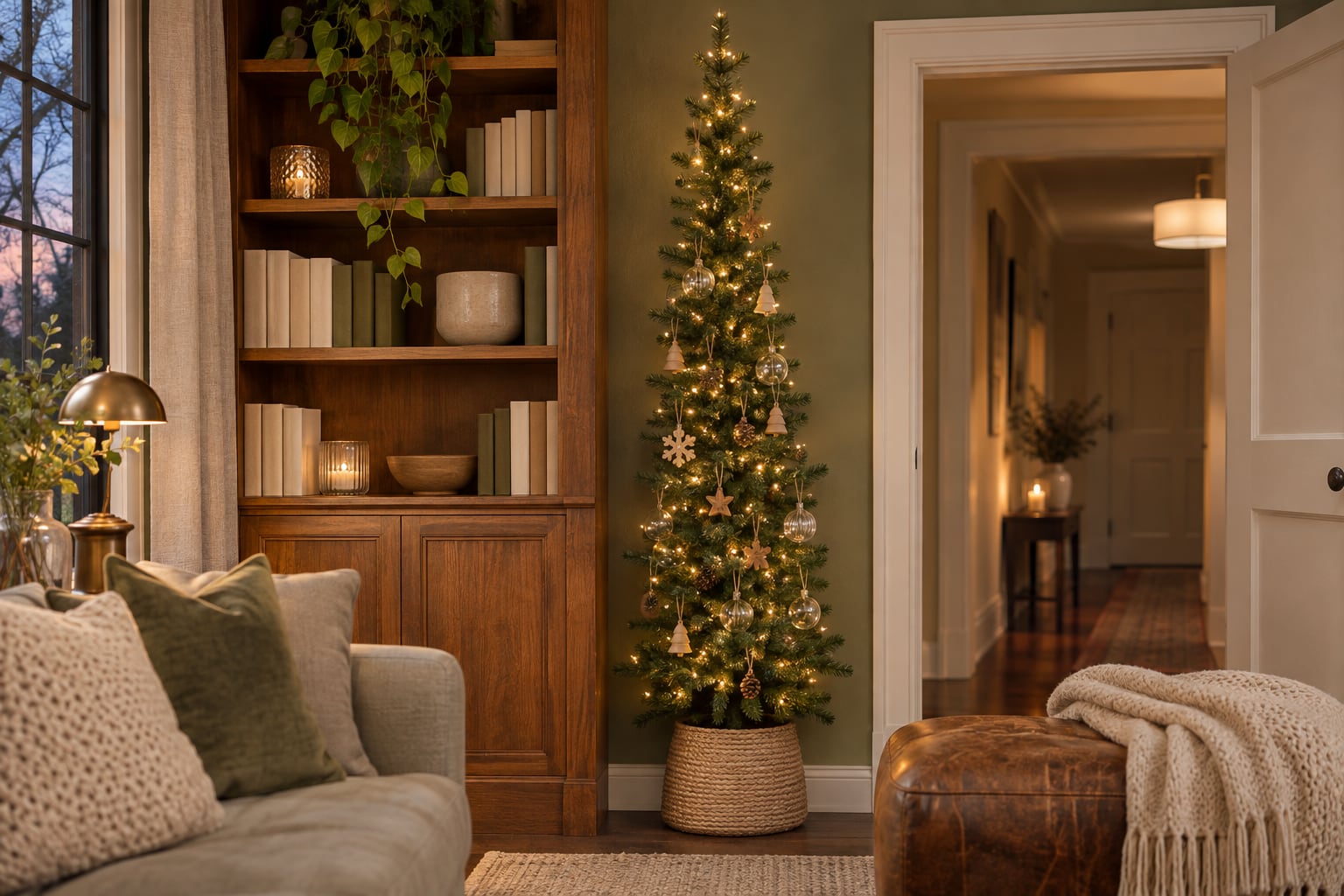
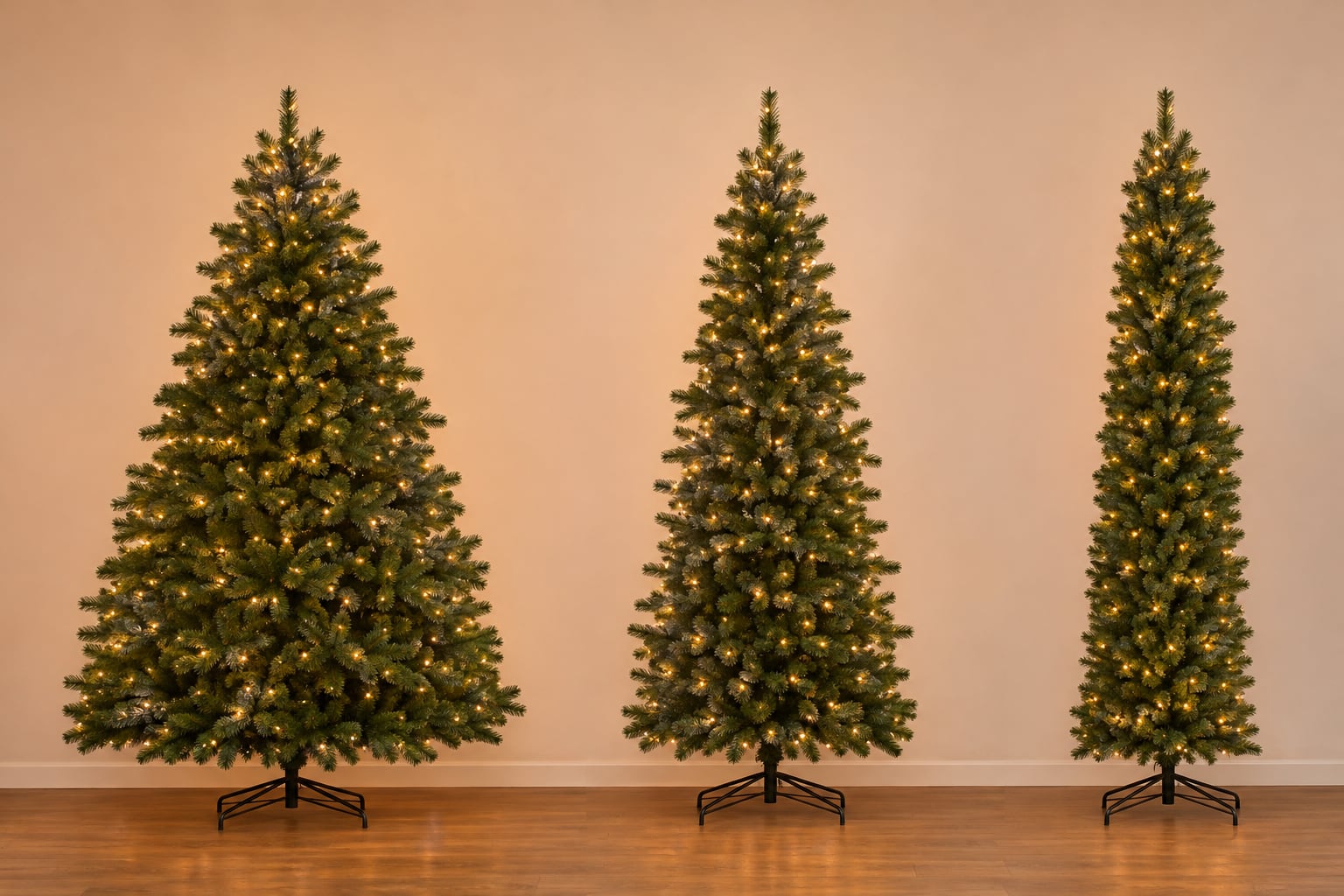
A pencil Christmas tree is the narrowest profile. The pencil trees we track are 28 to 36 inches wide at 7 to 7.5 feet. A slim tree is a full tree trimmed down: it keeps more of the classic cone and runs mostly 29 to 44 inches wide at 7.5 feet, against 50 to 56 inches for a typical full tree. A pencil tree saves the most floor, and a slim tree leaves more room for ornaments.
The labels aren't standardized, though, and they overlap more than you'd guess. In our catalog, two 7.5-foot trees with the same 36-inch width and the same tip count are sold as one slim and one pencil, and a 9-foot slim tree is narrower than a 7.5-foot pencil one. Treat the label as a hint and shop by the listed width. Decide how much floor you can give up first, then how much you want to hang on the tree.
Where Slim Ends and Pencil Begins
Tree makers agree on the order, if not on the numbers. Puleo, which sells all three profiles, puts it this way:
A pencil tree is the narrowest profile, a slim tree is a trimmed version of a standard tree, and a full tree is the classic wide cone. The difference is width, not height.
Balsam Hill describes a pencil tree as "very narrow, cylindrical" and says a slim tree has "a more natural shape, with branches that are spaced farther apart to give a more open, airy, and organic look." You'll also see "skinny" and "narrow" on the same kind of tree. Balsam Hill's slim collection calls its trees skinny and lists its slim Vermont White Spruce as the Vermont White Spruce Narrow.
Where one label ends and the next begins is up to whoever writes the listing. Here's every slim and pencil tree we track at 7 to 7.5 feet, the most common height, narrowest first, with a typical full tree for comparison.
| Tree | Sold as | Width |
|---|---|---|
| Hayden Pine, 7 ft | Pencil | 28 in |
| Ashland Glacier Fir, 7.5 ft | Slim | 29 in |
| Flocked Greensboro, 7 ft | Pencil | 30 in |
| Sanford Pencil Fir, 7.5 ft | Pencil | 36 in |
| Seattle Spruce, 7.5 ft | Slim | 36 in |
| Holiday Living Glacier Fir, 7.5 ft | Slim | 44 in |
| Holiday Living Parque, 7.5 ft | Slim | 44 in |
| Vermont White Spruce, 7.5 ft | Slim | 60 in |
| For comparison: typical full tree, 7 to 7.5 ft | Full | 50 to 56 in |
The Holiday Time Sanford Pencil Fir and the Seattle Spruce are both 7.5 feet tall and 36 inches wide, with 1,538 branch tips each, and one is sold as a pencil tree, the other as a slim one. The Ashland Glacier Fir, sold as slim, is narrower than two of the three pencil trees. At the other end, the slim version of the Balsam Hill Vermont White Spruce is wider than a typical full tree, and its full version is 66 inches. The labels don't line up any better on taller trees. At 9 feet, where a full tree typically runs 56 to 66 inches, the Ashland Rothwell Slim is 33 inches wide, narrower than the 7.5-foot Sanford Pencil Fir.
- The width check
At 7 to 7.5 feet, a typical full tree is 50 to 56 inches wide. A tree 36 inches wide or less is within the width range of the pencil trees we track, whatever its label says. One between that and a typical full tree's width is slim.
For other heights, compare the listed width with the full-tree widths in the chart in our Christmas tree size guide.
How Each Profile Looks From Across the Room
From across a room, the difference is the outline and how much of the tree's depth you can see.
Full is the classic wide cone. On a typical 7.5-foot tree, the bottom branches reach more than 2 feet out from the pole, so lights and ornaments sit at different depths and the pole mostly disappears behind them.
Slim keeps that cone, trimmed. Puleo's description holds up: "A slim tree keeps the classic taper, holds more ornaments than a pencil, and takes noticeably less room than a full tree." The sides slope less, so it looks taller and leaner. The narrower a slim tree gets, the more it starts to look like a pencil tree, which is why the labels blur.
Pencil trees come in two kinds, and Puleo, which sells both, describes the difference well. Its slenderest pencil tree, 15 to 21 inches wide depending on height, reads "as a column of greenery, almost architectural." Its Fraser Fir Pencil, about 30 inches wide at 7.5 feet, "reads as a real Christmas tree that happens to be narrow." The pencil trees we track, at 28 to 36 inches, are the second kind. That split is why the pencil widths you'll find online run from well under 2 feet to 3 feet.
Either kind has straighter sides than a slim tree, and in a big room a single narrow tree comes across as an accent. Our Ashland Glacier Fir review says the 29-inch tree "isn't the right choice for a main living room centerpiece in larger homes." In a small room, a narrow tree can be the main tree, and our guide to a Christmas tree for a small apartment makes that case.
Ornaments: Shorter Branches, Less Room
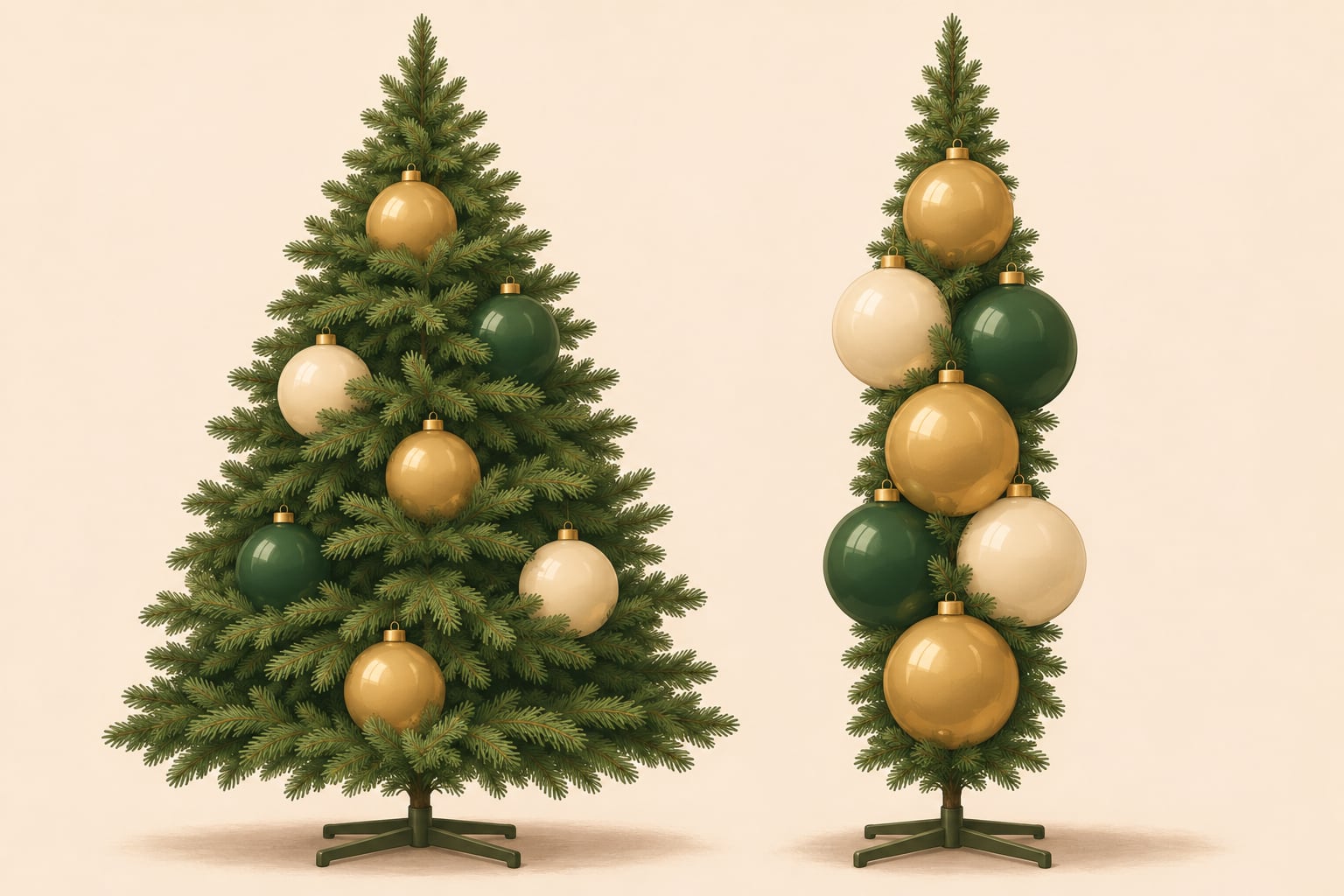
How much a tree can hold comes down to branch length. The bottom branches of a 54-inch full tree reach about 27 inches from the pole. On a 44-inch slim tree they reach about 22, and on a 30-inch pencil tree about 15. By rough cone geometry, a 7.5-foot slim tree that's 44 inches wide has about four-fifths of a 54-inch full tree's surface to hang things on. At 36 inches it's about two-thirds, and at 30 inches a little over half.
Depth matters as much as area. On a full tree you can hang ornaments near the pole, partway out, and at the tips, and that layering is a big part of what makes it look lush. A short branch has less room for it, so big ornaments end up competing for the same few inches, and one hung at the tip sticks out past the narrow outline.
Tree makers' advice for decorating narrow trees lines up:
- Scale down toward the top. Balsam Hill says to hang smaller ornaments near the top and bigger ones toward the bottom, and to skip ornaments "that aren't proportionate to the tree's narrow frame."
- Hang the heavy ones close to the pole. Nearly Natural suggests placing "slightly larger pieces closer to the trunk where the branches can support them," with smaller accents toward the tips.
- Run color up and down. Puleo suggests ribbon "dropped in long lines from top to bottom" and warns that wrapping a narrow tree "in rings tends to shorten it visually."
- Keep the topper slim. Puleo notes that "a wide star on a 21-inch tree looks top-heavy" and suggests a finial, a narrow star, or a bow.
How small to go depends on the tree. Puleo says its slenderest pencil tree looks best with many small ornaments, while its Fraser Fir Pencil "handles standard ornaments like a full tree, just with fewer." If you want to use a big collection of large ornaments, a full tree is the one with room for them.
Fewer Tips Doesn't Mean Sparse
Narrow trees list fewer branch tips, and it's easy to read that as a thinner tree. Mostly it's geometry: less width means less branch to cover. When one model comes in both profiles, the slim version loses tips roughly in step with its surface:
| Model | Full version | Slim version | Tips on the slim | Surface of the slim |
|---|---|---|---|---|
| Holiday Living Parque, 7.5 ft | 55 in, 2,796 tips | 44 in, 2,018 tips | 28% fewer | 21% smaller |
| Bradley Spruce, 9 ft | 61 in, 4,147 tips | 44 in, 2,914 tips | 30% fewer | 29% smaller |
| Balsam Hill Vermont White Spruce, 7.5 ft | 66 in, 2,574 tips | 60 in, 2,120 tips | 18% fewer | 10% smaller |
The slim Bradley Spruce carries as many tips for each square foot of branch as its full version. The slim Holiday Living Parque and Vermont White Spruce carry about 8 percent fewer for the same area. For the Vermont White Spruce, that matches the "more open, airy" look Balsam Hill describes for its slim trees. Its tip counts come from Balsam Hill's listings.
So judge a narrow tree's tip count against trees of the same width, not the same height. Full 7.5-foot trees in our catalog list a median of about 2,500 tips. A 36-inch tree has about two-thirds the branch surface, so around 1,600 tips is par, and the Sanford and Seattle Spruce, at 1,538, are close to it. Our Sanford review lands in the same place: "The 1,538 tip count is modest for 7.5 feet, but the slim profile helps. You're not trying to fill a massive diameter, so the density feels adequate rather than sparse." Brands count tips differently, so treat comparisons across brands as rough.
When a Narrow Tree Does Look Sparse
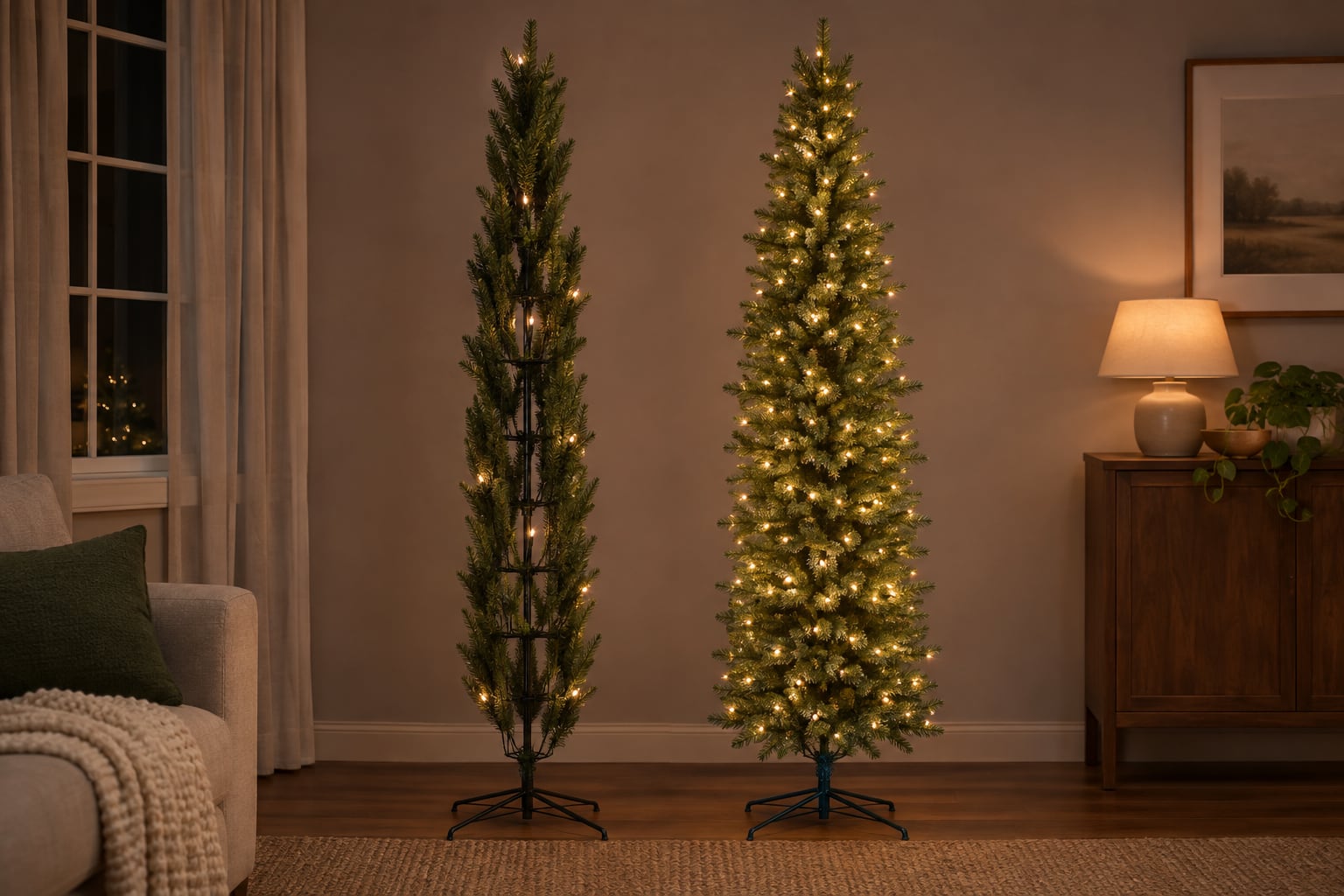
A narrow tree has less depth to hide things in. As Puleo puts it, "You see more of the center on a pencil tree." The pole, the gaps, and the dark patches that a full tree buries in its depth show through. When a slim or pencil tree looks thin, it's usually one of four things.
Too few tips for its width. The Rothwell Slim spreads 1,275 tips over 9 feet. For the branch surface it has to cover, that's about three-quarters as many tips as a typical full tree in our catalog carries, and its review warns that you'll see through to the branches and the center pole unless you load it with ornaments. The Ashland Glacier Fir has even fewer tips for its size, but it's heavily flocked, and Puleo says flocking makes a slender tree read "denser than its tip count suggests." Our review notes that reviewers praise it as "beautiful enough to display with minimal or no ornaments."
Too few lights. The classic look is 70 to 90 mini lights per foot on a full tree, and a narrow tree needs fewer in proportion to its surface. Scale the classic count the way our guide to how many lights a Christmas tree needs does, and you get roughly 45 to 60 lights per foot for a 36-inch tree and 35 to 50 for a 28- to 30-inch one. The 7-foot Holiday Living Hayden Pine pencil tree has 210 lights, 30 per foot, and its review counts the lower light density as a con. The Flocked Greensboro pencil tree, at about 43 per foot, is in range, and the Sanford, at about 47, sits at the low end of its range. Before you add a strand to a pre-lit tree, check its manual. Puleo's, for one, says not to connect extra light sets "to the existing light sets on your pre-lit tree." The lights guide's section on adding lights to a pre-lit tree covers what else to check.
Branches not fluffed all the way. A narrow tree shows every branch you skipped. Reviewers of the Seattle Spruce say that without enough fluffing you can see straight through to the trunk, and our review says the tree's "moderate fullness and slim profile mean every branch placement matters." The upside is fewer branches to do: the Hayden Pine's review says its 7-foot pencil version, with fewer branches, is much quicker to fluff than the 9-foot full one. Our guide to fluffing an artificial Christmas tree covers getting each branch out to its full reach.
Gaps between branch layers. Some trees leave too much pole between layers of branches, and no amount of fluffing fixes that. Owners of the Holiday Time Glittering Frosted Slim Pine report noticeable gaps between branch layers on some units, 6 inches or more. Check owner photos for it before you buy.
Which Profile for Which Spot
Our small apartment guide puts the floor to clear at about 6 feet across for a full 7 to 7.5 ft tree, 5 feet for a slim one, and 4 for a pencil tree. Beyond the floor, it comes down to the tree's job:
- The room's main tree, with floor to spare: full. A full tree gives you the most ornament room and the lushest look, and it's the one for a big ornament collection.
- The main tree in a tight room: slim, or pencil if it's tighter still. A slim tree around 40 to 44 inches wide keeps the classic shape and takes standard ornaments, just fewer of them, while giving back about a foot of floor. With only about 4 feet to clear, a pencil tree can still be the room's tree, and the small apartment guide picks a few.
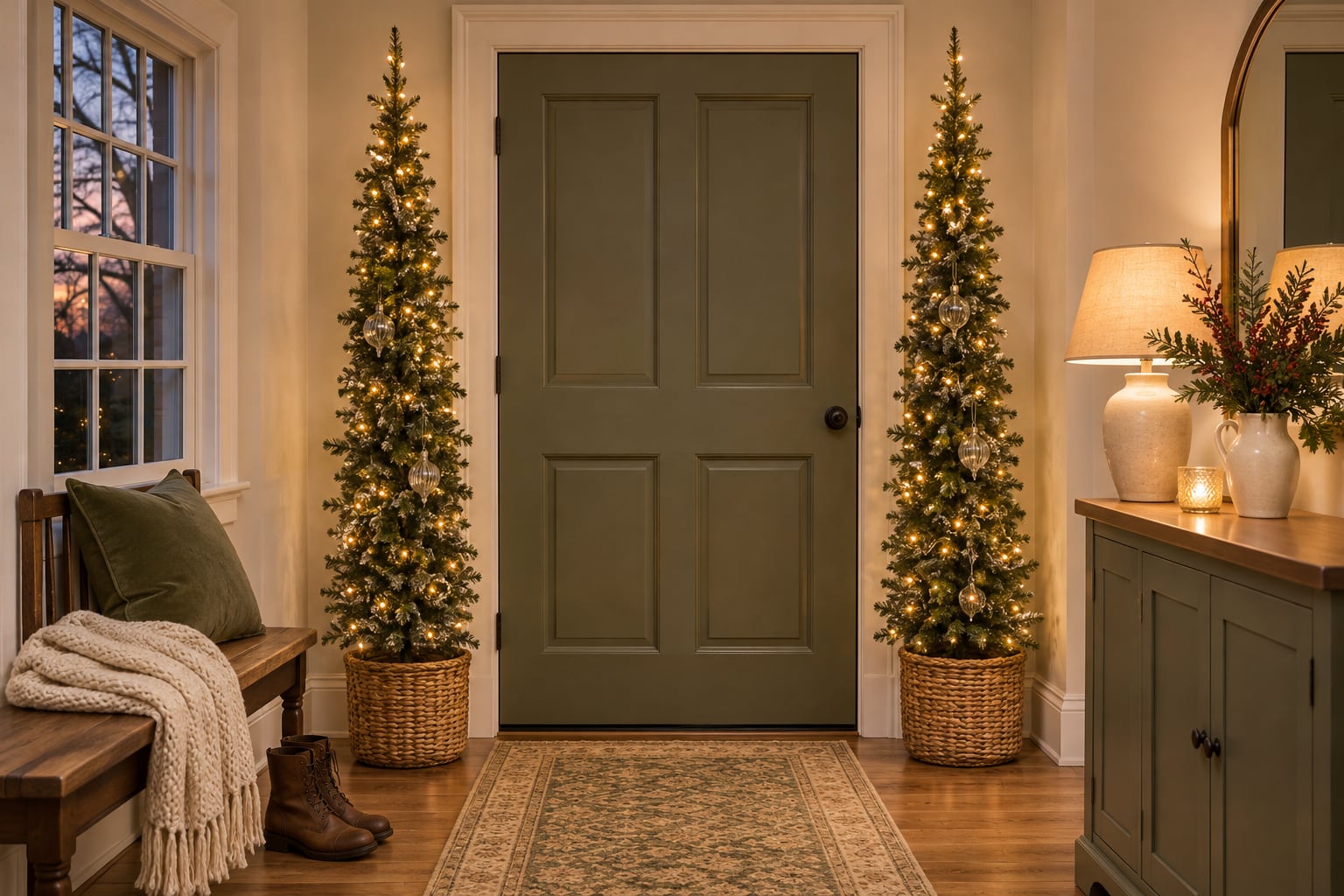
- Entryways, landings, tight corners, and pairs: pencil. A 28- to 36-inch pencil tree fits where anything wider would block the path, like the gap between a sofa and a window. Narrow trees also work in pairs. Balsam Hill says its tall, skinny trees "look just as striking in pairs flanking your entryway or fireplace mantel," and our Flocked Greensboro review calls its pencil version "good for corners, hallways, secondary rooms, or alongside a main tree."
If either a slim or a full tree would fit, the trade is easiest to see within one model. The slim Parque gives up 11 inches of width, more than a quarter of its tips, and 100 of its 550 lights. The slim 9-foot Bradley Spruce weighs about 37 pounds against 60 or more for the full one, which matters on stairs. Don't count on a shorter box, though. Our small apartment guide notes that a 7- to 7.5-foot tree's box runs roughly 3.5 to 4.5 feet long whatever its shape.
Our catalog's slim and pencil filter lists every tree we track that's sold as slim or pencil, and each tree's page gives its width.
Slim and Pencil Tree Questions
What's the difference between a slim and a pencil Christmas tree?
Width. A pencil tree is the narrowest profile, with the straightest sides; the ones we track are 28 to 36 inches wide at 7 to 7.5 feet. A slim tree keeps more of a full tree's cone and is mostly 29 to 44 inches wide at 7.5 feet, against 50 to 56 for a typical full tree. Brands don't agree on where one ends and the other begins, so compare listed widths rather than names.
How wide is a pencil Christmas tree?
There's no standard width. The pencil trees we track are 28 to 36 inches wide at 7 to 7.5 feet, about a third to two-fifths of their height, and some makers sell much slimmer ones: Puleo lists a pencil tree that stays between 15 and 21 inches wide from 3 to 7 feet. Check the listed width, and clear about a foot more than that on the floor.
Do pencil Christmas trees look sparse?
Not by design. A pencil tree lists fewer tips because it has less branch surface to cover, and a well-made one carries about as many tips for its surface as a typical full tree. It looks sparse when it's short on lights or tips for its width, when the branches aren't fluffed all the way out, or when there are gaps between branch layers. Expect to see a bit more of the pole than on a full tree, since there's less depth to hide it.
Is a slim tree or a full tree better?
A full tree is better if you can clear about 6 feet of floor and want room for a big ornament collection. A slim tree is better when the floor is tight: at 7.5 feet, a 44-inch slim tree takes about a foot less floor than a typical full tree and keeps the classic cone, though it carries fewer tips, fewer lights, and less room for large ornaments.