
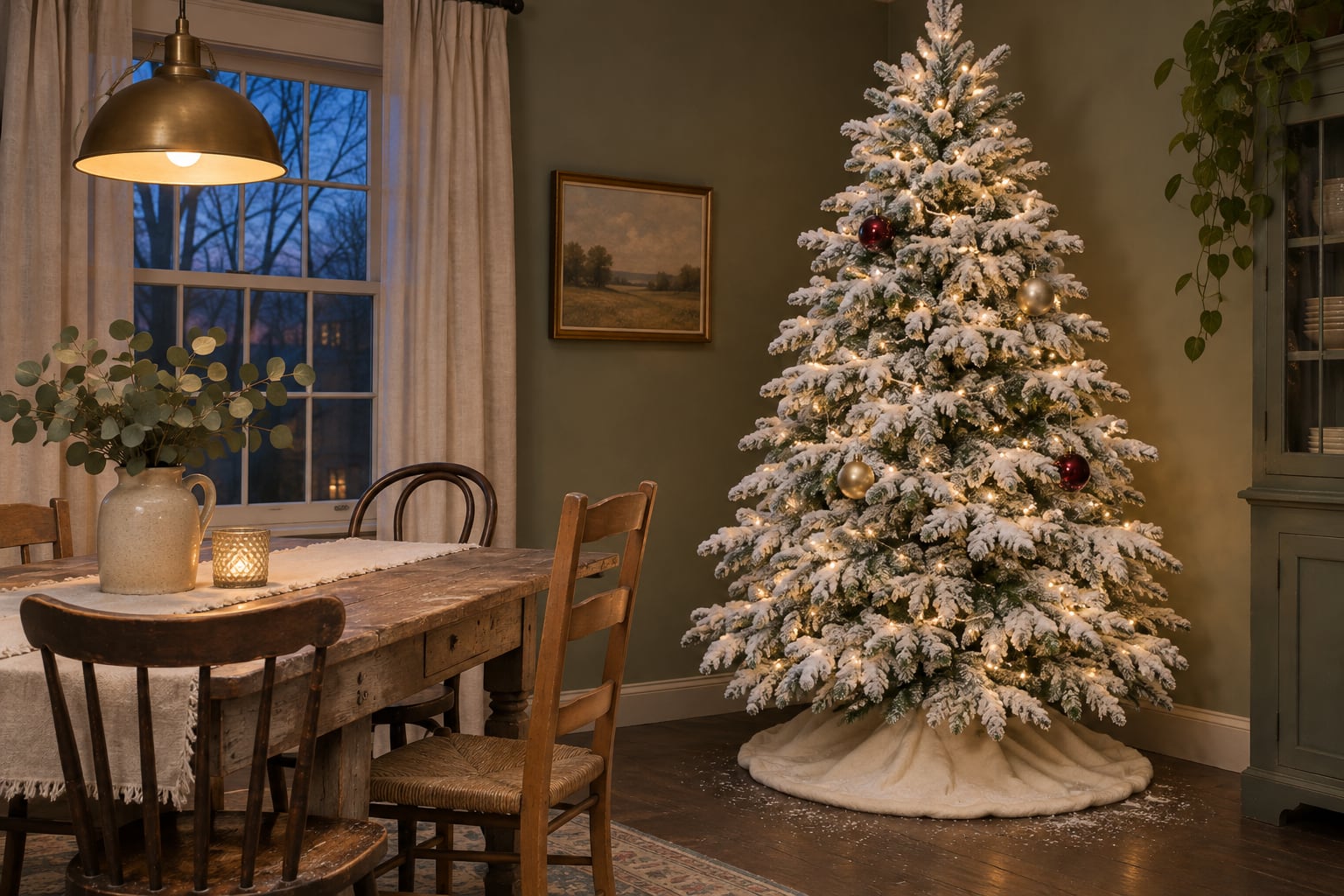
A flocked Christmas tree is a tree coated in fake snow. On an artificial tree, it's done at the factory: the branches are sprayed with glue, then fine fibers, usually white, are sprayed onto the glue, so the tree looks like it spent the night out in a snowfall. The coat runs from a light dusting to branches that look buried. Real trees can be flocked too, at a tree lot, and you can flock a real or artificial tree at home with a kit.
The coating is what you're signing up for. It sheds, most of all during setup. It can't get wet, so cleaning means dusting. Heat, humidity, and sunlight can yellow it. And it says little about the tree underneath: the trees in our catalog that come in a flocked version range from all PVC to 65 percent PE, the molded plastic that makes a tree look real up close. None of that is a reason to skip one if you love the look. It's just more upkeep than a green tree.
- Flocking
The fake snow on a flocked tree, and the process of putting it there. Fine fibers, usually white, are sprayed onto a layer of glue on the branches.
How a Tree Gets Flocked, and What the Snow Is Made Of
A 2026 U.S. patent for a new flocking method describes the usual process in two steps. First, a "glue emulsion is applied onto an item by spraying, such as tree branches." Then "fine paper or cotton particles, which can be called flocking material," are sprayed onto the glue.
What those particles are depends on who you ask. King of Christmas says "our flocking is made up of a cotton-based material." One supplier of flock for tree lots, Pursell, calls its Snow Flock "a cellulose-based material," which means plant fiber, what paper and cotton are mostly made of. The ASPCA, asked about pets, told Snopes that "flocking material is typically plastic." So the patent, the tree maker, and the flock supplier point to plant fiber, while the ASPCA says plastic. Our catalog listings don't name a flocking material, so for most trees the honest answer is fine fiber, glued on.
Canned snow spray is a different product. The National Capital Poison Center says that once its solvents and propellants evaporate, the residue "is made of mostly fat or calcium."
Flocked vs. Frosted
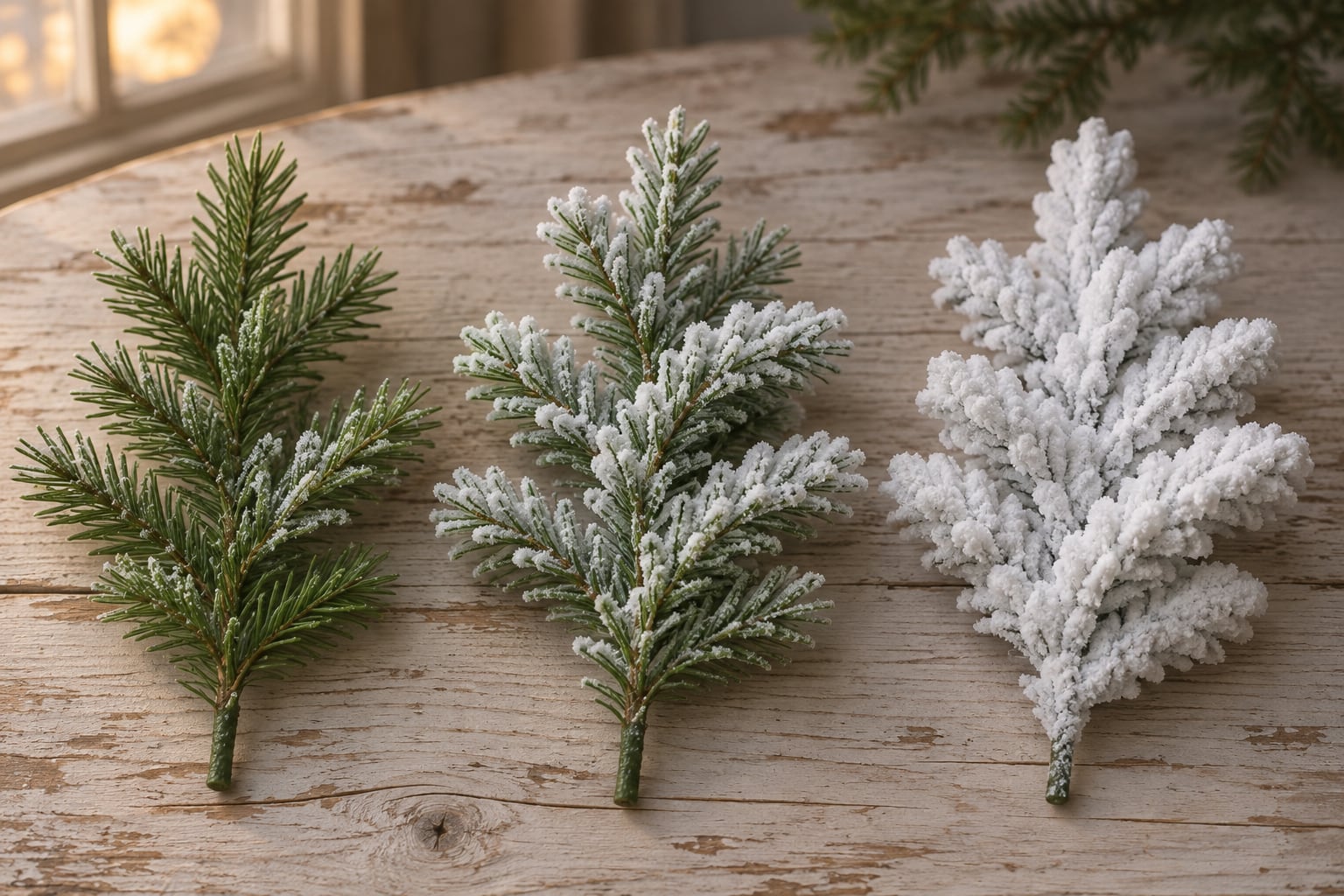
Balsam Hill, which sells both, describes flocking as the heavier coat, "usually thicker than a frosted finish," covering "a larger portion of the foliage." Frosting is a lighter layer, mostly at the branch tips, and a snow-tipped finish is sparser still. Listings use "snowy," "snow-dusted," and "frosted" loosely, though, so judge a tree by its close-up photos, not its name.
Less coating means less to come loose. Balsam Hill says frosted trees "offer the same wintry look as flocked trees, but with less upkeep." Add glitter and that can change. Our review of the Glittering Frosted Slim Pine, a frosted tree with glitter mixed into the coating, warns that its glitter "sheds. A lot."

What Our Flocked Tree Reviews Show
Flocked trees vary a lot in how much white they carry and in how much of it ends up on the floor. Here's what our reviews of five flocked trees say:
| Tree | Coverage | Shedding, per our review | PE |
|---|---|---|---|
| Holiday Living Flocked Greensboro | Heavy | Mostly stays on the tree | 0% |
| Ashland Glacier Fir | Heavy | Messy during the first setup | 0% |
| GE Candlewood Pine | Heavy | During setup, and now and then all season | About 25% |
| Holiday Living Snowy Berkshire | Medium | Stays on the tree | 0% |
| Holiday Living Glacier Fir | Medium | Some during setup and fluffing | 25% |
A heavy coat doesn't have to mean a mess. Our review of the Flocked Greensboro says its flocking "stays on the tree instead of creating a mess" during fluffing: "not perfect, but better" than cheap flocked trees. The Candlewood Pine, also heavily flocked, sheds during setup, and its review says to "expect occasional white specks on your floor throughout the season." The medium coat on the Snowy Berkshire stays put, per its review. You can't judge shedding from photos, so read owner reviews of the exact tree before you buy.
The snow says little about the branches under it, either. Three of these five trees are all PVC, and the other two are about 25 percent PE. On a heavily flocked tree, the coat hides much of what PE would show off. Our Flocked Greensboro review puts it plainly: "the flocking masks it, but underneath it's budget PVC." Flocking can even work against PE. Our Snowy Dot Glittered Blue Spruce review notes that it can make PE tips "look oddly thick and rounded," because it "tends to coat each individual needle, making them bulkier." If you want a tree that looks real up close, shop by PE percentage, as our guide to realism and build quality explains, not by how snowy it is.
Why Flocked Trees Shed
Shedding comes with how flocking is made. The fibers end up only "more or less bonded" to the branch, the patent says, and keeping flocking "from breaking away and turning to debris" is "a long-standing problem."
Every tree maker we checked treats some shedding as part of the deal. Fraser Hill Farm's manual says "it is normal for our flocked trees to shed any loose snow flocking" during assembly, and that "shedding can also occur when shaping the tree and in high traffic areas." King of Christmas calls "some flocking loss during first setup and early seasons" normal and leaves "flocking" and "minor shedding" out of its warranty. National Tree Company's warranty says pieces of flocking and glitter "may loosen in the carton during shipping and handling or during normal use," calls that normal, and doesn't cover it. It also covers its flocked trees for two years, against three for its regular trees.
Owners disagree on how bad it gets. On a Hometalk Q&A, one owner said flocked trees "can be very messy during setup and take down" but seem to shed less after a few years, and another said "it really depends on the tree" and that theirs "made almost no mess." A writer in their second year with a flocked tree called the coating "an absolute nightmare mess." Plan on sweeping after setup, and on the odd white fleck all season, more if the tree stands by a busy doorway.
Setting Up a Flocked Tree
Balsam Hill says "most shedding happens during the first setup of each season, as branches are moved into their final shape," so plan on these steps every year, not just the first. Line up a helper for a big tree, too. Our Candlewood Pine review says the 7.5-foot tree weighs 43.65 pounds, heavier than some comparable trees, "partly due to the flocking and all those lights."
- Put down a sheet first. Balsam Hill suggests "a drop cloth or old bedsheet," and Best Choice Products' manual suggests assembling a flocked tree "outside or on a disposable surface." Our Glitter Flocked Cashmere review adds that hardwood beats carpet.
- Separate stuck branches slowly. Flocked branches can arrive stuck together, and Fraser Hill Farm's manual says it's "normal for the tree to shed to remove excess snow flocking" as you pull them apart.
- Fan the tips instead of scraping them. Balsam Hill's advice is to fluff "by pulling outward and fanning individual tips rather than snapping or scraping branches." Our guide to fluffing an artificial Christmas tree covers the rest of the method.
- Clear the pole connectors. If your pre-lit tree's sections plug together through the center pole, Fraser Hill Farm warns that extra snow in the base connectors "may obstruct the connection," so check the sockets before you stack the sections.
- Keep it off your face. Best Choice Products' manual says to "avoid contact with the face, eyes, and mouth" and to wash up after accidental exposure.

Decorating a Flocked Tree
Flocked branches can be harder to hang things on. Our Snowy Berkshire review found that ornament hooks "don't grab as securely" on that tree, which it puts down to the flocking and the branch structure. King of Christmas suggests lighter ornaments that won't "put undue pressure on the flocking." You may not need many. Owners of the Ashland Glacier Fir, our review notes, find it "beautiful enough to display with minimal or no ornaments."
For lights, cool white plays up the snow and warm white makes the tree look cozier. If you add your own strings, white wire hides better than green on a heavily flocked tree.
Pets and Kids
Dry flocking isn't considered a poisoning hazard for pets, according to the ASPCA. Its spokesperson told Snopes, after checking with the senior director of toxicology at ASPCA Poison Control, that "flocking material is typically plastic, so the primary risks when ingested by our pets is potential foreign body and GI upset." In plain terms, the worry is a pet eating enough to upset its stomach or block its gut. A blockage is an emergency: the veterinary charity PDSA warns that delaying treatment "may cause your cat to become very ill or even die." If you flock a tree yourself, the ASPCA says to keep pets away until it's thoroughly dry. If your cat chews the tree, our guide to cat-proofing a Christmas tree suggests a plain green one instead.
For kids, Best Choice Products' manual says to keep its flocked trees "out of reach of children and pets if possible." We found no poison-center guidance on factory flocking. The closest is the National Capital Poison Center's page on spray-on snow and instant-snow powder, which says both are "unlikely to cause poisoning when swallowed since they are both poorly absorbed." Its advice after a taste is to "rinse the mouth and offer sips of water." For a person, call Poison Help at 1-800-222-1222. For a pet, call your vet or the ASPCA Animal Poison Control Center at 888-426-4435, where a consultation fee may apply.
Cleaning and Storing a Flocked Tree
Clean a flocked tree dry. King of Christmas says flocking "does not tolerate moisture" and that "water or cleaning chemicals can cause it to clump, dissolve, or lose adhesion." Dust it with a soft brush, or with a handheld vacuum's soft brush attachment on low suction, moved lightly over the branches "without pressing the attachment into the flocking." No damp cloths and no cleaning sprays. If a bare spot shows after decorating, King of Christmas points to touch-up flocking sprays. Treat those like any aerosol snow: the poison center says to use them with good ventilation, never in a small space, and never near open flames.

Where the tree stands matters too. King of Christmas says to keep a flocked tree away from direct sunlight, heaters, and vents "to prevent the flocking from drying out and shedding."
Store it cool and dry, somewhere the temperature stays steady. Balsam Hill calls heat and humidity "the primary enemies of specialty finishes" and warns that garages, attics, basements, or sheds with uncontrolled temperatures "can cause yellowing or adhesive breakdown over time." King of Christmas is less strict, or at least less consistent: its storage guide says a basement, attic, or closet "may be ideal" if it's cool and dry, while its care guide calls garages and attics "less than ideal." Keep stored sections out of the sun, too, since UV light can yellow white coatings. And don't crush the tree. King of Christmas suggests wrapping each section "snug but not so tight that it compresses the branches and damages the flocking," and Balsam Hill says not to stack heavy things on a stored tree.
Skip shaking the tree at takedown. King of Christmas's storage guide suggests you "gently shake the tree" to get loose flocking off, but its own care guide says to "avoid rough handling or shaking, because this can dislodge more flocking," and Balsam Hill also says to "avoid shaking." The care guide's alternative is a gentle dusting with a microfiber cloth or feather duster, which "removes loose flocking and any accumulated dust." Either way, take the tree down over the same sheet you set it up on.
Flocked or Plain Green?
A flocked tree makes sense if you want a snowy look that does most of the decorating for you and you don't mind sweeping after setup. A heavy coat is forgiving on a budget, too, since it hides plain PVC tips.
Even our Best Flocked pick among the best 7.5-foot Christmas trees, the Glitter Flocked Cashmere, sheds some flocking and glitter during the first fluffing, which owners call "messy but not bothersome." The "cashmere" in its name means hard-needle PVC, not wool, as our cashmere tree explainer covers.
Pick a plain green tree instead if:
- your pet chews the tree or eats what falls off it
- you want a tree that looks real up close, which takes PE, not snow
- the only storage you have is a hot attic or a damp garage
For a hint of snow with less cleanup, a frosted tree without glitter is the middle ground.
Flocked Christmas Tree Questions
Do flocked Christmas trees shed?
Yes, most of all during setup, when you separate and fluff the branches. Fraser Hill Farm, National Tree Company, and King of Christmas all call some shedding normal, and some owners say it eases off after a few years. National Tree Company and King of Christmas don't cover lost flocking under warranty. In our reviews, shedding varies from tree to tree, even among heavily flocked ones, so check owner reviews of the exact model.
Is the fake snow on Christmas trees toxic?
Dry flocking isn't considered a poisoning hazard for pets, according to the ASPCA, which says the main risks if a pet eats it are an upset stomach or a blockage. We found no poison-center guidance on factory flocking for people. The closest, the National Capital Poison Center's page on canned "flocking snow," says it's unlikely to poison someone who swallows it because it's poorly absorbed. Best Choice Products' tree manual still says to keep flocked trees out of reach of children and pets if possible and to avoid contact with the face, eyes, and mouth. If a child swallows some, call Poison Help at 1-800-222-1222. For a pet, call your vet or the ASPCA Animal Poison Control Center at 888-426-4435.
How do you clean a flocked Christmas tree?
Dry. Dust it with a soft, dry brush or a handheld vacuum with a soft brush attachment on low suction, moved lightly over the branches. King of Christmas warns that water and cleaning chemicals can make flocking clump, dissolve, or lose its grip, so skip damp cloths and cleaning sprays.
Is a flocked or unflocked tree better?
An unflocked tree is easier to live with: no flocking to sweep up, ordinary cleaning, and no white coat to yellow. A flocked tree gives you a snowy look that needs fewer ornaments and hides plain PVC tips, in exchange for sweeping after setup, dry-only cleaning, and careful storage. If you're paying for a high-PE tree because it looks real up close, get it unflocked, since a heavy coat hides much of the detail.