
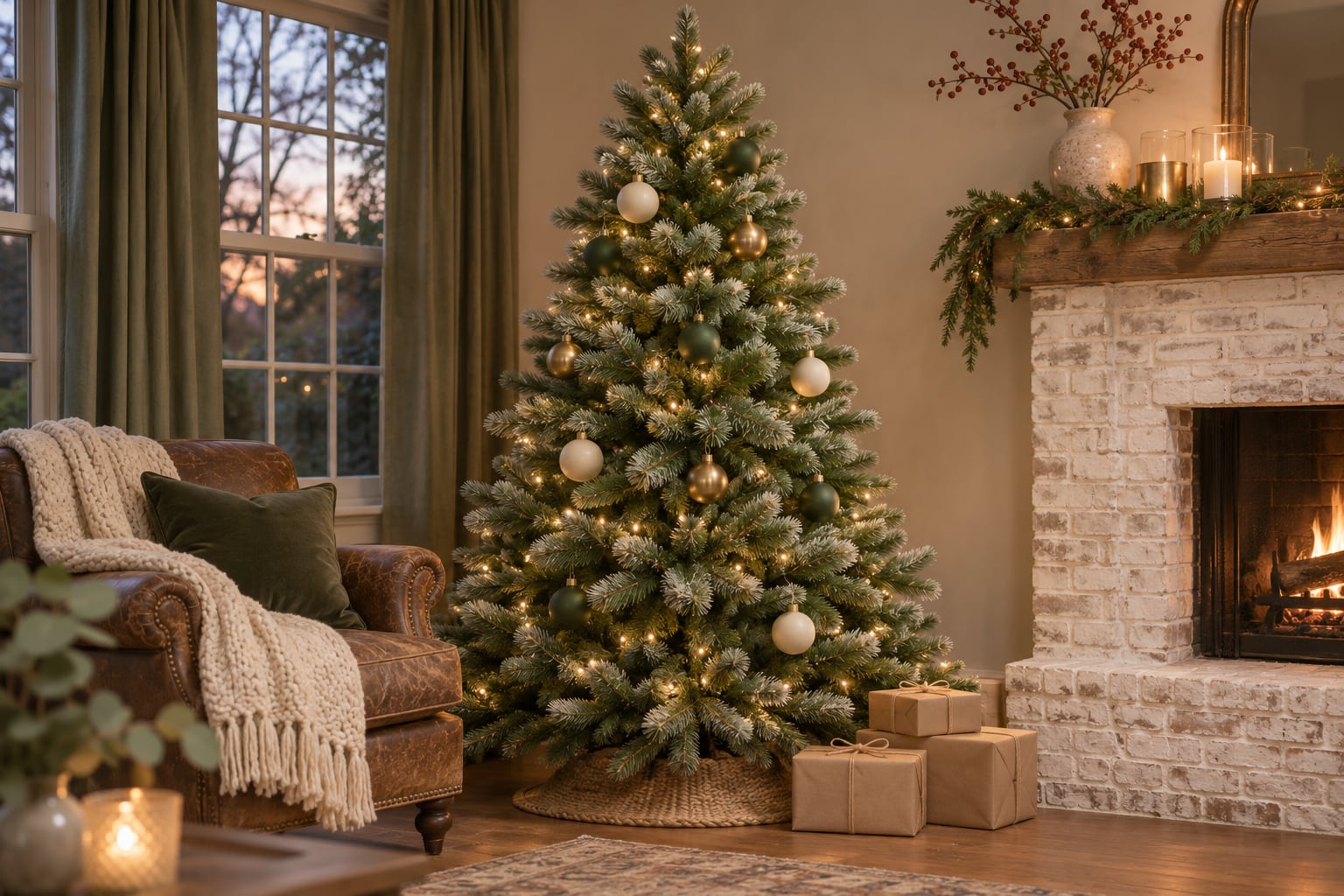
A cashmere Christmas tree is an artificial tree whose branch tips have a textured finish the brand calls "cashmere." On most of them, that means firm, rounded hard-needle PVC, often with frayed or split ends, which looks fuller and a bit more needle-like than the flat PVC on a basic tree. Despite the name, it isn't wool: the tip materials the brands list are all plastics.
What the word doesn't tell you is how real the tree looks. "Cashmere" describes texture, and brands don't agree on which texture. It doesn't tell you how much PE a tree has, either, and PE, the molded plastic that copies real branches, is what makes an artificial tree look real up close. If realism is the goal, shop by PE percentage. If you want a full, textured tree to load with ornaments, or a snowy flocked one, cashmere tips are a sensible pick.
What "Cashmere" Means on a Tree Listing
Brands use the word in different ways, so it means whatever the listing says it means. Here's how the trees we checked use it:
| Tree | Where the word appears | Tip materials |
|---|---|---|
| Ashland Cashmere Pencil | A finish | Hard-needle PVC |
| Ashland Stella Pine | A finish, paired with glitter | PVC and hard needle |
| Ashland Jackson Spruce | A "soft" finish | PE, PVC, and hard needle |
| National Tree Company Arcadia Pine | The branch tips | PVC |
| Holiday Living Hayden Pine | One of three tip types | Cashmere PVC, plain PVC, and PE |
| Vickerman Cashmere Pine | The tree's name | PE, PVC, and hard needle |
Ashland treats cashmere as a finish on hard-needle tips, and our reviews of its Jackson Spruce and Celebration Pine describe that finish as hard-needle PVC with frayed ends. National Tree Company uses the word for a kind of tip. Its Arcadia Pine has "wide cashmere branch tips" for a softer look, and another of its trees mixes "evergreen and cashmere branch tips." On the Holiday Living Hayden Pine, cashmere tips with "frayed edges for thickness," as our review puts it, are one of three tip types alongside plain PVC and molded PE. Vickerman uses the word as a name: its Cashmere Pine has "a blend of PE, PVC, and Hardneedle tips."
The common thread is texture, and many cashmere tips add frayed or split ends. You'll also see "cashmere pine," which on a listing is a product name, usually for a pine-style tree with cashmere tips. Four of the six trees above are sold as pines, and that fits, since hard-needle strands look more like pine needles than flat PVC does. The name doesn't guarantee the look, though: our Hayden Pine review says its mix of cashmere, flat PVC, and PE tips doesn't read as a pine from across the room. Our guide to the types of Christmas trees covers what does.
- Hard-needle PVC
Firm, rounded PVC strands that look more like pine needles than the flat strips on a basic tree. It's still PVC, with no molded PE. Most tips sold as "cashmere" are hard-needle PVC with a textured or frayed finish.
Is Any of It Wool?
No. A few older blog and Q&A pages say it is. One explainer, last updated in 2022, says the tips "have been treated with the soft wool from Kashmir goats," and a reader comment on another says the wool is used to "coat the ends of the tips of the pine needles."
The listings don't back that up, and they don't describe any kind of fabric. The tip materials the brands name are all plastics: PVC, hard-needle PVC, and PE. The word is borrowed from the soft fiber in a sweater, which makes for a funny fit: Ashland's Cashmere Pencil lists "342 classic cashmere tips" right above "Hard needle PVC."
Cashmere vs Flat PVC vs Molded PE
Here's how cashmere tips compare with the two other kinds you'll find on artificial trees, flat PVC and molded PE.
| Flat PVC | Cashmere (hard-needle PVC) | Molded PE | |
|---|---|---|---|
| Made of | Thin strips of plastic film twisted into wire | Firm, rounded PVC strands, often frayed at the ends | Plastic molded from real branches |
| Up close | Flat, uniform, with a plastic shine | More dimensional, but clearly PVC | Closest to real needles |
| To the touch | Stiff and crinkly | Firm, with more texture than flat PVC | Soft and flexible on good PE, stiff on some |
| Fullness | Fills volume cheaply | Fluffy and substantial | Less dense without PVC filler |
| Fluffing | Spread the tips apart, pointing different ways | Same as flat PVC | Mostly angling each tip |
Look. Cashmere tips are a step up from flat PVC: rounder, a bit more needle-like, and more dimensional. They're still PVC, though. Our Celebration Pine review, on a 0 percent PE tree with frayed hard-needle tips, says it "photographs well and has good visual depth, though up close it's clearly PVC." Molded PE closes that gap because it's cast from real branches, as our guide to realism and build quality explains.
Feel. The name promises softness, and the frayed ends deliver a little. Our Jackson Spruce review says they "create a softer, more textured feel" than typical flat needles. But many listings pair the word with "hard needle," and that's the more honest description: these are firm plastic tips.
Fullness. PVC is the filler that makes a tree look full, and textured tips fill more space than flat ones. Our Celebration Pine review calls its tips "more dimensional than flat traditional PVC," with a "notably fluffy and substantial appearance" once fluffed. Texture doesn't guarantee fullness, though: our Jackson Spruce review calls that tree reasonably full but notes that some owners can see through its branches. All-PE trees go the other way on fullness. Our Elegant Grand Fir review calls "moderate fullness" the tradeoff for its all-PE build.
Fluffing. Cashmere tips are PVC, so they fluff like PVC: spread the tips apart and point them in different directions, rather than just setting each one's angle as you would a molded PE tip. The Jackson Spruce listing's setup advice is to "separate each tip and shape them to spread out the tips." Budget the time: our Celebration Pine review plans on 30 to 60 minutes for its 842 tips on the first setup, and the 9-foot Hayden Pine can take 3 to 4 hours. Go gently, too, since our Jackson Spruce review notes owner reports of needles and pieces coming off during the first fluffing. Our guide to fluffing an artificial Christmas tree has the full method.
The Label Won't Tell You the PE Percentage
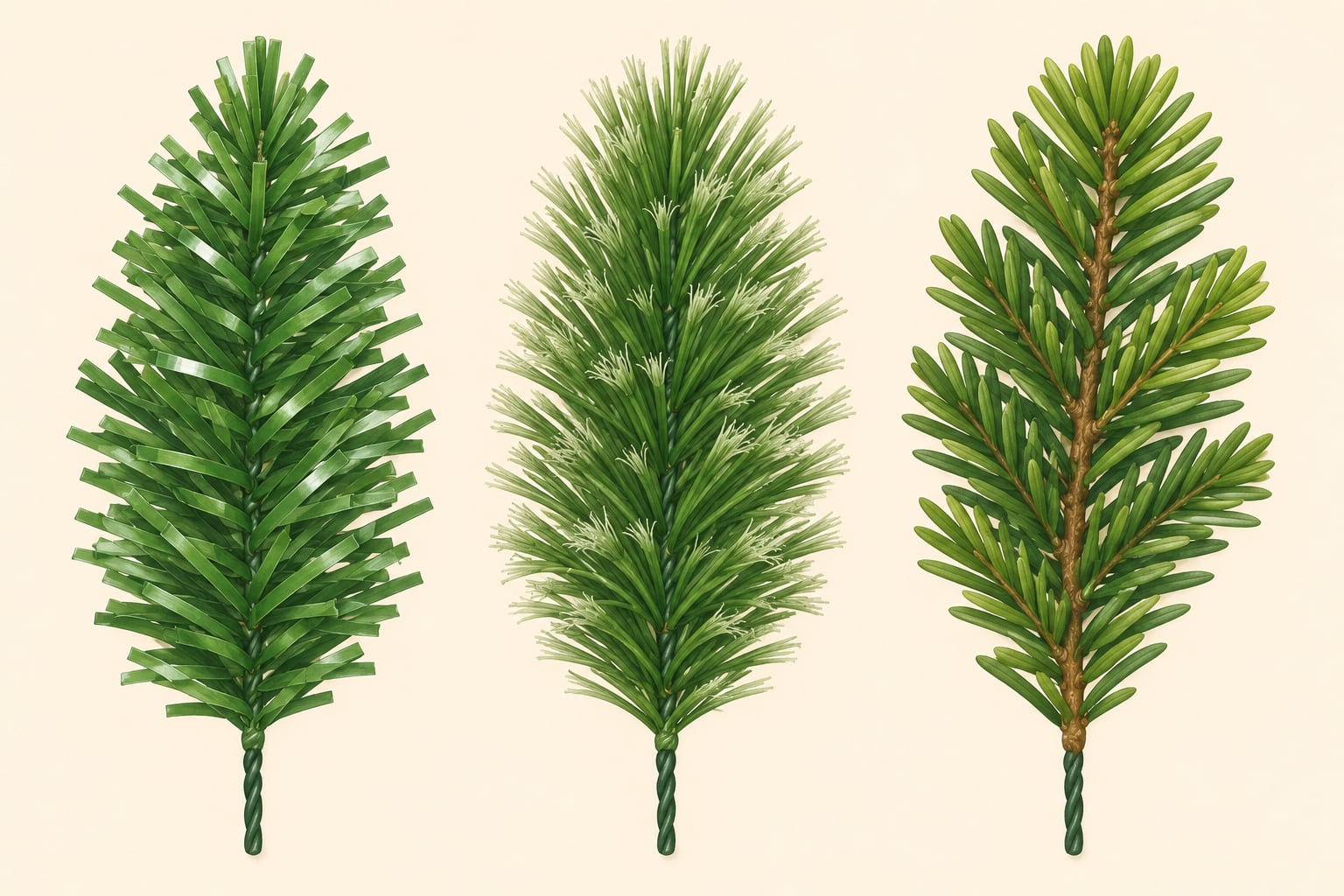
PE percentage is the biggest factor in how real an artificial tree looks, and "cashmere" won't tell you what it is. In our catalog, trees with cashmere tips run from 0 to 30 percent PE, all below the 50 percent our realism guide says looks good from across a room:
- The Celebration Pine and the Glitter Flocked Cashmere are 0 percent PE. Every tip is PVC, the cashmere-style ones included.
- The Jackson Spruce's listing says "PE, PVC, and hard needle construction" and counts "1,297 realistic branch tips," but our review puts its PE at about 5 percent. That's a lot of "realistic" for a tree that's mostly PVC.
- The Hayden Pine is 30 percent PE, with cashmere tips on most of its sizes.
None of that is a knock on 0 percent PE. On a classic, budget-friendly, or flocked tree, all-PVC construction is normal and honest. The trouble starts when a listing, or a shopper, treats "cashmere" as a realism claim.
To find out how much PE a tree has:
- Look for a PE percentage or a PE tip count. None of the cashmere listings we checked gives one, but some listings do. If a listing splits its tip count by material, divide the PE tips by the total.
- Read the materials line. A list like "PE, PVC, and hard needle" tells you there's some PE, not how much. In our catalog, trees that list all three run from about 5 percent PE (the Jackson Spruce) to 25 percent (the Ashland Glendale Spruce).
- Zoom in on the photos. Molded PE tips look like small real sprigs, with needles growing from a center stem. PVC tips, cashmere included, look like small bottle brushes.
- Check our catalog. Every tree we track lists its PE content on its page.
Under Flocking and Lights
Flocking suits a mix of cashmere and flat tips. Our review of the Glitter Flocked Cashmere says its mix of cashmere-style and flat PVC tips "actually works beautifully under flocking," because "different needle types catch and hold the flocking differently, creating visual depth." The same review notes that "some people actually find PE tips look odd when flocked," so an all-PVC flocked tree makes sense. One catch it reports: some tips pressed against others in the factory have incomplete flocking, though they tend to be interior branches you won't see.
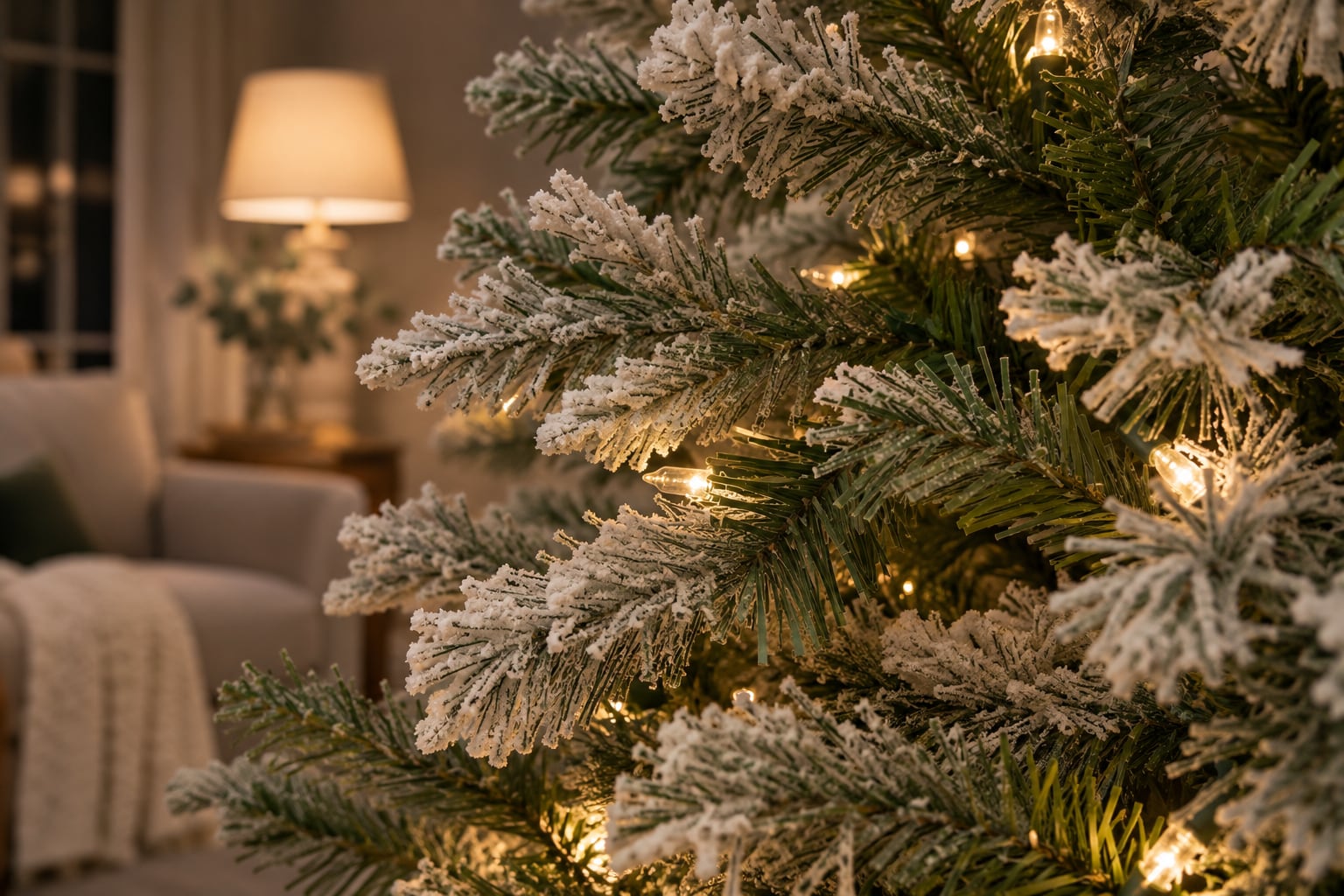
Under lights, cashmere tips are still PVC. Our realism guide puts the difference this way: PVC "reflects light like plastic," while PE needles "scatter light like real needles." Cashmere often comes with added sparkle, too. Ashland pairs the finish with glitter on its Stella Pine, and the Celebration Pine mixes silver tinsel strands into its branches, which our review says "catch light and add sparkle."
Who Should Buy a Cashmere Tree
Our realism guide's advice for heavy decorators sums up where cashmere fits: "Save money on PE percentage. You're covering it anyway."
Cashmere tips
Pros
- Fuller and more dimensional than flat PVC
- More texture to the touch than basic PVC tips
- Mixed with flat tips, they give flocking more depth
- Common on budget-friendly trees
Cons
- Still PVC, and it reads as PVC up close
- Doesn't tell you the PE content
- Means something different from brand to brand
- Takes the same careful fluffing as any PVC tree
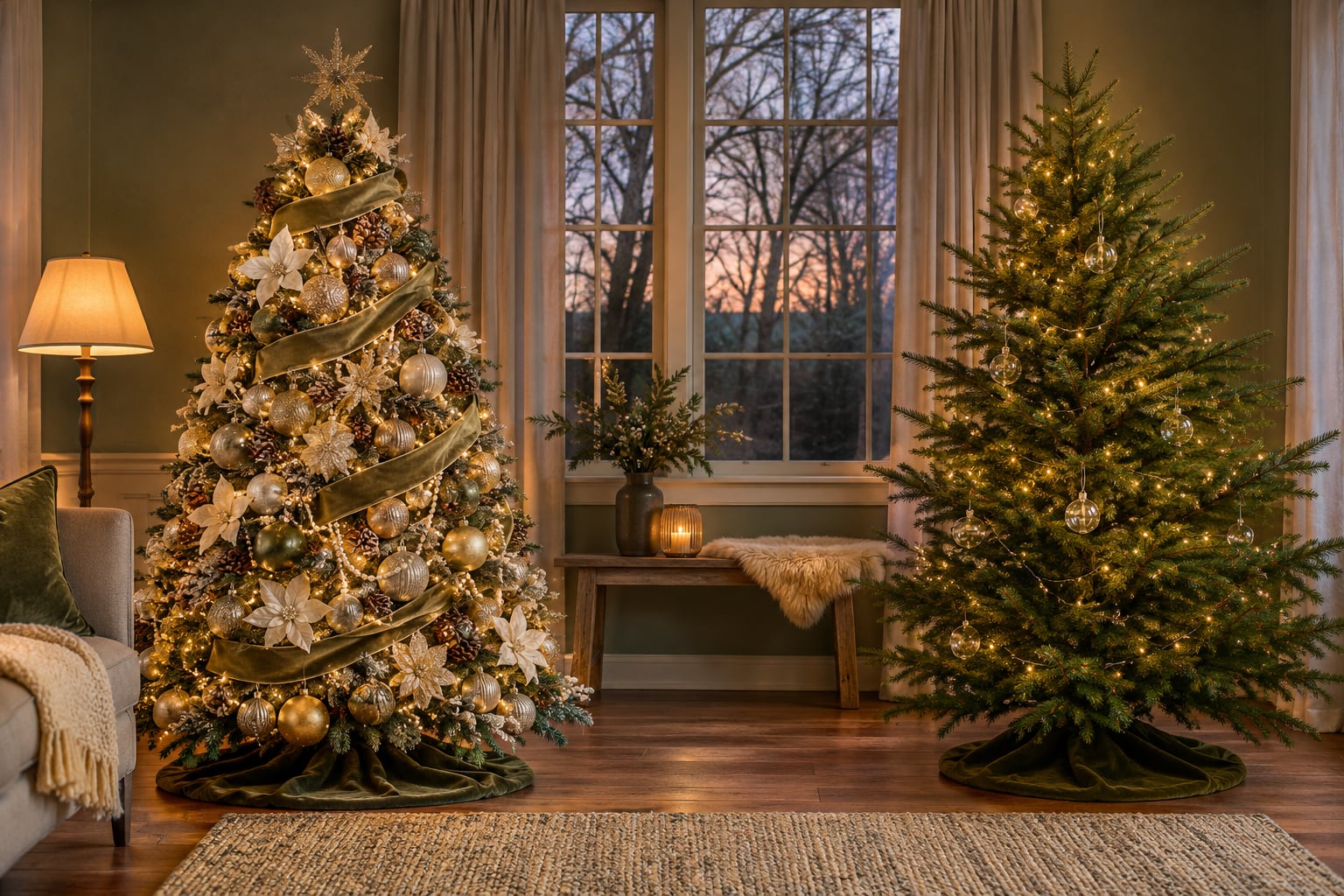
A cashmere tree makes sense if you want a full, textured tree and plan to cover it with ornaments, garland, or ribbon, or if you want a snowy flocked look. It's also a reasonable middle ground if you like the classic artificial-tree look and want more texture than flat PVC without paying for PE.
Shop by PE instead if you want a tree that looks real up close or one that still looks good with only a few ornaments. Our realism guide puts that at 70 percent PE or more, because "the tree itself is the star." Start with our most realistic artificial Christmas trees. The Balsam Hill Vermont White Spruce is 70 percent PE, and the Home Decorators Collection Elegant Grand Fir is all PE, though its review warns that the stiff needles make ornaments harder to hang.
Cashmere Christmas Tree Questions
Is a cashmere Christmas tree made of real cashmere?
No. A cashmere Christmas tree is an artificial tree, and "cashmere" describes the texture of its branch tips, not wool. The brand listings we checked give the tips as PVC, hard-needle PVC, or a mix with PE, and none mentions wool, though a few older web pages say the tips are treated with goat wool.
Are cashmere Christmas trees soft?
Softer than flat PVC, but not soft like the fiber they're named for. Most cashmere tips are hard-needle PVC, firm strands with a textured or frayed finish. Our review of the Ashland Jackson Spruce says its frayed ends "create a softer, more textured feel" than typical flat needles, but they're still firm plastic.
Do cashmere Christmas trees have PE tips?
Some do, but the name won't tell you which ones or how much. Trees with cashmere tips in our catalog range from 0 to 30 percent PE, and some listings name PE as a material without giving an amount. Look for a PE percentage or a PE tip count in the listing, or look the tree up in our catalog.
Is a cashmere tree better than a regular artificial tree?
It's more textured than a basic flat-PVC tree and usually looks fuller and more dimensional. It isn't more realistic than a tree with a high PE percentage. Choose cashmere for a full, textured, or snowy tree you'll decorate heavily, and a PE-heavy tree if you want it to pass for real up close.