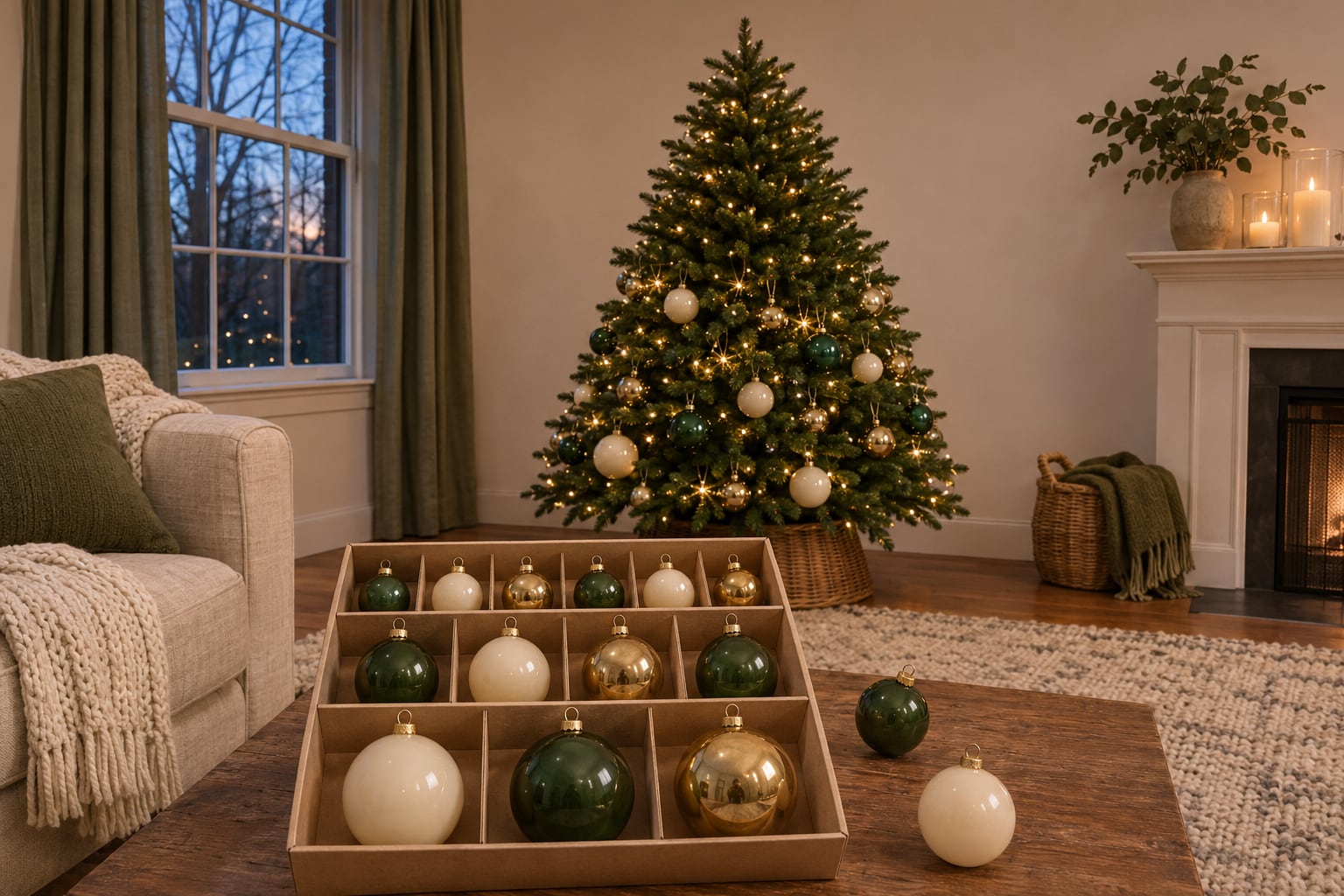
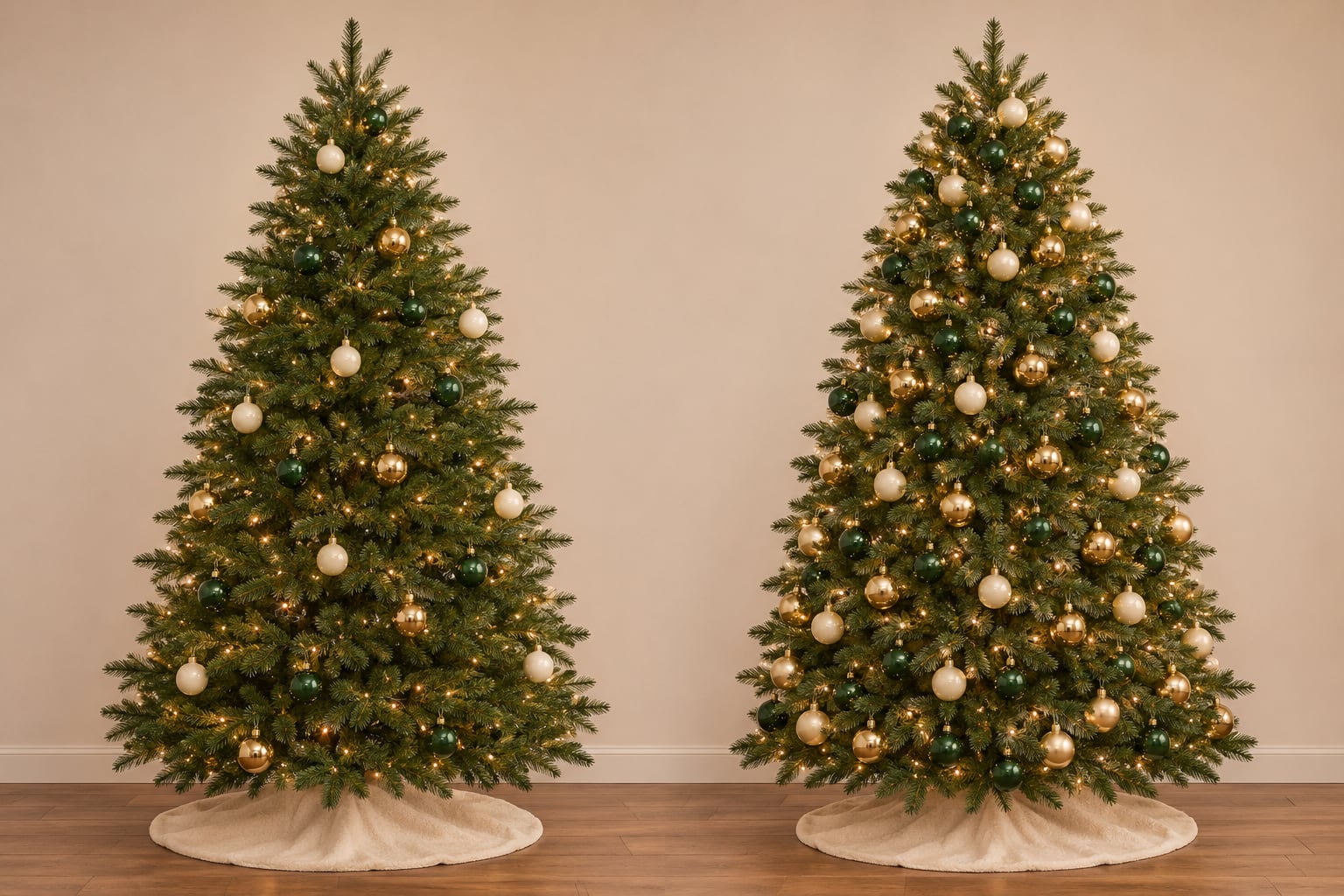
For a full 7-foot tree, plan on about 60 to 85 standard ornaments, meaning 3-inch balls, for a lighter look, and 85 to 120 for a fuller one. A 7.5-foot tree takes about 70 to 100 or 100 to 140, a 6-foot tree 50 to 70 or 70 to 95, and a 9-foot tree 95 to 135 or 135 to 185.
Those counts assume a full-profile tree and ornaments about 3 inches across. Slim and pencil trees take fewer, and the small balls that fill many multipacks count for much less than a standard one, so a box of 100 can cover a lot less tree than it sounds. The chart below runs from tabletop trees to 12 feet, and the sections after it adjust it for your tree and the ornaments you already own.
How Many Ornaments for Each Tree Height
Lighter means branches show between the ornaments. Fuller means ornaments reach every part of the tree, with some green still showing between them.
| Tree height | Lighter look | Fuller look |
|---|---|---|
| 4 ft | 20 to 30 | 30 to 45 |
| 5 ft | 35 to 45 | 45 to 65 |
| 6 ft | 50 to 70 | 70 to 95 |
| 6.5 ft | 55 to 75 | 75 to 105 |
| 7 ft | 60 to 85 | 85 to 120 |
| 7.5 ft | 70 to 100 | 100 to 140 |
| 8 ft | 80 to 115 | 115 to 160 |
| 9 ft | 95 to 135 | 135 to 185 |
| 10 ft | 110 to 160 | 160 to 220 |
| 12 ft | 145 to 205 | 205 to 285 |
The 7.5-foot row follows King of Christmas's and Ally Berry's per-foot rules, which put a 7.5-foot tree at about 75 to 135 ornaments. Balsam Hill's chart, which counts ornaments 4 to 8.75 inches long, lands close by, at 105 for light coverage and 140 for heavy coverage. Every other row scales with the tree's height times its width, which tracks how much outside surface there is to cover. The widths are typical ones for the full trees in our catalog: about 32 inches at 4 feet, 36 to 38 at 5 feet, 47 at 6 to 6.5 feet, 50 to 54 at 7 to 7.5 feet, 60 at 9 feet, and 69 at 12 feet. Our Christmas tree size guide gives the full range for each height. We track only a few 8- and 10-foot trees, so those rows use widths between their neighbors.
So the count climbs faster than the height: by the chart, a 4-foot tree takes about a third of a 7.5-footer's ornaments, and a 12-foot tree about twice as many. A rule of a fixed number per foot gives the small tree too many ornaments and the tall one too few.
How Many Ornaments for a Tabletop Tree?
On a 2- or 3-foot tree, 3-inch balls look oversized. King of Christmas suggests "petite baubles" for its small and tabletop trees, to "keep the tree from looking overloaded," so this chart counts 2-inch ornaments.
| Tree height | Lighter look | Fuller look |
|---|---|---|
| 2 ft (about 16 in wide) | 12 to 18 two-inch ornaments | 18 to 25 two-inch ornaments |
| 3 ft (about 24 in wide) | 30 to 40 two-inch ornaments | 40 to 55 two-inch ornaments |
In standard 3-inch balls, that's about 6 to 11 for a 2-foot tree and 12 to 25 for a 3-foot tree. The widths are the same ones our light count chart uses for tabletop trees.
Why Ornament Guides Disagree
Balsam Hill's decorating guide opens its ornament section with "There's no set rule for the number of ornaments on a Christmas tree," and the other guides prove it. For a 7-foot tree, the answers we found ran from about 45 to 400.
The most common rule is 10 to 15 ornaments per foot of height. King of Christmas calls that "a full, traditional look." Ally Berry's decorating guide and two decor stores' guides we read give the same range for trees under 9 feet, and Ally Berry and one of the stores give 12 to 20 per foot for taller trees. At the low end, the ornament maker Old World Christmas says "6.2 ornaments per foot of Christmas tree is the most pleasing ratio," a figure it credits to university math students, though it admits its own staff "decidedly do not adhere to" it.
Three things pull the numbers apart:
- Ornament size, often unstated. Balsam Hill's chart, 105 ornaments for light coverage on a 7.5-foot tree and 140 for heavy coverage, "considers ornament sizes ranging from 4 inches to 8.75 inches long." One decor store's size chart puts a 6- to 7-foot tree at 200 to 400 ornaments by assuming 1.5- to 2.5-inch ones, on the same page that recommends 10 to 15 per foot. They're counting different things, which explains much of the gap, though not all of it.
- Height without width. Per-foot rules treat every foot of tree the same, but the bottom feet are much wider than the top ones, and the brands' own charts bend away from their rules. King of Christmas's chart gives trees under 3 feet 10 to 20 ornaments, where its per-foot rule would allow up to 45, and gives 8- to 9-foot trees 110 to 150. Balsam Hill's works out to about 11 to 16 per foot at 6.5 feet and 17 to 23 per foot at 9 to 10 feet.
- Labels. One guide's light look is another's full one. Balsam Hill calls 70 to 100 ornaments "minimalist," while King of Christmas's "full, traditional" rule puts a 7-foot tree at 70 to 105.
Our chart counts one size, 3-inch balls, and scales by surface, which is what the brands' charts do loosely. The next three sections adjust it.
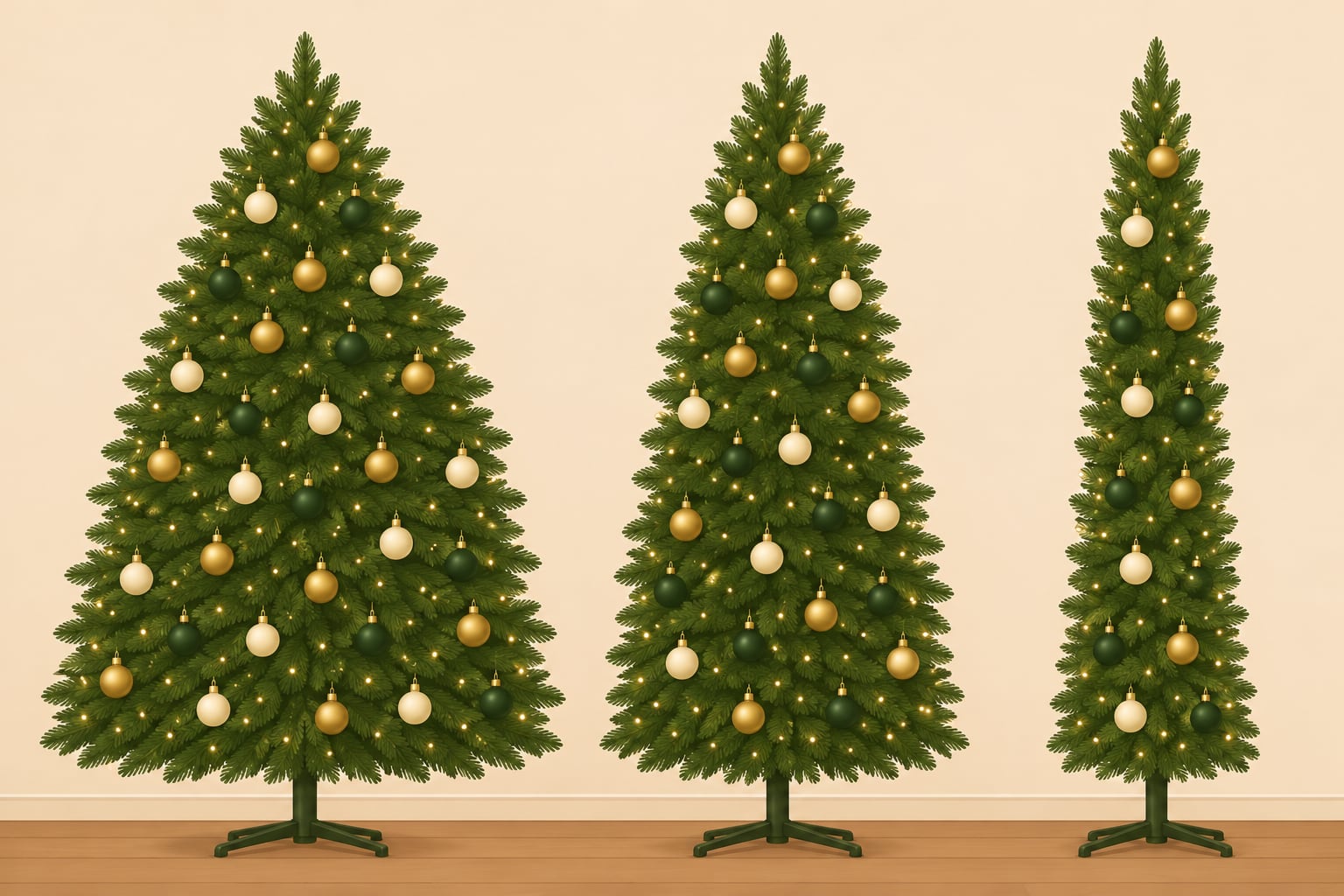
Slim, Pencil, and Extra-Wide Trees
The chart assumes a full-profile tree. A narrower tree of the same height has less to cover, so scale the count by width: divide your tree's width by the typical width for its height.
- Slim. Holiday Living's Parque, now discontinued, came as a full 7.5-foot tree 55 inches wide and a slim one 44 inches wide. The slim one takes about four-fifths as many ornaments, about 80 to 115 for a fuller look instead of 100 to 140.
- Pencil. The Sanford Pencil Fir is 36 inches wide at 7.5 feet, two-thirds of a typical full tree, so plan on about 65 to 95 for a fuller look.
- Very narrow. The Ashland Glacier Fir is sold as slim but is only 29 inches wide at 7.5 feet. It takes about half the chart's count.
- Extra wide. At 7.5 feet, the Vermont White Spruce is 66 inches wide, so it takes about a fifth more than the chart, about 120 to 170 for a fuller look.
Ally Berry's guide lands in the same place for narrow trees: about 20 percent fewer for a slim tree and about 35 percent fewer for a pencil tree. King of Christmas also suggests smaller ornaments on slim and pencil trees "regardless of the tree's height"; if you take that advice, count them by size, as the next section explains. Our slim vs pencil comparison lists the width of every slim and pencil tree we track at 7 to 7.5 feet, and its ornaments section covers what to hang on them.
A sparse tree, built with open space between its layers of branches, takes fewer ornaments than its width suggests, because each one hangs in the open where it shows. Our sparse tree guide covers how to decorate one.
Big Ornaments, Small Ornaments, and the Box You Already Own
Small ornaments cover less of the tree than their count suggests, because a ball half as wide covers only about a quarter as much. So count small ones by size:
- A 1.5-inch (40 mm) ball counts as about a quarter of a standard one.
- A 2-inch (50 mm) ball counts as a bit under half.
- A 2.5-inch (65 mm) ball counts as about two-thirds.
- A 3-inch ball or anything bigger counts as one. Big ornaments get their own adjustment below.
Sets usually list sizes in millimeters: 60 mm is about 2.4 inches, 80 mm about 3.1, and 100 mm about 3.9. For shapes that aren't round, go by how wide they are.
Multipacks are sold by the piece, which makes the small sizes look like more than they are. One 87-piece shatterproof set we looked at holds 44 balls at 40 mm, 32 at 60 mm, and 11 at 80 mm, and its listing calls it a "perfect fit for any normal size tree." By the space they cover, those 87 pieces add up to about 43 standard ornaments. That's a lighter look on a 5-foot tree, and well short of even a lighter look at 7.5 feet. If your tree looks bare with a hundred ornaments on it, small sizes are a likely reason.
To check the box you already own, sort it by size, count each pile, and convert. Say you have 40 standard balls, 20 four-inch ones, and 30 two-inch ones: that's 40, plus 20, plus about 13, or about 73 standard ornaments. That's a lighter look on a 7-foot tree. For a fuller one, add 25 to 30 standard balls, which puts you at about 100, the middle of the fuller range.
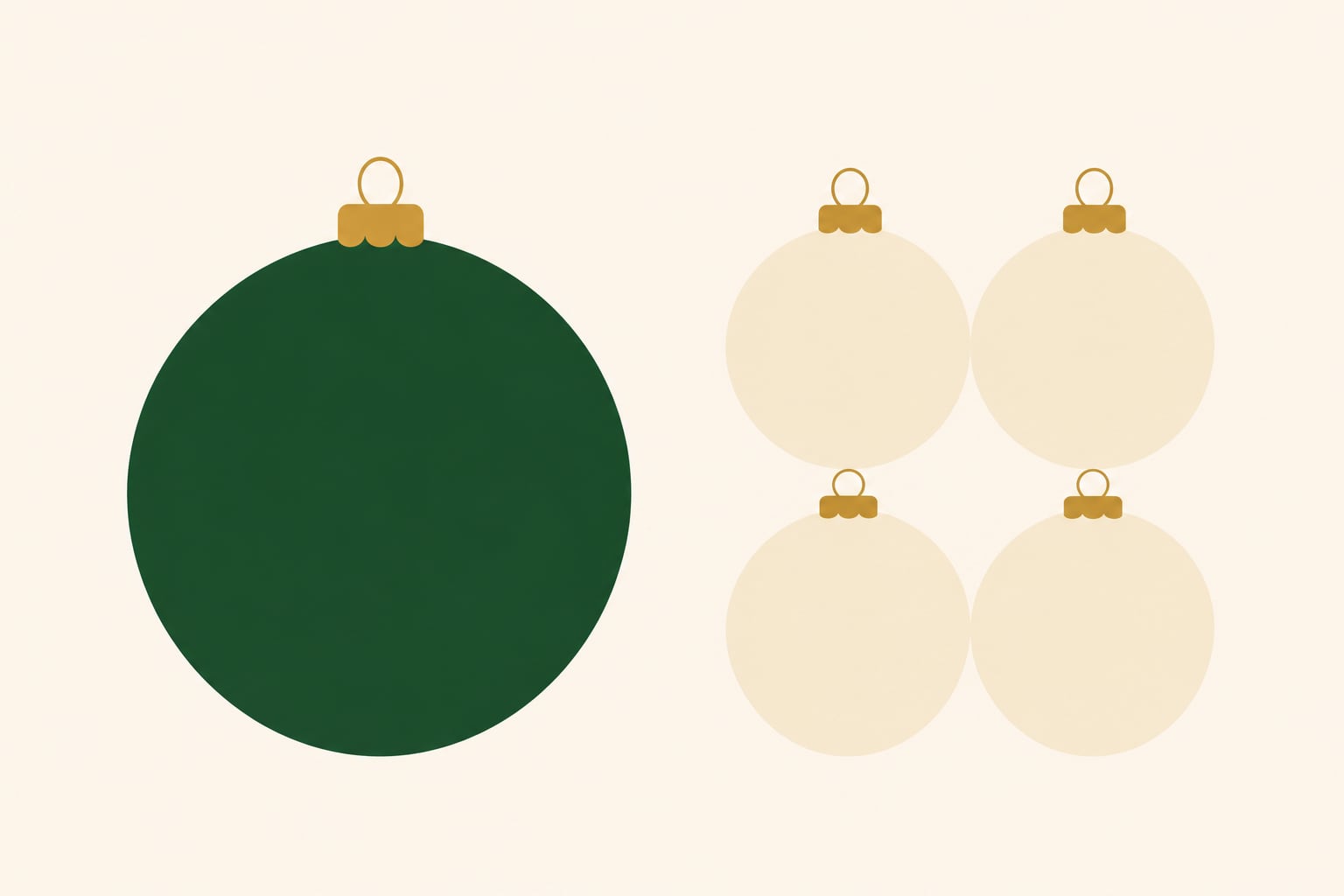
The guides suggest mixing sizes, and they agree on where each goes. Balsam Hill suggests combining small (1 to 2 inch), medium (3 to 4 inch), and large (5 to 8 inch) ornaments, starting with the larger ones, which "are heavier and look best towards the bottom of the tree," and placing them "deeper into the foliage," with smaller balls "closer to the branch tips." It also suggests ornaments around 2 to 3 inches for 4- to 6-foot trees and 4 to 6 inches for taller ones.
A tree of mostly big ornaments takes fewer pieces, but not as many fewer as their size suggests. Part of the reason is placement: big ones hang deeper in the branches, where the foliage hides part of each one. Ally Berry's guide suggests starting about 15 to 30 percent lower when most of your ornaments are 5 inches or bigger, which puts a fuller 7.5-foot tree at about 70 to 120 of them.
Lights and Ribbon Change the Count
Lights and ornaments trade off. Our light count chart gives a tree loaded with ornaments its classic count, about 70 to 90 mini lights per foot on a 6- to 10-foot tree, and saves the lush and statement counts, 100 or more per foot, for a tree with few ornaments or an all-white theme. So a pre-lit tree with a big light count can look finished with the lighter column: the Vermont White Spruce carries 1,440 mini lights at 7.5 feet, about 190 per foot. An unlit tree you light at the classic count is the one to fill with ornaments.
Ribbon, garland, and picks take up space that ornaments would otherwise fill. Balsam Hill says they "make ornament counts go further," and Ally Berry suggests starting 10 to 20 percent lower on a tree layered with them. If you're adding ribbon, Balsam Hill's ribbon chart works out to about 3 yards per foot of tree, or 22.5 yards for a 7.5-foot tree. On trees 10 feet and up, King of Christmas suggests starting with garland and ribbon "as your structural framework" and building the ornaments around it.
Will the Branches Hold Heavy Ornaments?
Usually, if you hang them in the right place. We didn't find a tree maker that publishes a weight limit for its branches, and Bob Vila's 2026 hands-on tests describe their ornaments only as "heavy" and "our heaviest," without weights. So go by where a branch is strongest and by what reviews say about the tree you have.
Hang heavy ornaments near the trunk and low on the tree. The same ornament bends a branch more the farther out it hangs, like a weight at the end of a diving board. King of Christmas says heavier ornaments "usually like to sit closer to the trunk, lighter ones work outward toward the tips," and Balsam Hill puts its larger ornaments toward the bottom and deeper into the branches. Keep the lightest pieces for the top section, the thinnest part of the tree.
That runs into pet safety. Our cat-proof tree guide keeps glass and wire hooks off the lower branches, the part a cat can bat and a dog can reach. With pets, hang heavy glass above that zone, close to the trunk, and save the bottom for unbreakable ornaments.
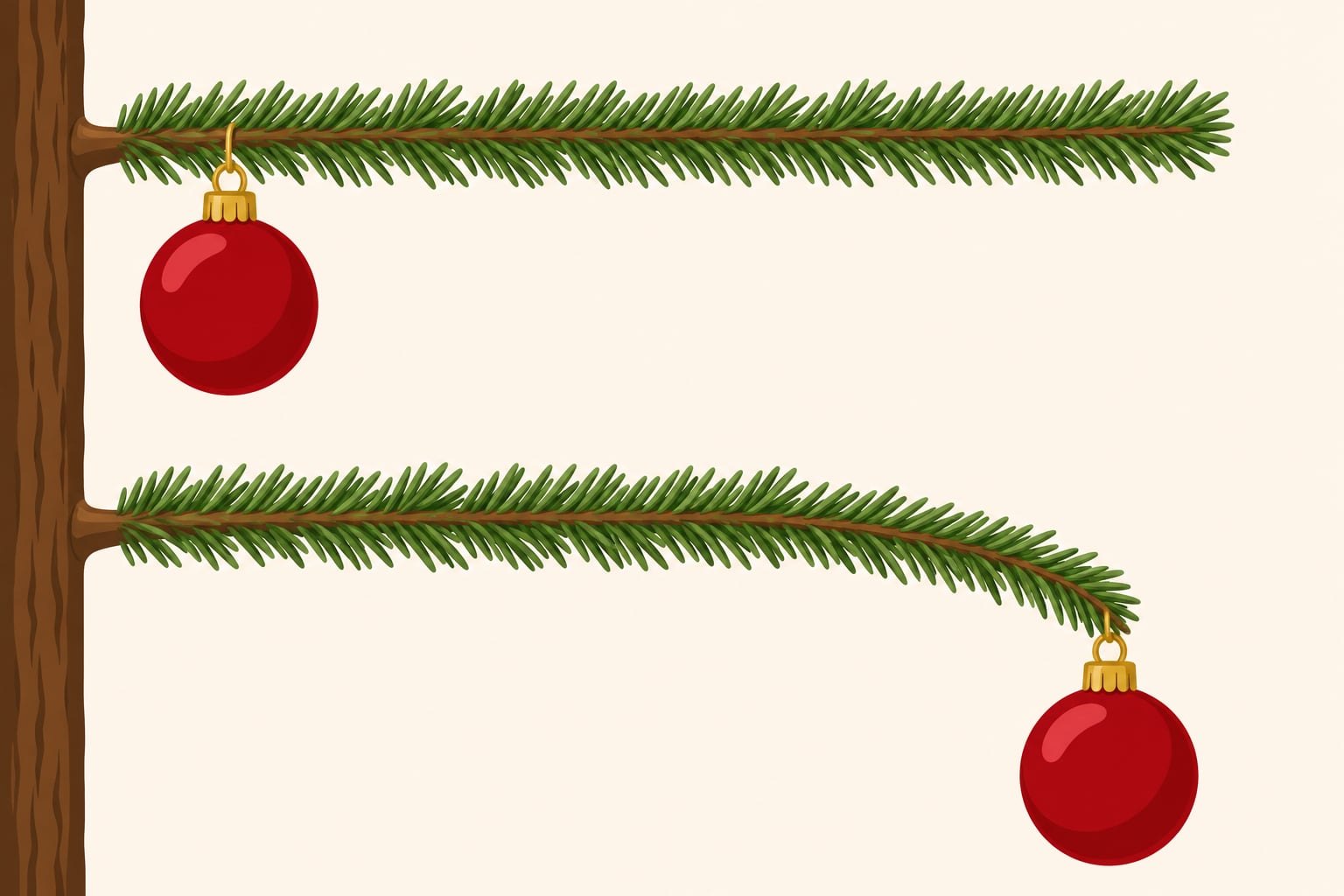
Needle type changes how ornaments hang, but it won't tell you what a branch can hold. Molded PE tips can be stiff or soft, and each gets in the way differently. On the all-PE Elegant Grand Fir, our review found "the stiff, realistic needles that look so good are harder to work with when hanging ornaments compared to softer PVC," and suggests lighter ornaments placed farther back on the branches. The soft, drooping PE fronds on the My Texas House Cypress bend instead, so its review has you "hanging ornaments toward the trunk, not on the outer branches." The weight itself rides on the wire inside the branch, which most listings don't describe.
Branch angle is a clue, not a guarantee. A branch that angles upward has room to dip under a heavy ornament before it droops, and our Vermont White Spruce review found its "strong upward-sloping branches handle heavy ornaments with ease." Downswept branches aren't automatically weak, though. In Bob Vila's tests, a downswept National Tree Company fir held "our heaviest ornaments without sagging," while the branches on a Balsam Hill flip tree "sagged under heavy ornaments."
So before loading a tree with heirloom glass, read its reviews for ornament complaints, and when a branch tip starts to dip, move the ornament closer to the trunk.
Ornament Count Questions
How many ornaments do I need for a 7 foot Christmas tree?
About 60 to 85 standard 3-inch ornaments for a lighter look and 85 to 120 for a fuller one, on a full 7-foot tree about 50 inches wide. For a narrower tree, scale by width: a pencil tree 28 to 30 inches wide takes a little over half. Count each 2-inch ornament as a bit under half of a standard one and each 1.5-inch ornament as about a quarter.
How many ornaments do I need for a 7.5 foot Christmas tree?
About 70 to 100 standard 3-inch ornaments for a lighter look and 100 to 140 for a fuller one, on a full tree about 54 inches wide. A 44-inch slim tree takes about a fifth fewer and a 36-inch pencil tree about a third fewer. Balsam Hill's chart, which assumes ornaments 4 to 8.75 inches long, gives 105 for light coverage and 140 for heavy coverage.
How many ornaments do I need for a 6 foot Christmas tree?
About 50 to 70 standard 3-inch ornaments for a lighter look and 70 to 95 for a fuller one, on a full 6-foot tree about 47 inches wide. Balsam Hill suggests ornaments around 2 to 3 inches for trees from 4 to 6 feet. If yours are mostly 2-inch balls, you'll need a bit more than twice as many.
How many ornaments do I need for a 9 foot Christmas tree?
About 95 to 135 standard 3-inch ornaments for a lighter look and 135 to 185 for a fuller one, on a full tree about 60 inches wide. That's about a third more than a 7.5-foot tree, not a fifth more, because a 9-foot tree is wider as well as taller. Balsam Hill suggests 4- to 6-inch ornaments for taller trees, and if most of yours are 5 inches or bigger, Ally Berry's guide suggests starting about 15 to 30 percent lower.
How many ornaments per foot of Christmas tree?
On a full 7.5-foot tree, about 9 to 13 standard 3-inch ornaments per foot of height for a lighter look and 13 to 19 for a fuller one. The rate changes with height, because taller trees are wider too: a 4-foot tree takes only about 5 to 11 per foot, and a 12-foot tree about 12 to 24. The common rule of 10 to 15 per foot fits trees of about 6 to 9 feet.
Is 100 ornaments enough for a Christmas tree?
For a full 7- to 7.5-foot tree, yes, if they're standard 3-inch ornaments: 100 is about where a lighter look turns fuller at 7.5 feet. If most of them are small, it's less than it sounds. An 87-piece multipack of 1.5- to 3-inch balls covers about as much tree as 43 standard ornaments. On a 9-foot tree, 100 standard ornaments gives a lighter look.
How many ornaments do I need for a small or tabletop tree?
A full 4-foot tree about 32 inches wide takes about 20 to 30 standard 3-inch ornaments for a lighter look and 30 to 45 for a fuller one. Tabletop trees look better with small ornaments: a 3-foot tree takes about 30 to 55 two-inch ornaments, and a 2-foot tree about 12 to 25.