
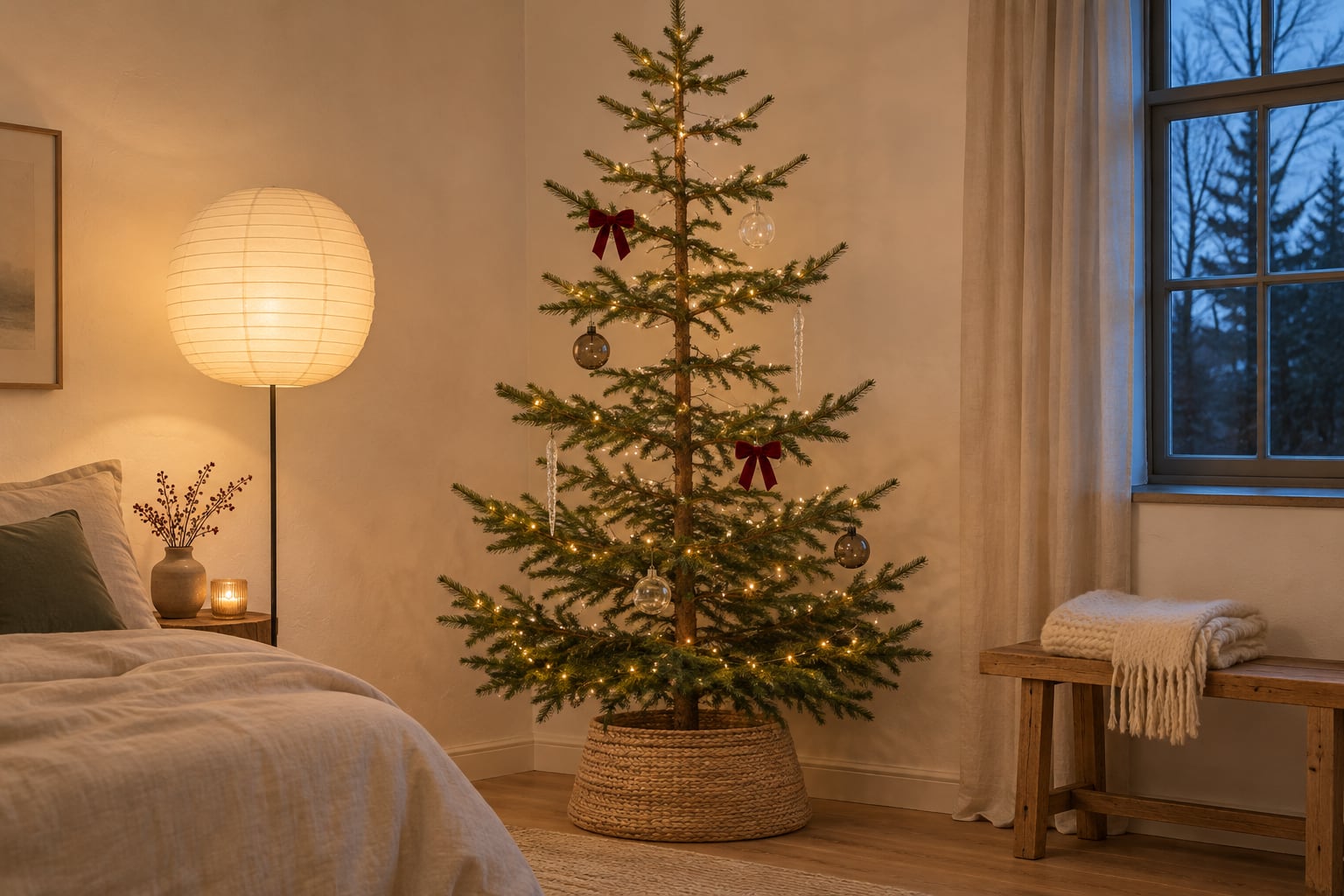
A sparse Christmas tree is built with open space between its layers of branches. You can see the trunk through the gaps, and ornaments hang in that open space instead of resting on the branch below. The look copies an evergreen that grew on its own, before anyone sheared it into a dense cone, and it's a style choice, not a cheaper tree with branches missing.
What makes a tree sparse is how its branches are spaced, not how many tips it lists, and sparse comes in degrees, from flat tiers on a bare trunk to trees that only open up near the top. Decorate one lightly: lights woven along the branches, fewer ornaments hung in the gaps, and the heavy ones close to the trunk.
Where the Open Look Comes From
Left alone, a lot of conifers grow in layers. The U.S. Forest Service's silvics manual says Scotch pine forms "one whorl of branches per year," a ring of branches with a stretch of bare trunk above it, and that a fast-growing tree spaces its whorls far enough apart to leave "a thin crown." Christmas tree farms close those gaps on purpose:
Pruning and shearing produce the symmetrical, high-density, cone-shaped characteristics of a quality Christmas tree.
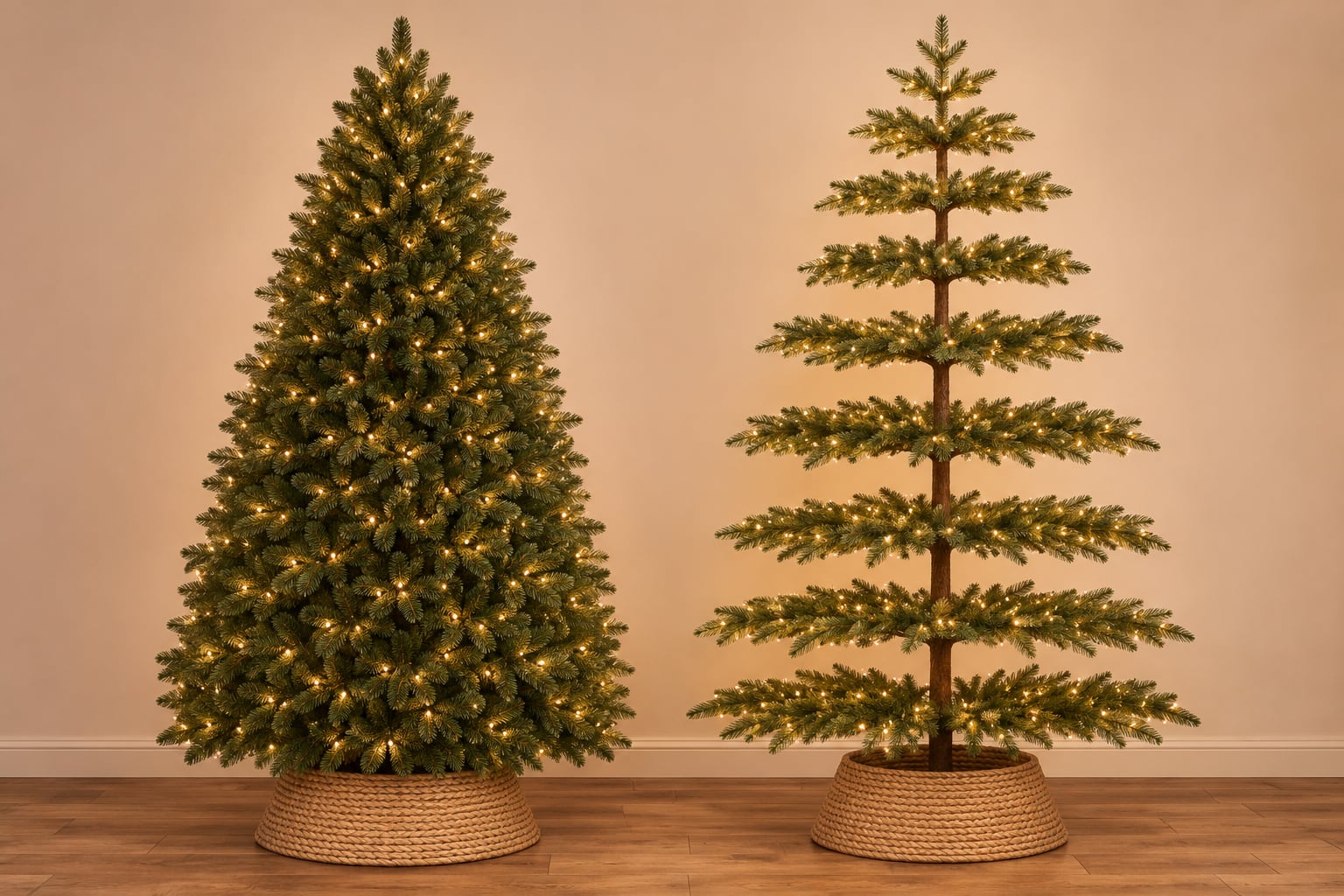
The same fact sheet says a well-shaped, dense tree has "a fairly uniform spacing of 8 to 10 inches between the whorls," and that once shearing starts, "it must be done every year to maintain uniform density." The full, bushy Christmas tree is a farm product. A sparse artificial tree copies the tree before the shears, with distinct layers of branches and open trunk between them.
Makers point to mountain and forest evergreens for the look. Balsam Hill says its Alpine Balsam Fir "takes inspiration from beautiful mountain evergreens," and King of Christmas says its Rushmore Fir is crafted "to capture the beauty of the Ponderosa Pine." Some species look open even on a farm, and our guide to the types of Christmas trees notes that noble fir tends to grow in more open tiers than Fraser fir. Both brands also invoke the Charlie Brown tree when they describe their sparse trees.
Sparse Means Spacing, Not a Low Tip Count
It's easy to read sparse as "fewer tips," and some sparse trees do list fewer. Here are five 7.5-foot trees sold or reviewed as sparse, next to the middle half of the full-profile 7.5-foot trees in our catalog:
| Tree, 7.5 ft | Width | Branch tips |
|---|---|---|
| Balsam Hill Yukon Spruce | 60 in | 651 |
| My Texas House Cypress | 50 in | 730 |
| Balsam Hill Alpine Balsam Fir | 48 in | 1,368 |
| King of Christmas Rushmore Fir | 65 in | 3,076 |
| Balsam Hill Aspen Silver Fir | 72 in | 5,685 |
| Full-profile trees, middle half | 50 to 56 in | 1,556 to 3,189 |
The Yukon Spruce and the My Texas House Cypress list fewer tips than nearly every full-profile 7.5-foot tree we track, and the Alpine Balsam Fir fewer than most. The Rushmore Fir falls inside the middle half. The Aspen Silver Fir lists more than twice the median, and Balsam Hill's own spec sheet still rates its density "Sparse," the low end of a scale that runs up to "Exceptionally Full." That same spec sheet says "a typical 7.5 ft tree with 1,500–2,500+ tips appears full."
So the count doesn't decide it. Balsam Hill says its sparse trees are "designed with spacious gaps between layers of foliage," and branches grouped in layers with open trunk between them read as sparse whatever the total. Treat the cross-brand numbers as rough, though, since makers don't all count tips the same way.
It works the other way as well. The Holiday Living Snowy Berkshire lists 657 tips at 7.5 feet, even fewer than the cypress, and our review calls that "appropriate for a pine," since its long needles fill out each tip. Low counts on long-needle trees are normal and don't make them sparse.
Width doesn't define a sparse tree either. Long branches with room between them still take up floor space, and three of the five trees above are wider than a typical full-profile tree. If floor space is your problem, you want a narrow profile, which our guide to slim vs pencil Christmas trees covers. A tree can be both: Balsam Hill describes its Alpine Balsam Fir as having a "sparse, slim silhouette."
Sparse Comes in Degrees
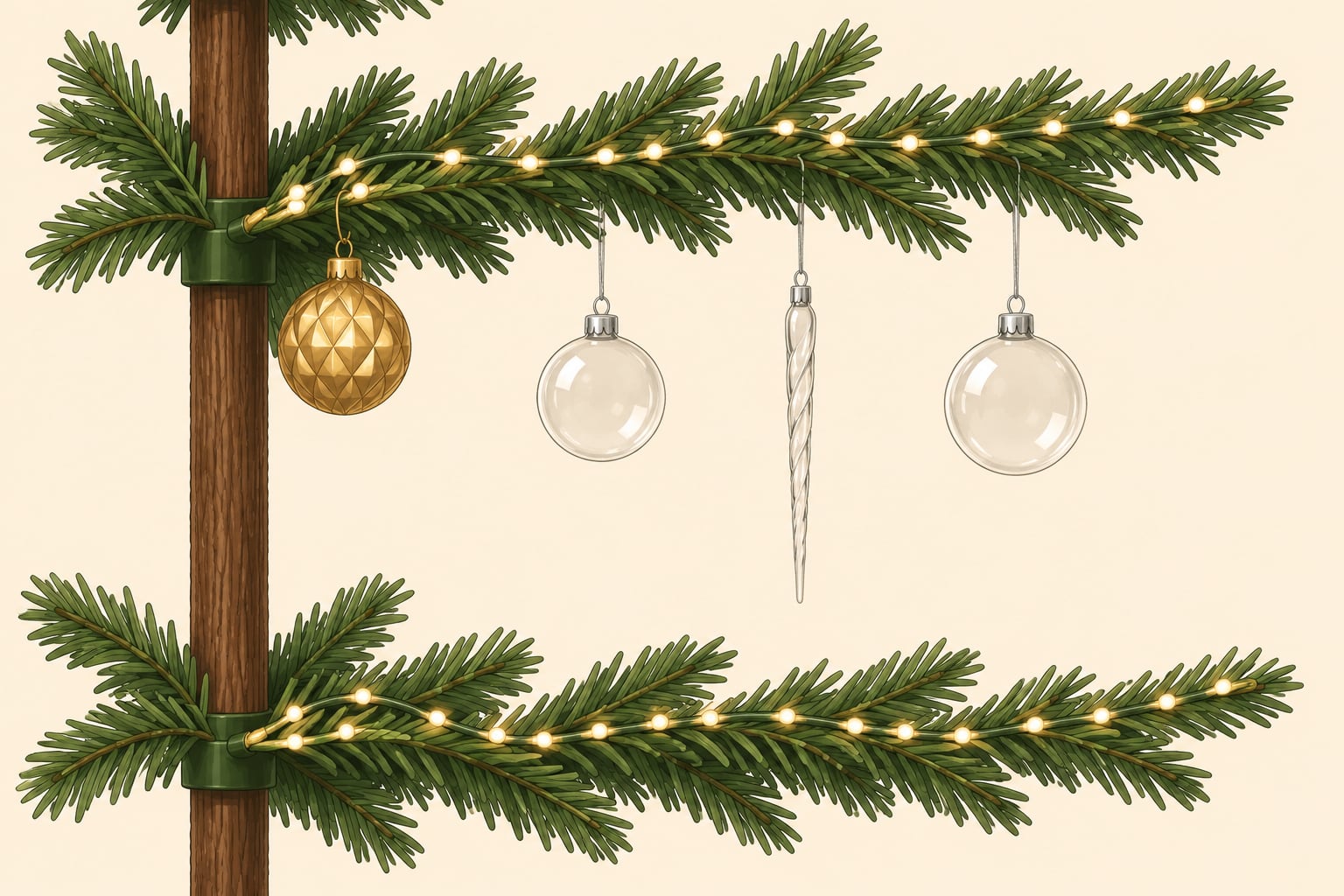
Not every sparse tree is as bare as the one pictured above. Balsam Hill's spec sheets give the same "Sparse Tree" shape to trees that range from mostly trunk to fairly full, and across the makers' sparse lineups, three looks stand out.
Flat tiers on a bare trunk. Level tiers stacked far apart, closer to a display stand than a tree. Balsam Hill's Calistoga Ornament Tree is built this way, and the name tells you what it's for. It isn't short on tips, either: the 6-foot Calistoga lists 2,469, all packed into those tiers.
Open layers. Natural-looking layers from top to bottom, a little fuller toward the bottom, with trunk showing between them all the way down. That's the look of Balsam Hill's Alpine Balsam Fir and King of Christmas's King Noble Fir, which run 48 to 50 inches wide at 7 to 7.5 feet and both come in flocked versions. The My Texas House Cypress is open too, with soft, drooping cypress fronds in place of stiff fir branches.
Fuller layers. The layers still show near the top, but the lower branches are long and full enough to overlap, so the trunk only peeks through below. Balsam Hill's Aspen Silver Fir and European Fir look like this, and the brand rates the European Fir "Medium" on its density scale, two steps above the Sparse rating on most of its sparse trees. King of Christmas describes its Rushmore Fir as "a wider, more naturalistic sparse silhouette with long, sweeping branches." Those long branches need room: the Aspen and European Fir are 6 feet wide at 7.5 feet, and the Rushmore is 65 inches.
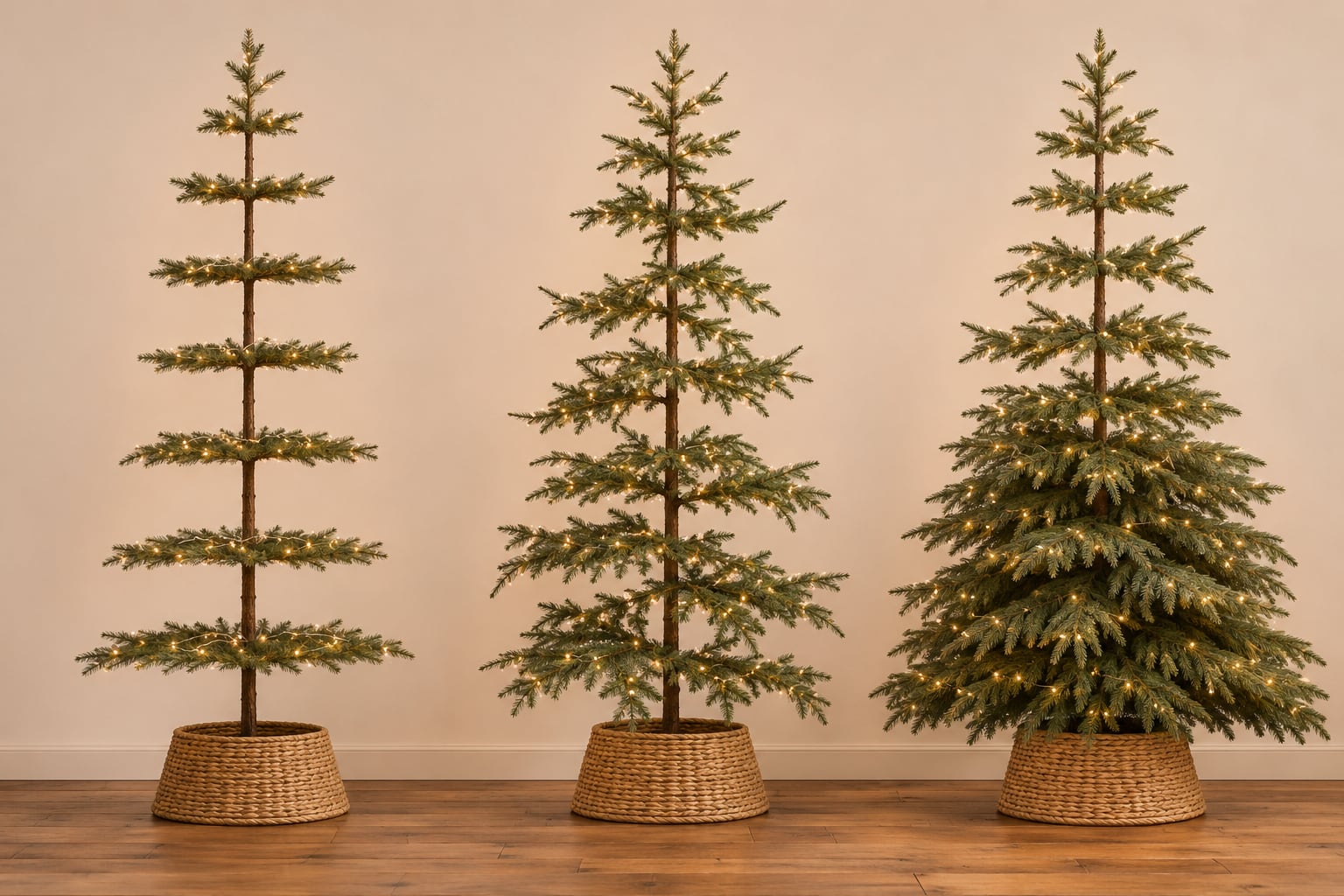
The more open the tree, the more the ornaments become the show, and the barer it looks without them. A fuller sparse tree still leaves room for ornaments, but it holds up better undecorated and shows less trunk and cord. The shape label won't tell you which one you're getting, so look at the photos and check how much trunk shows in the bottom third of the tree.
Sparse by Design, or Just Thin?
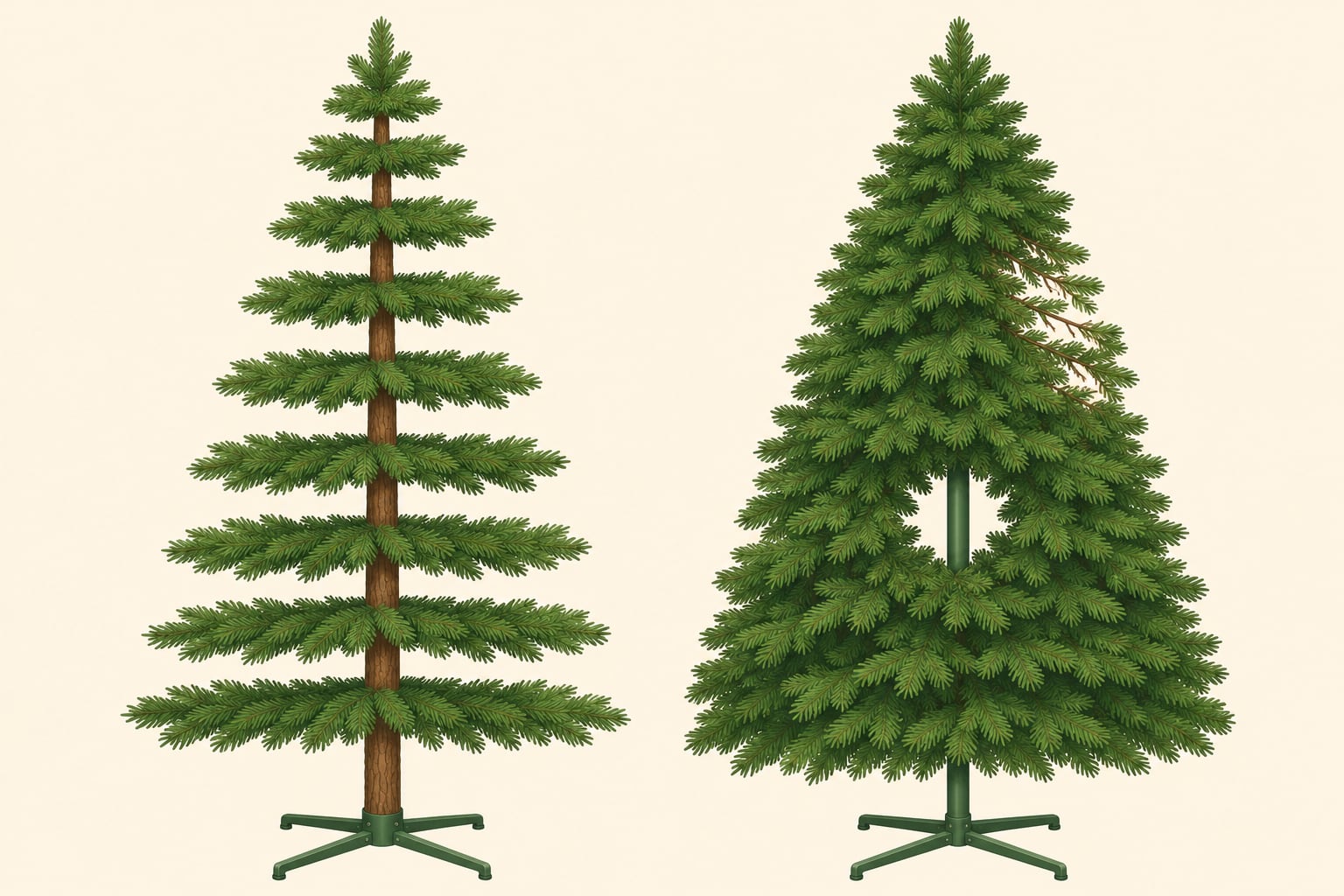
"Sparse" also gets used for a full tree that came up short, and that's a different thing to buy. As our tree-types guide puts it, "gaps on an artificial tree usually look like a defect." On a tree built sparse, the gaps are the design. Two things tell them apart.
How it's sold. A tree built sparse usually says so. Balsam Hill calls its Alpine Balsam Fir "sparse by design" and lists a "Sparse Tree" shape on the spec sheet. If the listing promises a full tree and owner photos show holes, it's a thin tree, whatever the reviews call it.
Where the gaps are. On a tree built sparse, the gaps follow a pattern: they sit between complete layers and look about the same all the way around. On a thin tree, they're one-offs: a bald patch on one side, a see-through middle, an extra-wide gap where two sections meet, and they can vary from one unit to the next. Our Milford Pine review, for one, warns that "even with dedicated effort, expect some gaps and see-through spots, especially in the center of the tree." That's a full tree short on branches, not a sparse one.
Either way, look at owner photos of the whole tree, lit, before you buy. A tree built sparse can still arrive barer than its listing: our My Texas House Cypress review, for the one tree in our catalog built sparse on purpose, lists "Product photos show a fuller tree than what arrives" as a con.
How to Decorate a Sparse Christmas Tree
You might not decorate it much at all. Our My Texas House Cypress review says "some buyers love the tree as-is with just the lights, treating it as a sculptural element that doesn't need much embellishment." If you do decorate, go in this order.
- Fluff each layer. Spread each layer's branches out before anything goes on, as our fluffing guide describes. Fluffing fills out each layer, but it won't close the space between layers. That's set by where the branches attach to the trunk.
- Count lights by the branches, not the height. Pre-lit sparse trees are all over the map at 7.5 feet: 450 fairy lights on the Alpine Balsam Fir, 500 LEDs on the My Texas House Cypress, and 1,200 LEDs on the Yukon Spruce. For an unlit one, our light-count chart puts a full 7.5-foot tree at 525 to 675 mini lights for a classic look, and about twice that for micro or fairy lights. A sparse tree with a few short layers needs less than that, and a wide one with long branches can need as much, so start low and add a strand if the layers look dark.
- Light it along the branches. If your tree is unlit, weave each strand out along a branch toward the tip and back toward the trunk, the method in our guide to hanging lights on a Christmas tree, and run the connections down the trunk. On a sparse tree, any wire that crosses from one layer to the next hangs in plain view against the open space, and wrapping lights around the outside strings wire across every gap. Fairy lights on thin wire are the easiest to hide. For a glow from inside, Nearly Natural suggests "wrapping strands close to the trunk, illuminating the airy structure."
- Hang ornaments in the gaps. On a full tree, an ornament sinks into the needles and leans on the branch below. On a sparse tree, it hangs free in the space between layers, where it can turn and catch the light and where you can see it from across the room. Because every one shows, you need fewer. As King of Christmas says, "each ornament is visible and appreciated, so a smaller collection works perfectly." Spread them around each layer rather than filling every gap, since the open space is part of the look. Long shapes suit the tall gaps. Balsam Hill suggests finial ornaments that "dangle between branches," and King of Christmas suggests long icicle ornaments. Hang some deeper in, too, where the lights near the trunk reach them.
- Go by what the branches can hold. Nearly Natural suggests "larger, unique pieces" hung "deeper into the tree's open branches," and deeper in is where the support is. Our My Texas House Cypress review says "you'll need to hang decorations closer to the trunk where the branch wiring provides support," and the tree's page rates it poor for heavy ornaments. Before you load up any sparse tree, look for owner reviews that mention ornament weight.
- Keep fillers loose. Ribbon, bows, tree picks, and beaded garland all suit a sparse tree if they stay loose. King of Christmas suggests picks tucked through the branches and "loosely draped ribbon," and Balsam Hill suggests beaded garland. Garland wrapped tightly around the outside fills the very gaps the tree is built around.
- Finish the base. A sparse tree shows more of its stand. A skirt or a collar hides it, and Balsam Hill suggests "a woven or galvanized metal tree collar" for its sparse trees.
Who Should Get a Sparse Tree
A sparse tree suits you if you have ornaments worth showing off and want each one seen, if your room leans minimal, or if you like a tree that looks finished with almost nothing on it. The My Texas House Cypress goes up fast, too: our review says most owners report setup "in under 10 minutes," with little fluffing.
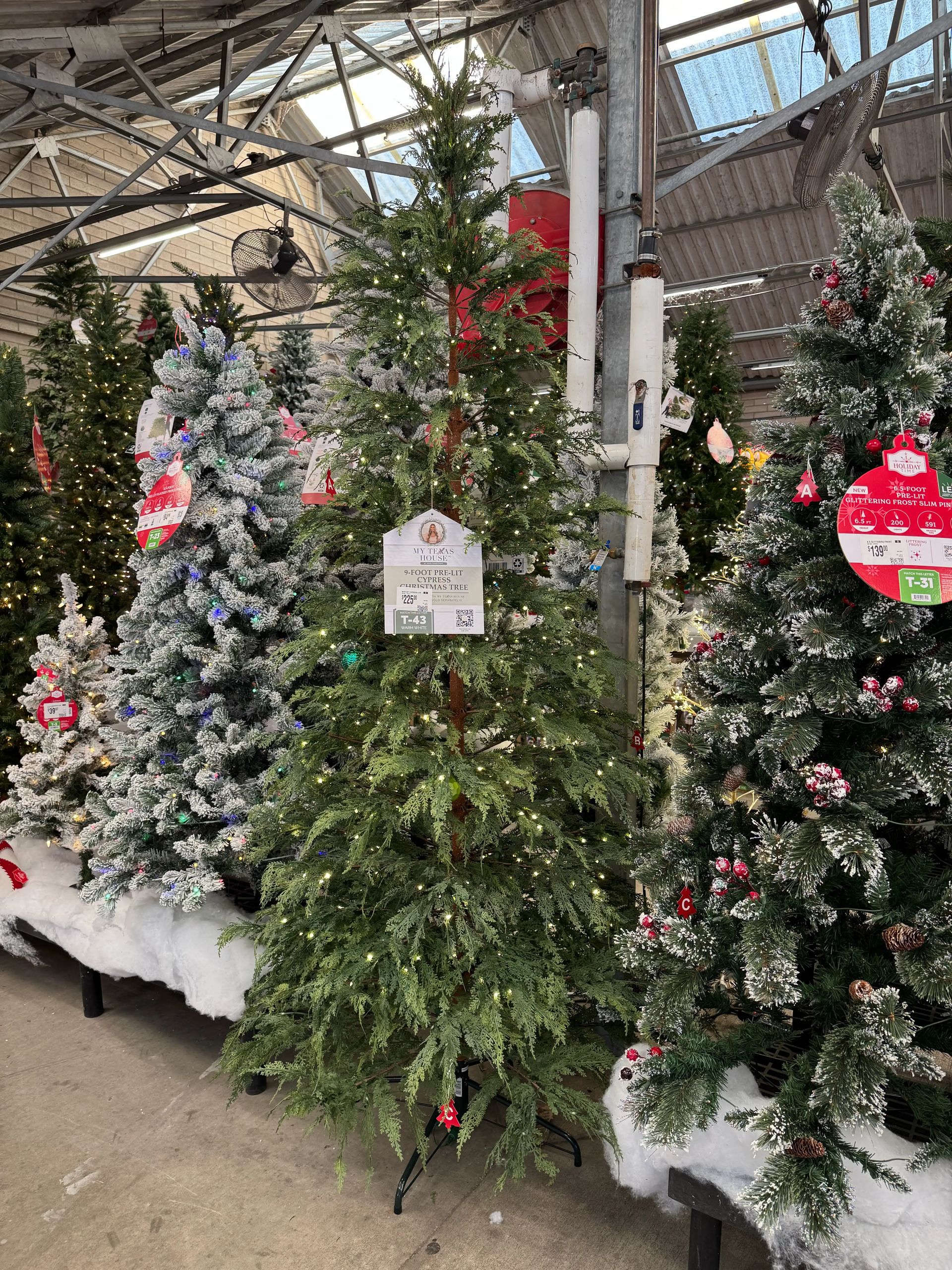
Skip one if you hang a big collection of heavy ornaments, want the tree to read as a solid wall of green from every side, or want the trunk and cords out of sight. The cypress review puts it plainly: "the gap between branches and the visible trunk/light cords become more apparent with minimal decoration, which bothers some buyers but fits the aesthetic for others."
If you want something in between, start with the fuller sparse styles above, or look at full trees that are airier than most. All-PE trees without PVC filler read more open than trees packed with PVC, and our Elegant Twinkling Grand Fir review describes "a more natural but less dense profile." The Cedar Cypress pairs drapey cypress-style tips with PVC filler for what its review calls "intentional airiness (not trying to be a wall of green)." Neither suits heavy ornaments: the Grand Fir review says "branches struggle to support heavier decorations," and the Cedar Cypress review says its "PE branches can't support ornament weight."
Whichever way you go, check four things before you buy:
- Width. Measure the spot. Sparse trees with long branches run up to 6 feet wide at 7.5 feet.
- Coverage. In owner photos, see how much trunk shows in the bottom third, and decide how bare you want it.
- Branches. Look for reviews that mention ornament weight, especially on soft cypress-style tips.
- Lights. On a pre-lit tree, check the light type and count. Fairy lights on thin wire hide best against the open space.
Sparse Christmas Tree Questions
What is a sparse Christmas tree?
A sparse Christmas tree has open space between its layers of branches, so the trunk shows through and ornaments hang in the gaps. It copies an evergreen that grew without shearing, rather than the dense cone that tree farms create by shearing every year. The look comes from how the branches are spaced, not from a low tip count: 7.5-foot trees sold as sparse list anywhere from about 650 to more than 5,000 tips. Some are mostly trunk, and others fill in their lower branches and only open up near the top.
Are sparse Christmas trees good for ornaments?
For showing them off, yes. Ornaments hang free between the layers instead of sinking into the needles, so each one stands out. Whether a branch can hold a heavy ornament depends on the tree. Soft cypress-style tips need ornaments hung near the trunk, so check a tree's ornament notes or reviews before you load it up.
How do you make a sparse Christmas tree look fuller?
Fluff each layer out fully, tuck tree picks, greenery, or garland into the branches, and hang a few ornaments deeper in to cover the trunk. That fills out each layer, but nothing closes the space between layers, which is set by where the branches attach to the trunk. If you want more coverage than that, buy one of the fuller sparse styles or a full tree.
Is a sparse tree the same as a slim tree?
No. Sparse describes how the branches are spaced, and slim describes how wide the tree is. Many sparse trees are as wide as a full tree because their branches are long. Some are both, like Balsam Hill's Alpine Balsam Fir, which the brand describes as having a "sparse, slim silhouette."