
Buy an artificial tree if you'll keep it for years. Over a few Christmases, most budget and mid-priced fake trees cost less than buying a real tree every year, they don't need watering, and the American College of Allergy, Asthma and Immunology suggests one for people who are allergic to mold. Stay with real trees if the smell and the trip to pick one out are part of the holiday for you, if you'd likely replace a fake tree within a few years, or if you have nowhere to keep a big box for eleven months.
On carbon, every life-cycle study we found, from an independent one in Montreal to two paid for by the artificial-tree industry, says a real tree beats a fake one that's kept only a few years. Keep the fake one longer and it catches up, somewhere between 4 and 20 years, depending mostly on how far you drive for a real tree and what happens to it after Christmas. On fire, the National Fire Protection Association has said the risk is higher with real trees, but mostly with dry ones: a real tree that's kept moist is unlikely to catch fire.
A note on where we stand: we review artificial trees and may earn a commission when you buy one through our links, so we have a stake in this answer. Below, we've noted who paid for each study, including the ones that favor the trees we cover.
What a Fake Tree Costs Next to Real Ones
The average real tree held roughly steady in price from 2020 to 2024 in the National Christmas Tree Association's annual consumer survey, according to an evaluation done for the Real Christmas Tree Board. Measured against that average, here's what 7.5-foot trees in our catalog cost right now:
- Budget trees such as the Holiday Time Birchwood Fir, about a quarter PE, cost about one and a half real trees, so they're paid off by their second Christmas.
- Trees with more PE tips, such as the Grand Duchess (about half PE) and the Yorkshire Fir (about 69%), cost about three to three and a half real trees, so they're paid off by their fourth Christmas.
- High-end trees such as Balsam Hill's Vermont White Spruce cost about 20 real trees, even on sale. Its PE share is about the same as the Yorkshire's. The difference is in the branches, which angle up like a real spruce's and split into three smaller ones each, and in lights that can run clear and multicolor at once, with bulbs Balsam Hill says can be replaced one at a time.
If you usually pay less than average for a real tree, add a Christmas or two to each payback. Artificial trees are frequently discounted, which shortens it again. Lights cost the same either way unless you buy pre-lit, since a real tree needs strands just like an unlit fake one. A pre-lit tree's built-in lights may not last as long as its branches, though: one lighting supplier puts LED strings at six to seven seasons with proper care, and our pre-lit vs unlit comparison covers what you can do when a section goes dark.
Are Fake Christmas Trees Better for the Environment?
Only if you keep one for years. In the Montreal study below, making an artificial tree and shipping it from China accounted for 93% of its climate impact, so every season you use it spreads that cost thinner. A real tree's impact starts over every year, and in the same study, its biggest single source was the drive to buy it. Each study below asks how many years of real trees it takes to add up to one fake tree.
| Study | Who paid for it | How long a fake tree has to last |
|---|---|---|
| Ellipsos, Montreal, 2009 | No one with a stake, Ellipsos says | About 20 years on climate, with the tree lot 3 miles from home |
| PE Americas, 2010 | American Christmas Tree Association | 4 years if the real tree is composted or burned; 9 or more if it's landfilled and the lot is 10 miles away |
| WAP Sustainability, 2018 | American Christmas Tree Association | At least 5 years |
| University of Sheffield, 2024 | Not stated | More than 5 years |
Two of those were paid for by the American Christmas Tree Association, which, as NPR put it, represents the artificial-tree industry. Their numbers don't all favor the fake tree: in the 2010 study, a landfilled real tree bought 2.5 miles from home or closer beat the fake one on climate no matter how long the fake one was kept. On the other side, the executive director of the National Christmas Tree Association, which represents Christmas tree farmers, told NPR that real trees are "far superior for the environment." The Carbon Trust, a UK climate consultancy, puts the answer at 7 to 20 years, depending on the fake tree's weight and materials.
Your own answer depends on a few things the studies treat differently.
How long you'll keep the fake tree. Each side brings its own number. The artificial-tree association says most artificial trees are used for an average of 10 years. The Montreal study assumed six, a figure it took from the Canadian Christmas Tree Growers Association. A well-made tree that's stored with care can last a decade or more, if you still want it by then. When it's done, it will most likely go to a landfill: most artificial trees aren't recyclable, NPR notes, and a Virginia Tech sustainability researcher says that's where they typically end up.
What happens to the real tree in January. The Carbon Trust says having a tree chipped cuts its footprint by up to 80%, and the University of Sheffield researcher behind the 2024 study concluded that real trees are often the most sustainable choice, "but only if disposed of thoughtfully." He favors composting or recycling a tree over burning it, which releases its carbon quickly, along with soot. Landfills are where the studies split. The 2010 study treated a buried tree as storing its carbon, which helps the real tree, while the Carbon Trust says a landfilled tree gives off methane as it rots, which hurts it.
How far you drive for it. A real tree means a trip every year, and distance can flip the answer in both the industry-funded and the independent studies. In the 2010 study, if the real tree came from a lot 10 miles away and went to a landfill, the fake tree needed nine years to catch up. The Montreal study assumed a lot about 3 miles from home. When its authors moved it to 10 miles, the real tree came out worse on climate than a fake one kept six years.
A potted tree with roots sidesteps the disposal question. The Carbon Trust calls replanting the preferred method, and the Sheffield researcher says a potted tree's climate benefit keeps growing as long as it stays potted or gets planted. NPR notes that some companies rent live trees that go back to the nursery after the holidays.
The Montreal study also scored the trees on four kinds of damage. A fake tree used for six years came out three times worse than real trees for climate change and resource depletion, about even for human health, and almost four times better for ecosystem quality, partly because tree farms take up land. The authors note that plantations often sit where the land has no other use, such as under power lines, and that their effects stay local while climate change is global.
In the Montreal study's numbers, the stakes are small. Six years of real trees add up to about the carbon of driving an average car 78 miles, and one fake tree used for six years about 200, which led the authors to call the impact of either tree "negligible compared to other activities, such as car use." Incandescent lights can matter more than the tree itself. In the 2010 study, running 400 incandescent lights for one season took 1.5 to 3.5 times the energy of a real tree's entire life cycle. Dovetail Partners, an environmental nonprofit that reviewed the research, puts LED lights at about a fifth of the emissions of incandescent ones.
Are Real Christmas Trees a Fire Hazard?
A dry one is. From 2016 to 2020, U.S. fire departments responded to an average of 160 home fires a year that started with a Christmas tree, according to the National Fire Protection Association. That's less than 0.1% of reported home fires, and those fires caused an average of two deaths and 11 injuries a year.
Those counts lump real and fake trees together. NFPA's 2011 report on Christmas tree fires said that "the risk of fire is higher with natural trees than artificial ones," adding that researchers found dry natural trees burned easily, while trees kept moist "are unlikely to catch fire unintentionally." The U.S. Fire Administration says: "Water your Christmas tree every day. A dry Christmas tree can burn very hot and very fast." It also says to get rid of the tree after Christmas or when it's dry.
Three-quarters of home Christmas tree fires happen in December or January, and NFPA notes that "the longer a natural tree is kept up after Christmas, the more likely it is to dry out and ignite." If you like the tree up from Thanksgiving through New Year's, that's a point for artificial.
The Consumer Product Safety Commission has advice for both kinds. For a real tree, start with a fresh one: green, with needles that are hard to pull from the branches. For a fake one, look for a "Fire Resistant" label, though the agency warns that the label "does not mean the tree won't catch fire." The leading causes of tree fires apply to both: in NFPA's numbers, electrical failures or malfunctions were a factor in 34% of them, and heat sources too close to the tree in 20%. Whichever you choose, the Fire Administration says to keep it at least 3 feet from fireplaces, radiators, space heaters, candles, and heat vents, and to throw out light strands with frayed or pinched wires.
Allergies, Pets, and Needles
The American College of Allergy, Asthma and Immunology says some people get skin allergies from terpene, a substance in real-tree sap, and that live trees "may still have mold spores and pollen on them that can cause nasal allergies to flare." It recommends giving a real tree a thorough shake and rinse before it comes inside, and tells people with mold allergies to "consider using an artificial tree."
An artificial tree has allergens of its own: the same group warns that dust and mold can build up on one in storage, and on decorations kept in attics, basements, and garages. Clean an artificial tree before it goes up. The college suggests a handheld vacuum, and an N95 mask while you work.
With pets, the difference is mostly the water. The ASPCA says Christmas trees are "not particularly toxic," but real-tree water "may contain fertilizers and bacteria that can cause stomach upset, nausea or diarrhea" if a pet drinks it, so cover the stand. A fake tree has no water to drink, but a climbing cat can topple either kind, and the ASPCA's advice to anchor the tree applies to both.
A real tree drops needles, more as it dries, and the National Christmas Tree Association calls a stand that holds water the most effective way to keep a tree fresh and cut down on needle loss. Fake trees shed some too, mostly during the first setup.
Setup and Storage
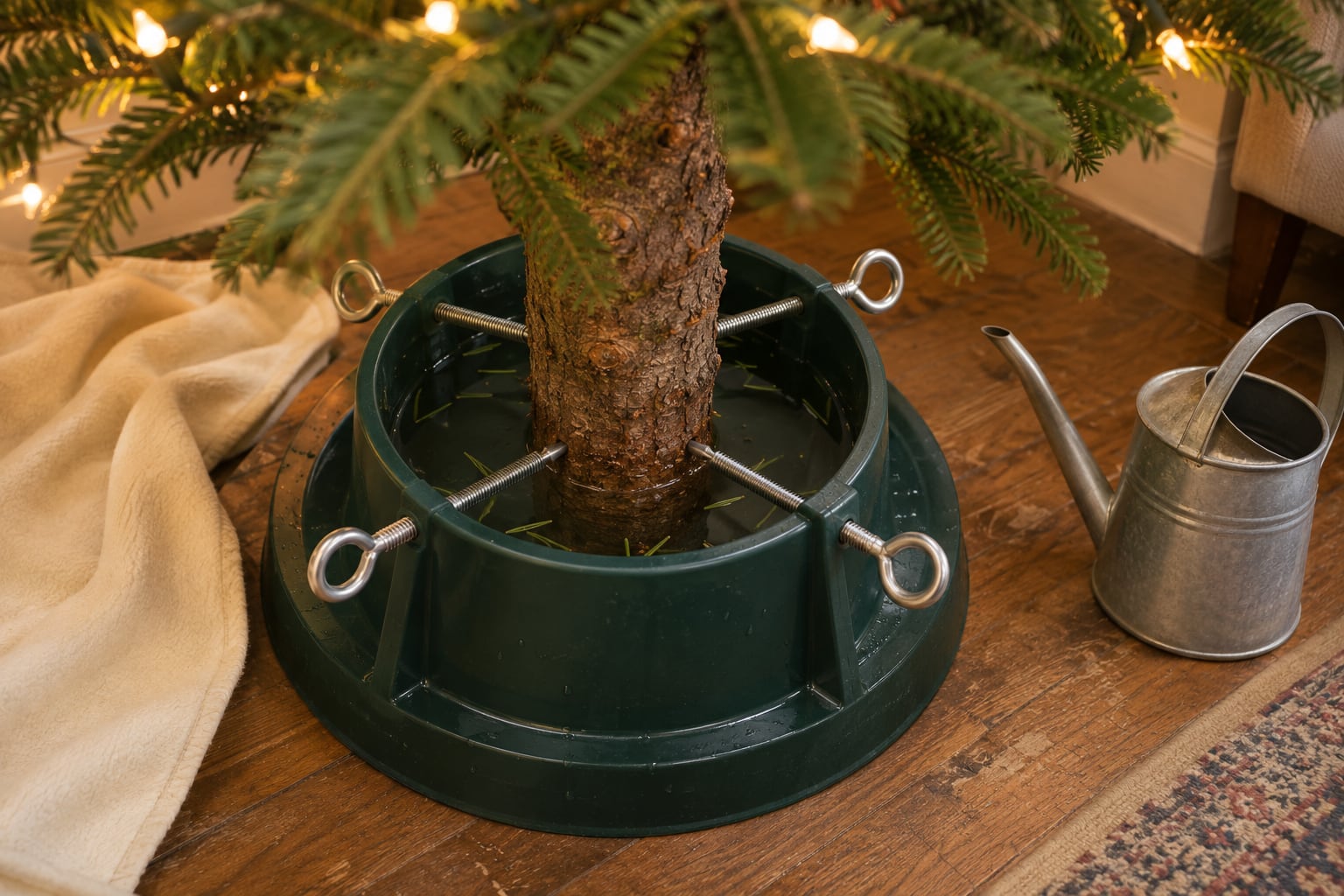
A real tree is a project every year. You pick it out and get it home, saw about half an inch off the trunk so it can drink, and set it in a stand that holds about a quart of water for every inch of trunk width, as the National Christmas Tree Association recommends. Then you check the water every day for as long as it's up. In exchange, it leaves after Christmas, and there's nothing to store.
A fake tree puts the work up front. Balsam Hill tells owners to plan on two people and two to three hours of fluffing the first time, depending on the tree's height and fullness, and considerably less in later years. Some memory-wire trees need far less from the start, and our fluffing guide has the method. A pre-lit tree also skips stringing lights. The catch is the box: a 7 to 7.5 ft tree's box runs roughly 3.5 to 4.5 feet long, and it needs a dry spot for the other eleven months. Our small-apartment guide covers storing one without a garage.
Look and Smell
No artificial tree smells like a fresh fir, and no two real trees look alike, which is part of the fun of picking one. Fake trees are uniform, and how real one looks comes down to how much of it is PE, molded from real branches, rather than PVC, and to how the branches are built. Our roundup of the most realistic artificial trees shows how close the best ones get.
Stay Real or Switch?
Stay with real trees if:
- The smell and the trip to pick one out are part of the holiday for you.
- A farm or lot is close by, and your town chips or composts trees after the holidays.
- You'd likely replace a fake tree within a few years, say for a move or a new look.
- You don't have a dry closet or garage corner for a 4-foot box.
- Your tree goes up in mid-December and comes down soon after Christmas.
Switch to artificial if:
- Someone in the house is allergic to mold.
- You want the tree up from Thanksgiving through New Year's without watching it dry out.
- You'll keep it ten years or more, long enough to come out ahead on carbon in most of the studies above.
- You'd rather not haul and water a tree every year.
If you're switching, our buying guide covers which specs are worth paying for in a fake tree and which are marketing.
Real vs Fake Christmas Tree Questions
Are fake Christmas trees better for the environment?
Only after years of use. Making and shipping a fake tree accounts for nearly all of its climate impact, 93% in an independent Montreal study by Ellipsos, while a real tree's impact comes back every year. Published estimates of when the fake tree catches up run from as few as 4 years, in a 2010 study by PE Americas that the artificial-tree industry paid for, to about 20, in the Montreal study. Where your household lands depends most on how far you drive for a real tree and what happens to it after Christmas.
Is a real or fake Christmas tree cheaper?
Over a few years, most fake trees are. Against the average real-tree price in the National Christmas Tree Association's consumer surveys from 2020 to 2024, a budget artificial tree costs about one and a half real trees, and a tree with more PE tips about three to three and a half, so either pays off within a few Christmases. High-end artificial trees can cost about 20 real trees.
Are real Christmas trees a fire hazard?
Dry ones are. The National Fire Protection Association's 2011 report on Christmas tree fires said the risk is higher with real trees than artificial ones, and that trees kept moist are unlikely to catch fire unintentionally. Water a real tree every day, keep it at least 3 feet from heat sources, and take it down after Christmas or once it dries out, as the U.S. Fire Administration advises.
Are artificial Christmas trees better for allergies?
Usually, if the allergy is to mold. The American College of Allergy, Asthma and Immunology suggests an artificial tree for people with mold allergies, since real trees can carry mold spores and pollen, and their sap contains terpene, which gives some people skin allergies. A fake tree collects dust and mold in storage, though, so clean it with a handheld vacuum, wearing an N95 mask, before it goes up.